


Who knew that one day the words “New York City subway” and “romantic” would be strung in the same sentence? Hidden inside the second story of a discrete narrow building near Huashan 1914 Creative Park in Taipei’s Zhongzheng District (中正區), B-Line by A Train is the ideal dining spot to bring a date after perusing art exhibitions or listening to a live indie band.
Inspired by the culture and design of the New York City subway, this fusion gastropub that opened last year is about as industrial-chic as it gets. The mood begins from outside the restaurant where a tiny orange door on the ground level marks the way up to the dining area. As patrons ascend the black metal staircase, it’s hard not to discern the musty wall along the stairwell which is covered entirely with a giant map of the New York City subway.
The main door on top of the staircase, made to resemble a high voltage bolt, opens into a pleasantly plush setting with intimately arranged fern-green sofas. The walls of the restaurant are made of grey bricks and marble, and lamps attached to dangling wires from the ceiling along with desk lamps at wooden tables provide dim lighting.
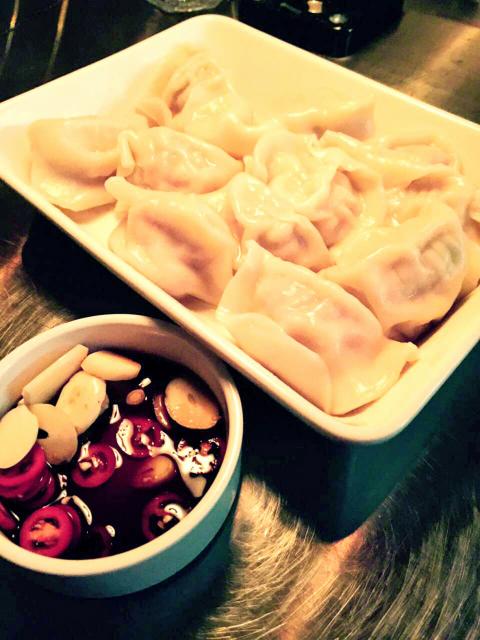
Photo courtesy of B-Line by A Train
Next to the entrance is the bar where good-looking young bartenders with smiles mix mojitos for chattering ladies. The bar’s design vaguely evokes a rattling tin can, which is essentially what the subway in New York is. Whiskey, wine and other delightful liquors are displayed against a red brick wall, conjuring a Prohibition-esque feel. A Lower East Side yuppie would feel right at home at B-Line by A Train, should he or she be transported to Taipei.
The food, on the other hand, is not very New York — if you’re craving a pastrami and pickle sandwich, you’ve come to the wrong gastropub. They do, however, have an impressive selection of family-style fusion eats that are a few notches classier than your average midnight pub food binge.
The Thai style beef short ribs salad (NT$340) is by far my favorite dish. Thin slices of beef are interspersed throughout a small sweet-spicy salad filled with cherry tomatoes, corn and onion. From presentation to taste, everything is tender and dainty, a far stretch from American-style short ribs.
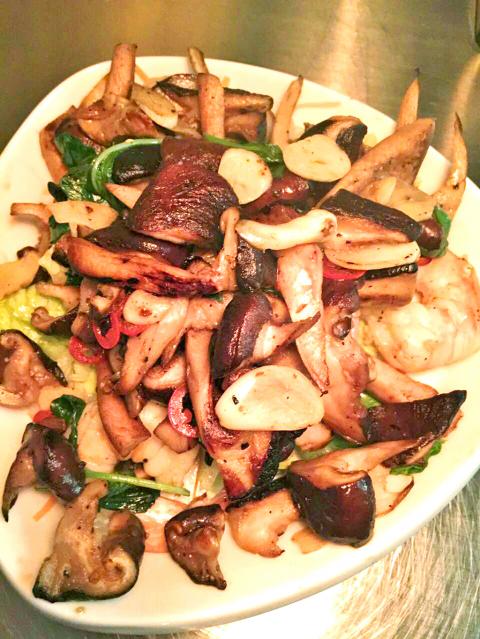
Photo courtesy of B-Line by A Train
A close contender is the stir-fried garlic mushrooms (NT$280). Sprinkled with pepper and chili, the mushrooms are delightfully succulent and spicy. The texture is light and chewy, while the garlic isn’t overpowering. This makes it a nice dish to nibble on and liven up the palate while sampling other food. The mushrooms pair well with B-Line by A Train’s sausage platter with seasonal vegetables (NT$350). The sausages are not so much the types you’ll find at Oktoberfest, but rather, they are sauteed with Southeast Asian herbs. In other words, less sauerkraut and more spice — though this is a fusion that syncs surprisingly well.
B-Line by A Train’s handmade dumplings (NT$220) could possibly rival those found in a legitimate dumpling shop. The pork and chives filling are tantalizingly juicy and the skin is springy. Shifting chef hats from Chinese to Italian, the truffle frittata (NT$280) was one dish that was not quite up to par with the rest. The truffle was only mildly discernable, hidden beneath too many layers of bland omelette. The frittata’s texture was a bit too soft and the outer layer a tad oily.
That being said, the real show-stealers at B-Line by A Train are its fine selection of beers and wines. A massive-sized Belgian Hoegaarden (NT$300) pairs well with almost all the food, its light wheat flavor helping to cleanse the palate between various small dishes.
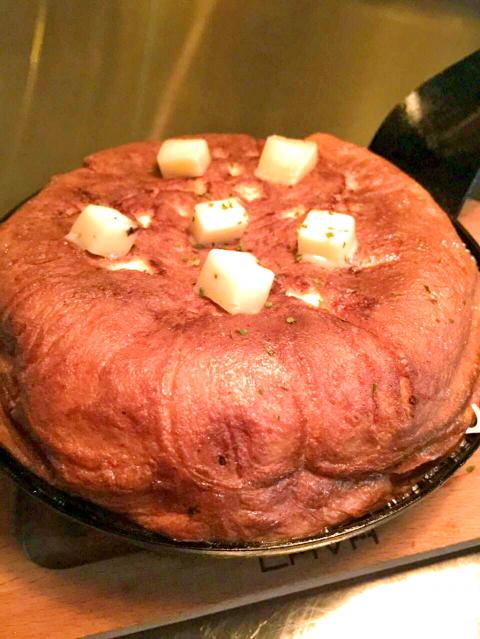
Photo courtesy of B-Line by A Train
B-Line by A Train may not serve pastrami and pickle sandwiches, but it nails New York to the bone by making multiple drinks Mondays seem suave. Never mind the bland frittatas — Taipei yuppies may finally have a decent late-night watering hole that isn’t a slinky, shiny Xinyi bar or conversely, the Taiwan-Beer-can-littered steps outside a 7-Eleven.
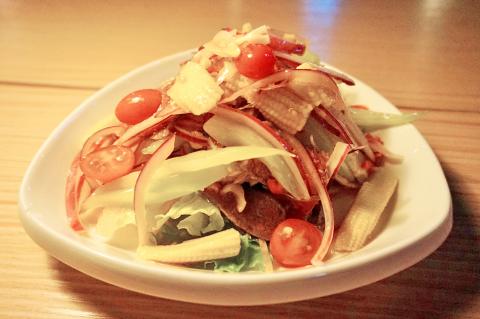
Photo: Dana Ter, Taipei Times
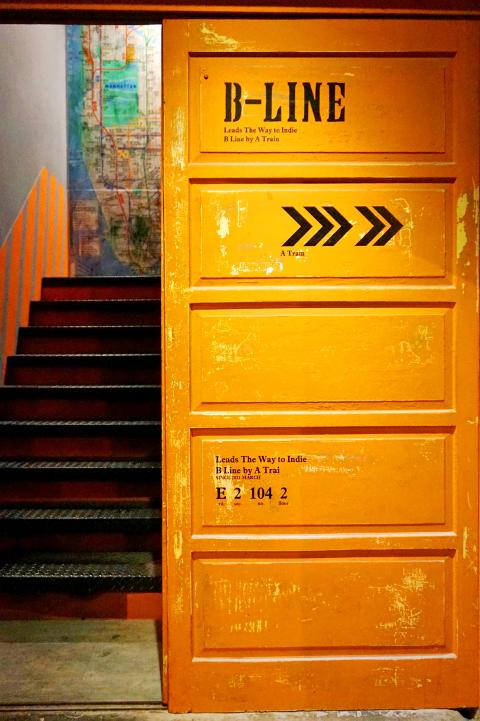
Photo: Dana Ter, Taipei Times

Taiwan’s English education system is being pulled apart by three opposing forces. Bilingual Nation 2030 pulls students toward English and global communication. Artificial Intelligence (AI) readiness pulls them toward digital judgment, verification and AI-mediated work. But Taiwan’s old exam culture pulls them back toward memorization, grammar drills, timed reading and correct answers. If the education system keeps using old exams to define success, it risks producing graduates who are neither genuinely bilingual nor genuinely AI-ready, but trained for tasks machines can already perform. The first force is Bilingual Nation 2030. Launched in 2018, the policy aimed to “help Taiwan’s workforce connect
It seems every few days one bumps into one of those “real man” comments in which Taiwan is urged to “face reality” or similar, and “make a deal,” with the speaker implying that soon it will be too late. “Deal” advocates always present themselves as having a superior grip on reality, and the manly ability to make the “hard choice.” Their testosterone-laden language often echoes that of Taiwan sellout advocates. Note that such commentary always specifies a process (“make a deal, work with, make progress”), never the end state of what occupation by a violent authoritarian colonialist state will entail. In
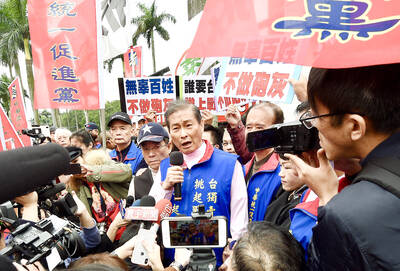
There are shadowy cabals plotting to sell out Taiwan to be annexed by China, by invasion if necessary. Fortunately, they are buffoons. In 2019, former Bamboo Union gangster and founder of the China Unification Promotion Party (CUPP), Chang An-le (張安樂, colorfully known as “White Wolf”), led a protest at the Legislative Yuan against comments made by then-premier Su Tseng-chang (蘇貞昌) that in the event of an attack by China, he would never surrender, but would protect the nation by fighting to the end, even if he only had a broom. Chang had party members bring a wooden casket that they
June 1 to June 7 "If all Taiwanese were as afraid of dying as you, then what would happen?” Physician Shih Chiang-nan (施江南) reportedly said this to his wife Chen Chiao-tung (陳焦桐) after she urged him to stop intervening on behalf of Taiwanese soldiers stranded overseas after serving in the Japanese Army during World War II. Shih had clashed with high-ranking officials over the issue, engaged in several heated arguments with Taiwan governor-general Chen Yi (陳儀) and allegedly shouted at general Ko Yuan-fen (柯遠芬), chief of staff of the Taiwan Garrison Command, over


 RSS
RSS