


A dozen years ago when the old chief of Taitung County’s Dulan Village (都蘭) died, his wife reached over and closed his eyelids, then took a gulp of Wisbih, an industrially-produced liqueur laced with caffeine and herbs that tastes like bubblegum, and told a relative to pour a shot for me. A few days later I held a shovel in my hands, and with the men of the village hefted earth onto the chief’s grave beneath a spattering rain, burying his body and his songs.
OCEAN SONGS
In this Amis Aboriginal community, a man’s singing voice was considered a measure of his character, and the chief’s rendering of traditional songs expressed a luminous connection between this people, their place and their past. At the funeral a one-armed chaplain looked up at the sky as a five-piece brass band in baby blue sailor caps played the gospel tune I Ain’t Got No Home. The chief’s grandchildren, the youngest about five years old, had come from cities with their parents to attend the funeral, and seemed as distraught from having to shake too many strangers’ hands as from their inchoate sense of loss.
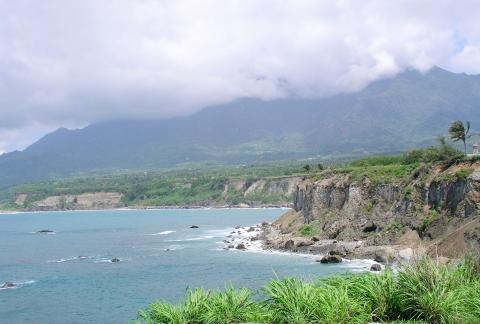
Photo: Huang Ming-tang, Taipei Times
This happened during my residence in Dulan from 2002 to 2004. Now, 10 years after my departure, I am back in Dulan for a three-month artist residency, in a house on the flank of Taiwan’s coastal range, a few kilometers north of where I built a driftwood recording studio and produced an album of ocean songs for a local record company.
During my absence, friends told me Dulan had undergone drastic changes. I was often in southwest China and Laos in these years, and in those places “drastic change” means the razing of villages and towns, the displacement of millions and the construction of massive dams and urban centers. From that perspective, I imagined the gorgeous and undeveloped coast I’d known would be buried beneath a row of 50-story resort hotels.
That has not happened. The coast here remains naked and raw, strewn with driftwood and stones, and the only large-scale commercial tourism development has been stalled by local protests. Still, the intra-community and inter-generational relationships which unified the community have eroded. The way of life I experienced in Dulan is probably gone forever, a point of equilibrium between tradition and modernity before it slid forward, leaving some of its wholeness behind.
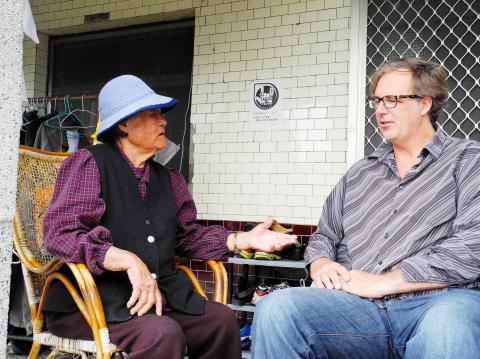
Photo courtesy of Scott Ezell
EXTERNAL PRESSURES
Dulan has gone through the predictable stresses of an Aboriginal community subject to increasing external pressure. A migration of urban professionals and exponentially increasing tourism (ironically catalyzed by the attention brought to Dulan by Aboriginal artists) has led to gentrification and a 500 percent rise in land prices and rents. Real estate speculation is common, and commodification of local culture has reduced many formerly bohemian artists to de facto servants of the mainstream tourist industry. The terms of individual and collective life for the indigenous community seem to be compressed by these factors, such that minor personal conflicts and differences become amplified in this place where people are fundamentally “home,” and do not consider it an option to leave — like a stone in one’s shoe, small frictions may become intolerable over time, and have resulted in fissures in the community.
Despite a decade’s changes, the Amis call-and-response song circles and traditional dance still sometimes re-cohere. The songs of this oral culture seem to me to be like Heraclitus’s river — with no recorded form or reference, there is no way to step into them the same way twice. As with recitations of the Bagre documented by Jack Goody among the LoDagaa people in Ghana, they are not repetitions of a fixed model, but are recreated living and alive every time they emerge from one’s throat and tongue.
The songs resonate in bodies which are also like rivers, also never the same way twice, not the same as they were yesterday or 10 years ago, and yet the songs form a continuum across the arc of time, from the chief to us, from the “traditional” past to a perhaps more fragmented present. The current moves through generations, and however the cultural, physical or economic landscape has changed, the river continues to flow — at least for now.
HOMECOMING
A few weeks ago, I drove on a borrowed motorbike through the village to visit the old chief’s wife. The concrete courtyard was empty, but standing there I remembered when half the village had gathered around a bonfire roasting a wild boar and illuminating the chief leading song circles in the night.
The chief’s son Akira offered me a plastic chair, and his mother joined us from the house. She had just turned 80, and was nearly blind from cataracts, but she held her hands out and embraced me warmly, welcoming me in her sing-song Mandarin, and called me Rekal, the Amis name she bestowed on me the first time we met.
We sat down around a plastic table, and I gave them a CD of the Dulan elders singing their traditional Amis songs, which I’d recorded six months before the old chief died. The chief’s family had either lost or never received a copy of the recording, so when we played the CD it was like exhuming a time capsule, the old chief’s voice emerging from beyond the grave, malleable as warm gold as it swung in and out of delicate falsettos.
The chief’s wife accepted a betel nut from the pack I had brought, augmenting the supply beside her in a woven basket. She drank rice wine from a plastic cup, while Akira and I drank cans of Taiwan Beer. I thought the chief’s wife would be struck with grief when she heard her husband singing, already gone so long, but instead she was elated, and sang along with the recording, pointing out the other singer’s voices as she recognized them. At times she stood up from her chair and swayed her arms and body into the rhythm of the Amis dance.
Instead it was I who could not keep from crying, as if years and change and mortality were welling up and out of my eyes. I was overcome with the humility of being woven as a strand into the fabric of the lives of these people I love, and of their culture and environment, of fulfilling some small role of connection.
Listening to the chief’s voice emerge from the past through this fixed unchanging medium was like receiving a sacrament from a gone time. The old chief’s wife, with betel nut juice staining her mouth blood red, took my hand and said, “Rekal, you are back, you are back, where have you been so long? My husband is gone, my husband is gone, I’m so glad that you are here.”
Scott Ezell is the author of A Far Corner, a narrative nonfiction account of a contemporary Aboriginal artist community in Dulan, published by University of Nebraska Press

The breakwater stretches out to sea from the sprawling Kaohsiung port in southern Taiwan. Normally, it’s crowded with massive tankers ferrying liquefied natural gas from Qatar to be stored in the bulbous white tanks that dot the shoreline. These are not normal times, though, and not a single shipment from Qatar has docked at the Yongan terminal since early March after the Strait of Hormuz was shuttered. The suspension has provided a realistic preview of a potential Chinese blockade, a move that would throttle an economy anchored by the world’s most advanced and power-hungry semiconductor industry. It is a stark reminder of
May 11 to May 17 Traversing the southern slopes of the Yushan Range in 1931, Japanese naturalist Tadao Kano knew he was approaching the last swath of Taiwan still beyond colonial control. The “vast, unknown territory,” protected by the “fierce” Bunun headman Dahu Ali, was “filled with an utterly endless jungle that choked the mountains and valleys,” Kano wrote. He noted how the group had “refused to submit to the measures of our authorities and entrenched themselves deep in these mountains … living a free existence spent chasing deer in the morning and seeking serow in the evening,” even describing them as

As a different column was being written, the big news dropped that Chinese Nationalist Party (KMT) caucus whip Fu Kun-chi (傅?萁) announced that negotiations within his caucus, with legislative speaker Han Kuo-yu (韓國瑜) of the KMT, party Chair Cheng Li-wun (鄭麗文), Taichung Mayor Lu Shiow-yen (盧秀燕) and Taiwan People’s Party (TPP) Chair Huang Kuo-chang (黃國昌) had produced a compromise special military budget proposal. On Thursday morning, prior to meeting with Cheng over a lunch of beef noodles, Lu reiterated her support for a budget of NT$800 or NT$900 billion — but refused to comment after the meeting. Right after Fu’s

Yesterday, the Democratic Progressive Party (DPP) nominated legislator Puma Shen (沈伯洋) as their Taipei mayoral candidate, the Chinese Nationalist Party (KMT) put their stamp of approval on Wei Ping-cheng (魏平政) as their candidate for Changhua County commissioner and former legislator Tsai Pi-ru (蔡壁如) of the Taiwan People’s Party (TPP) has begun the process to also run in Changhua, though she has not yet been formally nominated. All three news items are bizarre. The DPP has struggled with settling on a Taipei nominee. The only candidate who declared interest was Enoch Wu (吳怡農), but the party seemed determined to nominate anyone


 RSS
RSS