

Macaroni and cheese jazzed up with truffle, funnel cakes composed of layers of peanut butter, bananas, bacon and whipped cream — the food served at Pig & Pepper sounds like a fancier version of the familiar American fare, or what has come to be known as new American cuisine, a fusion encompassing culinary traditions from different cultures within the US.
While new American cuisine is highly dynamic, the restaurant, opened by two sisters who moved back from Los Angeles to Taipei, focuses its attention on offering a contemporary take on American comfort foods to local palates.
One example is the New York spiced chicken rice (NT$390) with yogurt dressing and harissa hot sauce. Originating from New York’s halal street carts, it is a popular late night snack among club hoppers and taxi drivers. The street food with Middle Eastern influences is composed of spice-infused long grain rice, chopped marinated chicken and sliced iceberg lettuce. The rice is enlivened by the mix of fresh yogurt and chili pepper paste.
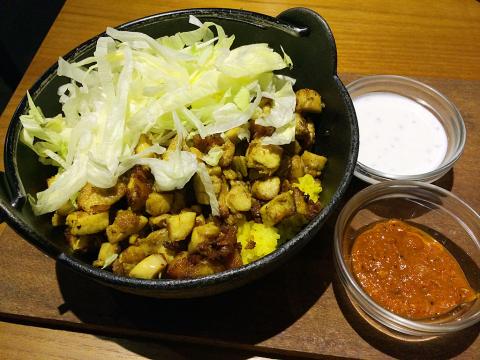
Photo: Ho Yi, Taipei Times
A hint of Mexican flavors can be detected in the fried cauliflower (NT$180) with chipotle aioli, one of the restaurant’s popular side dishes that is spiced up with creamy dip made from smoke-dried jalapeno. First grilled then quickly fried, the cauliflowers are cooked properly crisp, neither too hard nor too soggy.
My dining partner and I also enjoyed the crispy crab cakes (NT$320) with corn salsa, aioli and mango coulis — although it is hard for anyone to not take a liking to deep-fried goodies bathed in soul-soothing and creamy mayonnaise-like dressing.
The grilled Hokkaido scallops with cheese ravioli which came with truffle cream sauce (NT$680) however, didn’t impress. The seared, succulent scallops were good, but the combination of cream sauce and cheese-filled ravioli got a bit too cloying after several bites. This dish is better shared.
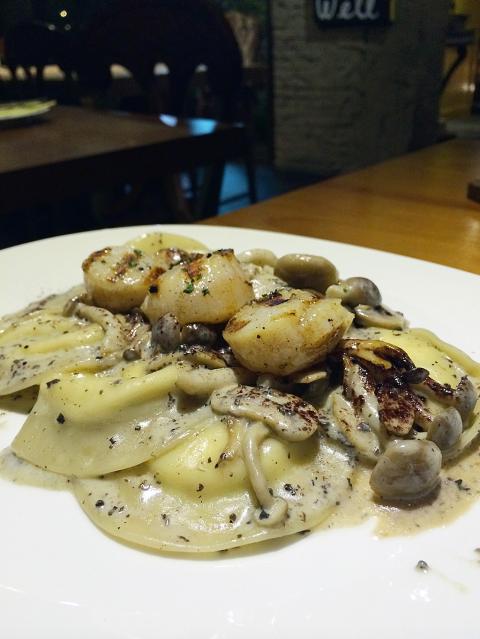
Photo: Ho Yi, Taipei Times
Other notable comfort foods included truffle Parmesan tots (NT$180), mac ‘n’ cheese with truffle (NT$200) and the open faced burger with Danish toast, cheddar cheese sauce and an egg, sunny side-up (NT$390) .
Also not to be missed is the Zeppoli (NT$280), a warm dessert consisting of balls of fried dough with chocolate sauce, sea salt caramel sauce and vanilla ice cream. Pig & Pepper boasts a solid selection of sparkling, red and white wines priced from NT$950 to NT$1,850 per bottle.
Unfortunately, I didn’t get to try the restaurant’s signature funnel cakes, which are only available from 11am to 3pm. A popular snack at fairs and carnivals in the US, the cake comes in four varieties, of which the caramel apple (NT$220) consists of apples roasted with vanilla bean, salted caramel sauce, almond crumble vanilla, bean custard and ice cream, and the mixed berry (NT$230) is a fruity, heavenly mixture of homemade berry jam and seasonal fruits with vanilla bean custard and whipped cream.
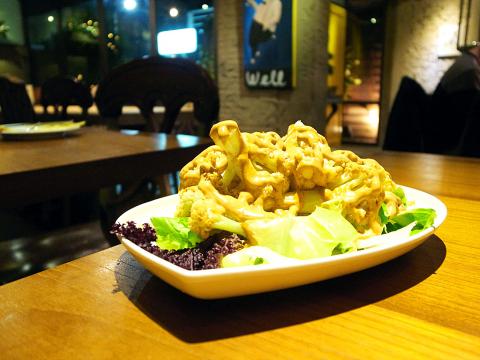
Photo: Ho Yi, Taipei Times
After our enjoyable dinner, I look forward to coming back to Pig & Pepper to try its brunch menu, available from 11am to 4pm on Saturdays and Sundays. It features dishes such as braised beef hash (NT$360), shredded duck confit sandwich (NT$360) and crab cake benedict (NT$420).
Whether it is a relaxing dinner or a Sunday brunch with friends, Pig & Pepper is an inviting spot to enjoy a good meal. Decked out with a wooden patio, the space exudes a charming air of quiet warmth with its interior pallet of peacock blue, light yellow and wooden brown.
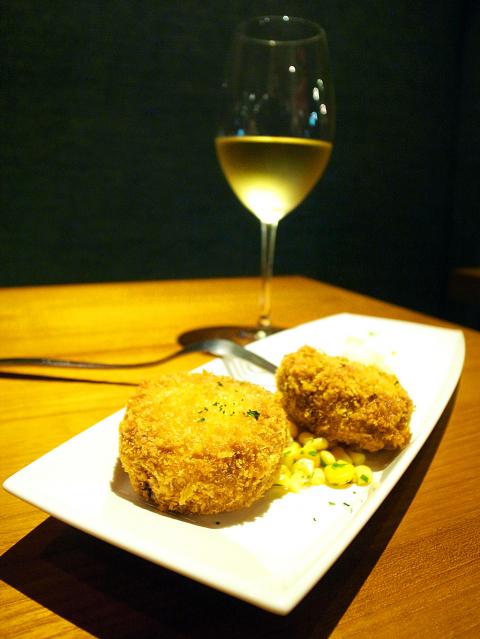
Photo: Ho Yi, Taipei Times

The flooding in Kaohsiung after the recent torrential rains has become an issue for mayoral candidates of both major parties. Chinese Nationalist Party (KMT) Kaohsiung mayoral candidate Ko Chih-en (柯志恩) brought in hydraulic-engineering professor Lee Hong-yuan (李鴻源), who called for comprehensive flood control measures on the Dianbao Creek (典寶溪), according to local media. Ko attacked the Democratic Progressive Party (DPP) for being behind on flood control measures, but as the city administration observed, there are many weaknesses in how the government can mitigate extreme rainfall. Nor is the river entirely under the management of the city. The low-lying Dianbao River

A decade ago, Taiwanese television had an image problem. When representatives of Taiwan’s Public Television Service (PTS) traveled to Singapore to meet Netflix, they brought two dramas: A Touch of Green (一把青, 2015), a sweeping story of war, displacement and military families, and Wake Up (麻醉風暴, 2015), a tightly constructed medical thriller. They were not simply trying to sell programs. They were trying to change an idea of Taiwan. International perceptions of Taiwanese television, PTS executives recalled in interviews conducted for my joint research with Chairman Hu Yuan-hui (胡元輝), were still strongly associated with the idol dramas that had enjoyed enormous regional popularity

The name “Taiwan” is to appear at South Korea’s Gwangju Biennale when it opens on Saturday, after months of objections from Taiwanese artists and government agencies over an attempted name change. China Pavilion personnel halted installation and left the venue on Friday, after China’s Ambassador to South Korea Dai Bing (戴兵) objected to the restoration of the “Taiwan Pavilion” name. As of Monday, the Chinese side was reportedly preparing to withdraw, although its formal withdrawal had not been completed. The pavilion dispute began on June 10, when the ministry and participating artists said organizers had changed “Taiwan Pavilion” to “NTMoFA Pavilion,” referring

The Chinese Nationalist Party (KMT)-controlled legislature in February 2006 established the National Communications Commission (NCC). One of the purposes of the NCC was to circumvent the control of the Government Information Office (GIO), long the KMT’s tool for overseeing the local media, by the administration of Democratic Progressive Party (DPP) president Chen Shui-bian (陳水扁). The NCC’s commissioners were originally apportioned according to the ratio of party control of the legislature. However, the Council of Grand Justices later ruled that agencies required greater coordination with the Executive Yuan, which then began sending a list of expert nominees for approval by the


 RSS
RSS