


He is schooled in ancient Cambodian martial arts, but Tok Sophon hopes to turn his pugilism skills into wealth and international glory in the modern cage-fighting arena — a transition some fighters fear will wipe out their craft.
Heavy thuds fill the room as Sophon aims ferocious kicks into pads held by his coach, one of a growing number of Cambodians learning mixed martial arts (MMA) — a combat sport where competitors use anything from kickboxing to wrestling to take down their opponent.
“I can make more money fighting in the cage [where MMA is often fought] than through traditional martial arts,” according to the 21-year-old, who joined the lucrative global circuit last year.
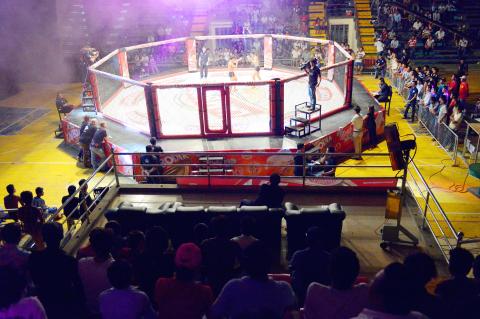
Photo: AFP
In his first bout in Malaysia he earned US$1,000, nearly 30 times more than an average contest in Kun Khmer — Cambodian kickboxing, which is similar to Muay Thai in neighboring Thailand.
The MMA boom stems from a recent revival in the Cambodian martial arts of Kun Khmer and Bokator after centuries of neglect and near extinction under the Khmer Rouge regime of the late 1970s, which outlawed both disciplines and murdered their masters.
Bokator is the older of the fighting styles, believed to go back more than 1,000 years to the armies of the Khmer empire who based elements of the style on animal movements.
It barely survived the hardline communist Khmer Rouge, who tried to wipe out Cambodian history in a bid to establish an agrarian utopia, but has since won new followers among Cambodians keen to learn the art and preserve a unique strand of their culture.
With its elbow and shin strikes, locks and grapples the sport deploys techniques which can cross over into MMA and Cambodian fighters have found it relatively easy to adapt their moves to the cage.
OUT WITH THE OLD?
In the three years since Bokator practitioners first competed in a MMA tournament in Malaysia — formally marking Cambodia’s entry into the sport — it has skyrocketed in popularity.
The country’s inaugural MMA association was launched last year with local television channels airing weekly fights.
According to the association, there are around 100 Cambodians who can now compete professionally in the sport.
On Friday nine of them are on the card to take on challengers from across the world when the ONE Fighting Championship, Asia’s largest MMA organization, holds its first global competition in the capital Phnom Penh.
While their training in traditional martial arts provides a solid foundation, fighters still need to learn new techniques and MMA rules to contest internationally.
Spotting a gap in this nascent market, Cambodian-American Chan Reach traded his job as a paramedic in New York in 2011 to train fighters in Phnom Penh on how to compete in the cage.
“I was watching a match on YouTube with Cambodian fighters being thrashed by foreigners, and knew I had to come to help train them,” said Reach, who is Tok Sophon’s trainer and himself a practitioner with 13 professional fights under his belt.
A few months ago the coach-turned-entrepreneur set up one of a growing number of gyms in the capital specializing in MMA.
“It is a new twist in an old sport ... and offers an exciting opportunity for Bokator and Kun Khmer fighters,” he said during a training break at the center.
But an older generation of fighters are concerned the thriving MMA industry poses a threat to their centuries-old practice, long-hailed as a symbol of Cambodia’s past military might.
“We are struggling to preserve our ancient martial arts. If the young generations and government officials do not support them, they will disappear,” said 63-year-old Chan Bunthoeun, a Khmer martial arts coach who learned the trade as a teenager from his father.
But with his own son now preparing to compete in the upcoming Phnom Penh contest he recognizes the lure of an industry offering far greater financial rewards and a shot at global fame.
The Cambodian MMA Association, however, is confident the sport’s international reach can also redouble interest in traditional martial arts.
“We are integrating our ancient martial arts with MMA ... The world will know our martial arts through MMA,” said Vath Chamroeun, president of the association.

Taiwan’s English education system is being pulled apart by three opposing forces. Bilingual Nation 2030 pulls students toward English and global communication. Artificial Intelligence (AI) readiness pulls them toward digital judgment, verification and AI-mediated work. But Taiwan’s old exam culture pulls them back toward memorization, grammar drills, timed reading and correct answers. If the education system keeps using old exams to define success, it risks producing graduates who are neither genuinely bilingual nor genuinely AI-ready, but trained for tasks machines can already perform. The first force is Bilingual Nation 2030. Launched in 2018, the policy aimed to “help Taiwan’s workforce connect
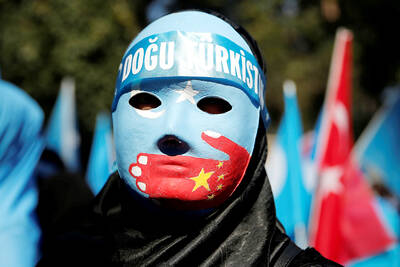
It seems every few days one bumps into one of those “real man” comments in which Taiwan is urged to “face reality” or similar, and “make a deal,” with the speaker implying that soon it will be too late. “Deal” advocates always present themselves as having a superior grip on reality, and the manly ability to make the “hard choice.” Their testosterone-laden language often echoes that of Taiwan sellout advocates. Note that such commentary always specifies a process (“make a deal, work with, make progress”), never the end state of what occupation by a violent authoritarian colonialist state will entail. In

There are shadowy cabals plotting to sell out Taiwan to be annexed by China, by invasion if necessary. Fortunately, they are buffoons. In 2019, former Bamboo Union gangster and founder of the China Unification Promotion Party (CUPP), Chang An-le (張安樂, colorfully known as “White Wolf”), led a protest at the Legislative Yuan against comments made by then-premier Su Tseng-chang (蘇貞昌) that in the event of an attack by China, he would never surrender, but would protect the nation by fighting to the end, even if he only had a broom. Chang had party members bring a wooden casket that they
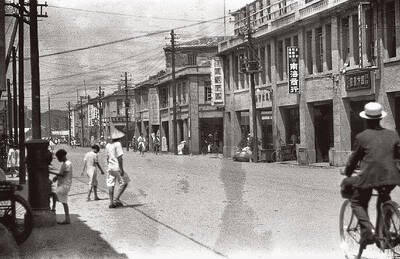
June 1 to June 7 "If all Taiwanese were as afraid of dying as you, then what would happen?” Physician Shih Chiang-nan (施江南) reportedly said this to his wife Chen Chiao-tung (陳焦桐) after she urged him to stop intervening on behalf of Taiwanese soldiers stranded overseas after serving in the Japanese Army during World War II. Shih had clashed with high-ranking officials over the issue, engaged in several heated arguments with Taiwan governor-general Chen Yi (陳儀) and allegedly shouted at general Ko Yuan-fen (柯遠芬), chief of staff of the Taiwan Garrison Command, over


 RSS
RSS