


Park Yeon-mi was part of North Korea’s black market generation — the millennials who grew up as illegal private trading flourished in the secretive, isolated country.
Despite the country’s official adherence to communist principals, more and more North Koreans now have greater unofficial loyalty to capitalism. After all, it was the state system that allowed an estimated one million people to starve during the “arduous march” famine of the late 1990s.
For Park, who escaped in 2007 with her family, it wasn’t just exposure to free trade that opened her eyes to the limits of life in North Korea. It was foreign films, and most of all, a pirate copy of the 1997 Hollywood epic Titanic.

Photo: Reuters
WINDOW TO THE OUTSIDE WORLD
When she was nine years old, Park was forced to attend the execution of her classmate’s mother. Her crime? She had lent a South Korean movie to a friend. The townsfolk were gathered in a large stadium to watch the punishment.
“She got killed in front of us,” said Park, now 20 years old. “I was standing next to her daughter — my whole school had to go.”
Park now lives in Seoul, where she works for the for-profit think tank Freedom Factory Co to raise awareness about the hardships faced by those she left behind. In the North, watching or listening to unauthorized foreign media is regarded as a crime against the state punishable with forced labor, jail time, and even death. Despite this, the popularity of international movies and TV programs — smuggled in over the border on USB sticks and CDs and sold on the black market — has grown rapidly.
Crackdowns on foreign media in North Korea are a continuation of long-standing attempts by the government to suppress interest in foreign cultures.
“There were different levels of punishment,” says Park. “If you were caught with a Bollywood or Russian movie you were sent to prison for three years but if it was South Korean or American you were executed.”
However, despite her aunt’s fate, Park and her friends could not give up the films that offered them “a window for us to see the outside world.”
“My favorite movies were Titanic, James Bond and Pretty Woman — people smuggled in pirate copies from China,” she told The Guardian by Skype from Seoul after attending a “hackathon” event last month in Silicon Valley.
Park remembers a single DVD costing about the same as 2kg of rice, so her family and her neighbors would share.
“Everyone was hungry so they couldn’t afford to buy many DVDs,” she said. “So if I had Snow White and my friend had James Bond we would swap.”
Organized by the New York-based NGO Human Rights Foundation, the event aimed to find ways to get information safely into North Korea, to offer other people that window Park refers to. An editorial in the North Korean Rodong Sinmun said the event’s aims to overcome the country’s tight controls on information were a “futile” attempt to brainwash the population.
For Park, information remains a crucial way to bring elements of freedom to North Koreans. She says she was afraid of getting caught, but “couldn’t stop watching the movies because there was no fun in North Korea, everything was so mundane and when I watched them I saw something new and felt hope — fear didn’t stop me nor will it stop others.”
Studies show that access to foreign media undermines state control on several levels. A recent InterMedia report commissioned by the US State Department found that “the increase in direct media access has been accompanied by an increasing willingness among North Koreans to share information with those they trust ... far fewer people seem to be reporting on each other than before.”
‘WANT TO DIE FOR LOVE’
Casey Lartigue, a colleague of Park’s at Freedom Factory Co, says information from foreign media offers a crucial alternative to the state’s propaganda machine. “[North Koreans] are brainwashed from birth into believing they have ‘nothing to envy,’ so outside media and information campaigns can give North Koreans the knowledge that there are other options out there.”
For the teenage Park, it was Hollywood love stories that had the biggest impact on the way she regarded her own home.
“Everything in North Korea was about the leader, all the books, music and TV,” she said. “So what was shocking to me about Titanic was that the guy gave his life for the woman and not for his country — I just couldn’t understand that mindset.”
“The other shocking thing about that movie was that it was set 100 years ago, and I realized that our country is in the 21st century and we still haven’t reached that level of development,” she said.
Park says love for anything or anyone other than North Korea’s leader — then the late Kim Jong-il, who was succeeded by his son Kim Jong-un in 2011 — was suppressed. “In North Korean culture, love is a shameful thing and nobody talked about it in public,” she said. “The regime was not interested in human desires and love stories were banned.”
“That’s when I knew something was wrong. All people, it didn’t matter their color, culture or language, seemed to care about love apart from us — why did the regime not allow us to express it?”
Though her exposure to foreign media raised many questions for Park, it wasn’t until her father was imprisoned for illegally trading metal with Chinese counterparts that the family knew they had to escape. When he was released to get treatment for cancer, they took their chance and fled to China.
The family still wasn’t safe there; China regards North Korean defectors as economic migrants and is known to detain and repatriate refugees if they are caught. Park and her family hid indoors for 18 months before eventually making their way to Mongolia, where they finally found help to relocate to South Korea.
Park says she believes young North Koreans can, and will, bring real change to their country. She says she hopes to one day return to a reformed North Korea, where people will enjoy wealth, freedom and love.
“All the foreign movies we saw about love affected me and my generation,” she said. “Now we no longer want to die for the regime, we want to die for love.”

Taiwan’s English education system is being pulled apart by three opposing forces. Bilingual Nation 2030 pulls students toward English and global communication. Artificial Intelligence (AI) readiness pulls them toward digital judgment, verification and AI-mediated work. But Taiwan’s old exam culture pulls them back toward memorization, grammar drills, timed reading and correct answers. If the education system keeps using old exams to define success, it risks producing graduates who are neither genuinely bilingual nor genuinely AI-ready, but trained for tasks machines can already perform. The first force is Bilingual Nation 2030. Launched in 2018, the policy aimed to “help Taiwan’s workforce connect
It seems every few days one bumps into one of those “real man” comments in which Taiwan is urged to “face reality” or similar, and “make a deal,” with the speaker implying that soon it will be too late. “Deal” advocates always present themselves as having a superior grip on reality, and the manly ability to make the “hard choice.” Their testosterone-laden language often echoes that of Taiwan sellout advocates. Note that such commentary always specifies a process (“make a deal, work with, make progress”), never the end state of what occupation by a violent authoritarian colonialist state will entail. In
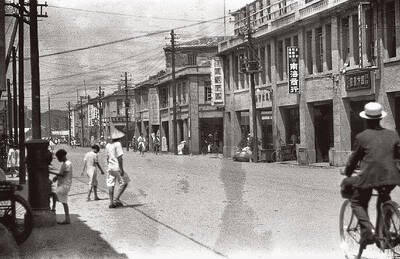
June 1 to June 7 "If all Taiwanese were as afraid of dying as you, then what would happen?” Physician Shih Chiang-nan (施江南) reportedly said this to his wife Chen Chiao-tung (陳焦桐) after she urged him to stop intervening on behalf of Taiwanese soldiers stranded overseas after serving in the Japanese Army during World War II. Shih had clashed with high-ranking officials over the issue, engaged in several heated arguments with Taiwan governor-general Chen Yi (陳儀) and allegedly shouted at general Ko Yuan-fen (柯遠芬), chief of staff of the Taiwan Garrison Command, over

“Taiwan’s Opposition Leader Comes to US With a Message Straight Out of Beijing” read a May 31 headline in the Wall Street Journal. Top US administration officials and members of Congress almost certainly read the WSJ, and if there was a bullet point takeaway that people in Washington should absorb ahead of Chinese Nationalist Party (KMT) Chair Cheng Li-wun’s (鄭麗文) arrival in DC on June 9, that headline is it. The last few columns have discussed this very topic, and the timing is not coincidental. While those top officials likely do not read the Taipei Times, judging by the number


 RSS
RSS