


This has turned out to be a year that is making members of A Moving Sound (AMS, 聲動樂團) live up to the group’s name: A heavy tour schedule has seen them give seven performances in five European countries in July alone. Nine shows are to come this month in the US and three music festivals in New Zealand and Australia are scheduled for next month.
That’s pretty good for a group that has almost come to define the word “indescribable” because it is nearly impossible to pigeonhole their music or their performances.
Take one US musician — Scott Prairie.Originally trained on the French horn, Prairie learned the bass guitar and now plays a number of other instruments, including the zhongruan (中阮), a Chinese plucked instrument. Add a Taiwanese theater administrator-turned-vocalist/songwriter — Mia Hsieh (謝韻雅) — who he met at a “contact jam” dance workshop in New York City. Add marriage and a move to Taiwan. Then add a flexible roster of five to six Taiwanese musicians who play traditional Chinese instruments, and mix in some Nanguan music, Aboriginal tales, dancing, fire artists and slices of daily life in Taiwan. Throw vocalization and dance workshops and multimedia elements into the pot.

Photo Courtesy of Katarina Acel
Marinate for more than a decade and what you have is a uniquely made-in-Taiwan product that has managed to carve out a niche for itself in the world music market and the international music festival scene for 12 years and produce four CDs (Pacu’s Trip in 2004 that was repackaged as Little Universe in 2009; Songs Beyond Words in 2007; Starshine in 2009; and A Moving Sound Collection in 2011).
It is a good thing that for Prairie, Hsieh and their collaborators, the creative journey is what they are interested in, not the idea of becoming an overnight sensation.
“[With] world music or the kind of artistic music that we do, you are not going to have a ‘big’ break. It is word of mouth, word of e-mail expansion. The more people hear us, the more opportunities we get,” Prairie said during an interview on Monday.
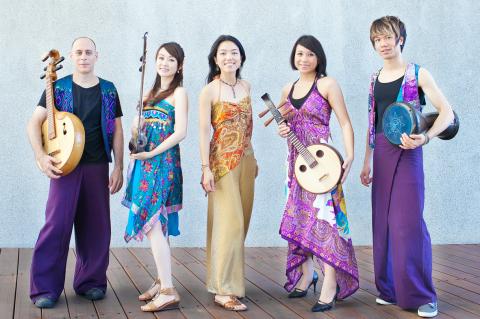
Photo Courtesy of Zhao Binshiang
“As the world becomes more focused [and] more commercially oriented, it’s harder. It is more homogenous; it is actually challenging to get people’s attention. People want quick. People have less time to appreciate difference,” he said.
The fact that the group is from Taiwan, and incorporates so many musical traditions and elements, is a big plus.
“What we do has the richness of Taiwan’s traditional energy. We grab people, the songs are rich. There are like a sampler for people. We have the advantage that people are curious about what’s happening in the Far East. At WOMAD [2012 in Wiltshire, England] we were picked as a highlight by the Financial Times,” Prairie said.
“We are not just unique in Taiwan — there are just no other groups doing what we do. There are some that use Chinese instruments, but in pop [music]. We use traditional instruments to make something original, we have an ability to stand out,” he said.
For Hsieh, who as the singer is the main focus of the group’s performances, it is all about making connections with members of an audience.
“We are always talking about how to describe our music ... Our music is very emotional, very theatrical, but not like in pop music,” she said.
“We create that moment of people being there ... big stage, small stage, inside or outside. All of our instruments are acoustic, [and] people have to feel the real sound of the instrument,” she added.
Whatever the size of the venue, one of the things AMS is known for, both in its songs and in its performances, is a sense of fun — and of the unexpected.
Part of that unpredictability comes from the myriad elements that can inspire Prairie or Hsieh to write a song, everything from a traditional Taiwanese marketplace to Tu Di Gong (土地公) to the tune a recycling truck blares as it makes its rounds.
“Sometimes we try to make more Taiwanese ... more fun, theatrical,” Hsieh said.
“Even [if] we bring in local, Taiwanese elements, we want to create original work. I always feel Taiwan has huge potential for original energy.”
That original energy will be on display on Monday night in Taoyuan City, where the band will be performing a local block party for the Mid-Autumn Festival.
“Organized by the local community and sponsored by the government. It’s free,” Hsieh said. “We are bringing a fire dancer as well.”
In addition to Hsieh and Prairie, the other members of the group on Monday will include Chen I-fang (陳依芳) on the erhu, Pan I-tung (潘宜彤) on the zhongruan and percussionist Alex Wu (吳政君).
Asked if they had any plans for a new CD, Prairie said they were too busy right now, both with their touring and with individual projects, such as Hsieh’s vocal workshops.
Not to mention that just managing the group takes up a lot of time.
“It is a lot of logistics. It is kind of my job to do the international; Mia takes care of [it all on] the Taiwan side," he said.
"Mia and I are a good team and never have any conflict,” he joked.
“We already have invites to Europe, US and Australia for next year ... each year [we] plant more seeds,” he said.
Neither Prairie nor Hsieh feel that they have reached the limits of what they as individual artists or AMS as a group can do.
We are going to keep going “until we drop down from exhaustion,” Prairie said.
■ A Moving Sound plays Monday at 7:30pm at an outdoor stage on Guofeng 2nd St, Taoyuan City (桃園市國豐二街龍安祠戶外舞台). Enter from Ln 80, Longan St (龍安街80巷). Admission is free.

Taiwan’s English education system is being pulled apart by three opposing forces. Bilingual Nation 2030 pulls students toward English and global communication. Artificial Intelligence (AI) readiness pulls them toward digital judgment, verification and AI-mediated work. But Taiwan’s old exam culture pulls them back toward memorization, grammar drills, timed reading and correct answers. If the education system keeps using old exams to define success, it risks producing graduates who are neither genuinely bilingual nor genuinely AI-ready, but trained for tasks machines can already perform. The first force is Bilingual Nation 2030. Launched in 2018, the policy aimed to “help Taiwan’s workforce connect
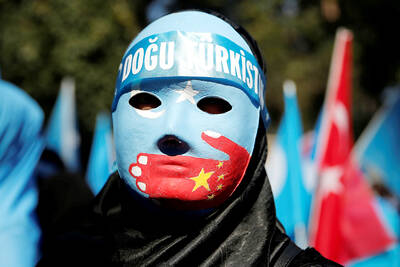
It seems every few days one bumps into one of those “real man” comments in which Taiwan is urged to “face reality” or similar, and “make a deal,” with the speaker implying that soon it will be too late. “Deal” advocates always present themselves as having a superior grip on reality, and the manly ability to make the “hard choice.” Their testosterone-laden language often echoes that of Taiwan sellout advocates. Note that such commentary always specifies a process (“make a deal, work with, make progress”), never the end state of what occupation by a violent authoritarian colonialist state will entail. In

There are shadowy cabals plotting to sell out Taiwan to be annexed by China, by invasion if necessary. Fortunately, they are buffoons. In 2019, former Bamboo Union gangster and founder of the China Unification Promotion Party (CUPP), Chang An-le (張安樂, colorfully known as “White Wolf”), led a protest at the Legislative Yuan against comments made by then-premier Su Tseng-chang (蘇貞昌) that in the event of an attack by China, he would never surrender, but would protect the nation by fighting to the end, even if he only had a broom. Chang had party members bring a wooden casket that they
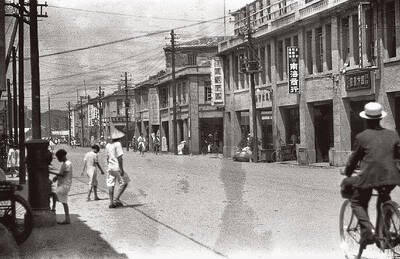
June 1 to June 7 "If all Taiwanese were as afraid of dying as you, then what would happen?” Physician Shih Chiang-nan (施江南) reportedly said this to his wife Chen Chiao-tung (陳焦桐) after she urged him to stop intervening on behalf of Taiwanese soldiers stranded overseas after serving in the Japanese Army during World War II. Shih had clashed with high-ranking officials over the issue, engaged in several heated arguments with Taiwan governor-general Chen Yi (陳儀) and allegedly shouted at general Ko Yuan-fen (柯遠芬), chief of staff of the Taiwan Garrison Command, over


 RSS
RSS