


Song of Pensive Beholding (Chants de la Destinee, 觀) proved a smash hit when it premiered in Taipei in December 2009 as one of the National Theater Concert Hall flagship productions, the culmination of a trilogy that Legend Lin Dance Theatre (無垢舞蹈劇場) founder and choreographer Lin Lee-chen (林麗珍) had begun almost 15 years before.
It has been equally popular on the international festival circuit in the intervening years, with stops in Hong Kong, France, Russia and several other countries, including an appearance at the Festival Internacional Cervantino in Guanajuato, Mexico, in October last year.
The company returns to the National Theater in just over two weeks for an encore performance of Song. Tickets for the top seats in the orchestra level and first floor sold out quickly; what seats remain for the three shows are largely on the edges of the orchestra section and the third and fourth floors. Lin takes years between each new production, so any chance to see her work sends her fans rushing to secure tickets.
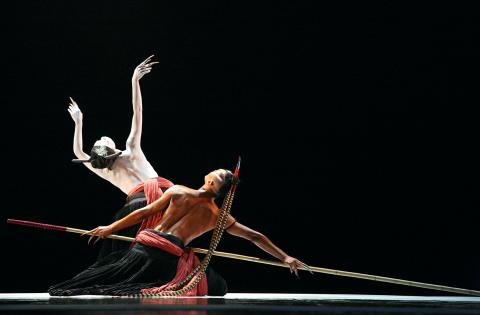
Photo courtesy of Legend Lin Dance Theatre
Song is all about ritual, time — and waiting. The kind of waiting that is very common to school kids who surreptitiously keep checking classroom clocks only to find the minute hand has barely moved since the last time they looked.
Since founding Legend Lin in 1995, Lin has developed a technique that emphasizes calmness, stability and tranquility. For a large part of Song, the performers’ pace and movements are so measured that it is almost impossible to say when they actually take a step or bend their bodies. They are so slow that the word “dance” appears misapplied in the company’s name.
However, the cumulative effect is both meditative and hypnotic, sending the audience into a trance-like state where time no longer seems to matter, only the ritual. Tableaux unfold, the world changes, and yet the differences are difficult to register.
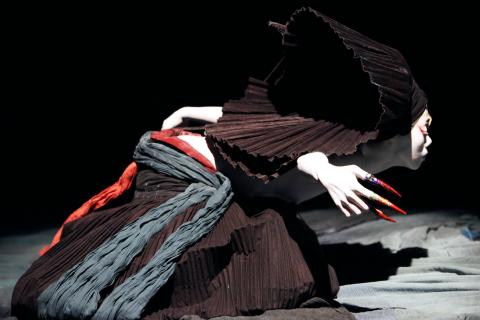
Photo courtesy of Legend Lin Dance Theatre
There is a very religious quality in Lin’s works in her trilogy — Mirrors de Vie (醮), Hymne aux Fleurs Qui Passent (花神祭春芽) and Song — which examines the connections mankind has to the earth and to one another, mixed with Taoist traditions and rites. There is also a strong environmentalist element.
Five years ago, Lin said that she had been inspired to create Song by watching eagles flying over the harbor in her hometown of Keelung.
Song tells the story of a mysterious eagle race, led by two brothers who have vowed to protect their land and their people. However, their pact is threatened when a spirit, the White Bird, who is betrothed to the earth, has an encounter with one of the brothers, causing a rift between the siblings.
The brothers’ clash allows for a pent-up explosion of energy, complete with primordial screams, as they circle the stage with long staffs in hand. It must be as much of a relief to the performers as it is to the audiences after so much built-up tension, yet it is a clash where the victor appears as beaten and lost as the vanquished.
The austere staging and lighting are counterbalanced by the exquisite costumes — by Oscar winner Tim Yip (葉錦添) — and body makeup. Every element is stunning, right down to the cloisonne finger guards worn on three fingers of each hand by White Bird and the brothers, helping transform those appendages into bird-like talons.
The company presented a show, Intimate Encounter (觸身‧實境), at the Experimental Theater last month that demonstrated just how time-consuming the costuming of the lead dancers in Song is. It took almost two hours for the Wu Ming-jing (吳明璟) and Cheng Chieh-wen (鄭傑文) to be body-painted — porcelain-white for her, burnished copper for him — coiffed and costumed, an exercise that required the utmost stillness from them.
It was clear that for the company’s dancers, backstage crew and technicians, the ritualistic aspects of each performance begin long before showtime, which makes the actual performances all the more breathtaking.
While Lin’s fans have by default had to be patient while waiting for a new work from her, having the chance to see Song again after almost five years makes the wait more bearable. It is a show not to be missed, for Legend Lin is a company like no other.
Dance Notes
What: Song of Pensive Beholding
When: Sept. 19 and Sept. 20 at 7:30pm, Sept. 21 at 2:30pm
Where: National Theater (國家戲劇院), 21-1, Zhongshan S Rd, Taipei City (台北市中山南路21-1號)
Admission: The only tickets remaining are in the NT$500 to NT$900 range. A few seats are left on either side of the orchestra section; the rest are on the third and fourth levels. Available at NTCH box offices, online at www.artsticket.com.tw and at 7-Eleven and other convenience store ticket kiosks

Taiwan’s English education system is being pulled apart by three opposing forces. Bilingual Nation 2030 pulls students toward English and global communication. Artificial Intelligence (AI) readiness pulls them toward digital judgment, verification and AI-mediated work. But Taiwan’s old exam culture pulls them back toward memorization, grammar drills, timed reading and correct answers. If the education system keeps using old exams to define success, it risks producing graduates who are neither genuinely bilingual nor genuinely AI-ready, but trained for tasks machines can already perform. The first force is Bilingual Nation 2030. Launched in 2018, the policy aimed to “help Taiwan’s workforce connect

It seems every few days one bumps into one of those “real man” comments in which Taiwan is urged to “face reality” or similar, and “make a deal,” with the speaker implying that soon it will be too late. “Deal” advocates always present themselves as having a superior grip on reality, and the manly ability to make the “hard choice.” Their testosterone-laden language often echoes that of Taiwan sellout advocates. Note that such commentary always specifies a process (“make a deal, work with, make progress”), never the end state of what occupation by a violent authoritarian colonialist state will entail. In

There are shadowy cabals plotting to sell out Taiwan to be annexed by China, by invasion if necessary. Fortunately, they are buffoons. In 2019, former Bamboo Union gangster and founder of the China Unification Promotion Party (CUPP), Chang An-le (張安樂, colorfully known as “White Wolf”), led a protest at the Legislative Yuan against comments made by then-premier Su Tseng-chang (蘇貞昌) that in the event of an attack by China, he would never surrender, but would protect the nation by fighting to the end, even if he only had a broom. Chang had party members bring a wooden casket that they
June 1 to June 7 "If all Taiwanese were as afraid of dying as you, then what would happen?” Physician Shih Chiang-nan (施江南) reportedly said this to his wife Chen Chiao-tung (陳焦桐) after she urged him to stop intervening on behalf of Taiwanese soldiers stranded overseas after serving in the Japanese Army during World War II. Shih had clashed with high-ranking officials over the issue, engaged in several heated arguments with Taiwan governor-general Chen Yi (陳儀) and allegedly shouted at general Ko Yuan-fen (柯遠芬), chief of staff of the Taiwan Garrison Command, over


 RSS
RSS