


Hunted for generations for its tasty meat, the scaly-skinned pangolin is under threat in Gabon as demand for the small mammal surges in Asia, where it is used in traditional medicine.
A timid and strange-looking creature, the pangolin is rarely seen in the wild, emerging only at night. But in the markets of Libreville, the capital of this west African equatorial state, one will see plenty among the crocodiles, porcupines, gazelles and other bushmeat favored by the Gabonese.
The odd-looking animal is easy to identify, with its elongated body, conical snout and lengthy tongue which it uses for eating insects. Its large reptilian scales give it the appearance of a prehistoric creature or, some say, an artichoke.
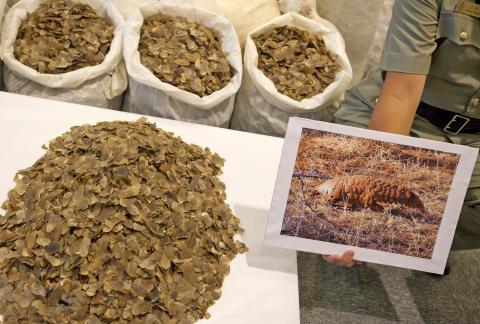
Photo: EPA
“People hunt the pangolin like any other meat because the forest is often the only resource” for people in Gabon, more than 80 percent of which is covered by woodland, said Gaspard Abitsi, managing director of the Wildlife Conservation Society (WCS).
Not only that, the Gabonese have developed a taste for it. “We have a big demand. People love pangolins. My neighbor bought four yesterday and they were quickly sold this morning,” said a trader in the Mont-Bouet market, surrounded by gutted animals.
EXPENSIVE BUT TASTY
At a local restaurant in Libreville, the pangolin is one of the stars on the menu. “It’s expensive, but it’s one of the best meats,” said Didine, the owner.
“We cook it in a broth and you have to let it simmer for a long time otherwise it’s too tough,” she said, stirring the contents of a big steaming pot.
In Gabon, environmental groups are trying to convince villagers of the need to protect the pangolin.
In that spirit, the Crystal Mountains National Park in north Gabon recently changed its emblem to a giant pangolin.
Weighing up to 35kg, the giant pangolin is a protected species yet still hunted, with specimens selling for 100,000 to 130,000 Central African Francs (US$200 to US$260). In comparison, the smaller pangolins go for around 15,000 Central African Francs, with some hunting allowed. But the Gabonese are not the only ones fond of the pangolin, of which there are eight species found in tropical areas in sub-Saharan Africa and parts of Asia.
For some time now, “it’s clear that demand has been getting stronger due to international trafficking,” said Rostan Nteme Mba, of the National Agency for National Parks. “And it’s the scales that most interest the traffickers.”
APHRODISIAC
In traditional Chinese medicine, the scales are used as an aphrodisiac, to restore youthful energy or to treat skin conditions such as psoriasis.
With such reputed virtues, demand has exploded in Asia and made the pangolin one of the world’s mammals most affected by illegal trade, according to the Zoological Society of London (ZSL) which specializes in the species.
It said more than a million have been captured in the last 10 years. It is difficult to know the full extent of poaching in a country like Gabon, which has no official statistics on the pangolin. But based on seizures of bush meat made by customs officials and the ministry of water and forests, the number being killed “is increasing,” according to the WCS. This is especially true in the north of the country, including in the Minkebe National Park, the largest of Gabon 13 national parks which borders Cameroon and Congo, according to officials.
“There are probably African channels” to facilitate the transit of goods to ports and airports and on to Asia, said parks official Nteme Mba.
The proliferation of Chinese firms in Gabon, where Beijing is one of the country’s main economic partners, is speeding up the transfer of pangolins outside the country, according to Abitsi.
“With so much logging and the construction of new roads, they have access to the resource. When the containers leave for Asia, it is unclear whether there is more than wood in it,” he said.
Authorities have taken steps to limit pangolin trafficking. A team of sniffer dogs specially trained to detect protected species such as the giant pangolin was set up earlier this year. The unit has made several minor seizures at the airport in Libreville.
“It’s an important first step to protect pangolins,” said Nteme Mba.

A recent report from the Environmental Management Administration of the Ministry of Environment highlights a perennial problem: illegal dumping of construction waste. In Taoyuan’s Yangmei District (楊梅) and Hsinchu’s Longtan District (龍潭) criminals leased 10,000 square meters of farmland, saying they were going to engage in horticulture. They then accepted between 40,000 and 50,000 cubic meters of construction waste from sites in northern Taiwan, charging less than the going rate for disposal, and dumped the waste concrete, tile, metal and glass onto the leased land. Taoyuan District prosecutors charged 33 individuals from seven companies with numerous violations of the law. This

As mega K-pop group BTS returns to the stage after a hiatus of more than three years, one major market is conspicuously missing from its 12-month world tour: China. The omission of one of the group’s biggest fan bases comes as no surprise. In fact, just the opposite would have been huge news. China has blocked most South Korean entertainment since 2016 under an unofficial ban that also restricts movies and the country’s popular TV dramas. For some Chinese, that means flying to Seoul to see their favorite groups perform — as many were expected to do for three shows opening

What is the importance within the Chinese Nationalist Party (KMT) of the meeting between Xi Jinping (習近平), the leader Chinese Communist Party (CCP), and Cheng Li-wun (鄭麗文), the leader of the KMT? Local media is an excellent guide to determine how important — or unimportant — a news event is to the public. Taiwan has a vast online media ecosystem, and if a news item is gaining traction among readers, editors shift resources in near real time to boost coverage to meet the demand and drive up traffic. Cheng’s China trip is among the top headlines, but by no means
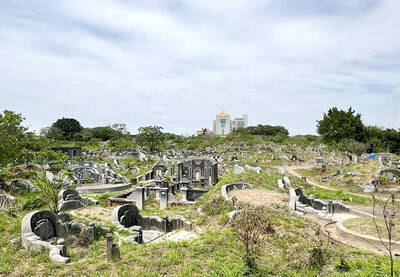
Apr. 13 to Apr. 19 From 17th-century royalty and Presbyterian missionaries to White Terror victims, cultural figures and industrialists, Nanshan Public Cemetery (南山公墓) sprawls across 95 hectares, guarding four centuries of Taiwan’s history. Current estimates show more than 60,000 graves, the earliest dating to 1642. Besides individual tombs, there are also hundreds of family plots, one of which is said to contain around 1,000 remains. As the cemetery occupies valuable land in the heart of Tainan, the government in 2018 began asking families to relocate the graves to make way for development. That


 RSS
RSS