


Over the years, EX-Theatre Asia (EX-亞洲劇團), a Miaoli-based performance troupe co-founded in 2006 by Indian director Chongtham Jayanta Meetei and Taiwanese artist Lin Pei-ann (林浿安), has gained recognition for its multicultural oeuvre that connects contemporary theater with Asian traditional performing arts.
But to Chongtham, the group’s artistic director, there is always a feeling that something is missing.
“We want to take out all the fear and concerns for making a production. We want to take our time. And it is okay if it doesn’t work out in the end,” Chongtham told the Taipei Times.
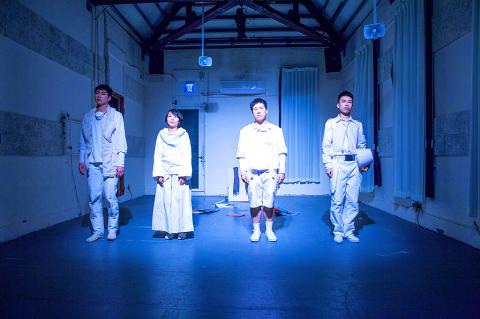
Photo courtesy of EX-Theatre Asia
That is the idea behind the Asia Creative Lab (亞洲創意實驗室), a project launched by the group in 2010 as a platform for artists who want to try different things without being concerned about budgets, deadlines and everything else that comes with making a public performance.
Currently on an island-wide tour, iStory4 is the theater company’s third work. It is a compilation of four short works by four young artists who look into their personal lives to create “not just a personal, but human story.”
Lai Li-ting (賴麗婷), for example, tackles the perennial theme of loss with the story of her father and his funeral, while Wu Jung-lin’s (吳融霖) uses his experience in the military to explore military corruption.
Unlike the previous two productions, The Mother Hen Next Door in 2010 and One Night With Miss Julie (一夜J情) in 2012, which are more of collaborations between individual artists and the troupe, iStory4 is the result of a two year-long process undertaken by the company’s members recruited in 2012.
Chongtham says that it is essentially an artist-centered project, aimed at exploring the creative and artistic process, rather than working toward a finished production.
“Maybe the audience will like it; maybe they won’t. It is not the core of this project. What have the actors gone through? How do they dig into their personal life? Once taken from personal life, how does it become a work of art? This is more valuable than the work itself,” he says.
During the weekly workshops held at the troupe’s base in Miaoli, Chongtham places great emphasis on physical training, including taichi classes and various martial-arts programs.
“Our body has become increasingly unusable as we are more used to technology. I think theater should bring back the importance and expression of the body,” Chongtham says.
In Chongtham’s own theatrical creations, the actor’s body, as the carrier of aesthetics and emotions, is always highly stylized. It is also rooted in Asian traditional performing arts as the Indian artist has been professionally trained in different art forms, ranging from classical Indian dance to Peking opera and Japanese Noh theater. He says these traditional art forms mark a unique kind of theater, philosophy and aesthetics that are distinctively Asian.
However, having worked with performers from different parts of Asia, Chongtham says that while actors from different cultures do express their bodies in different ways, they share more similarities than differences without background and training in traditional performing arts.
“The bodies of city life are becoming very similar. The expression is almost the same,” he says, adding “when all human beings behave the same way, it will be a very boring world.”
After Taipei and Hsinchu, iStory4 will tour to Greater Taichung and returns to the base of EX-Theatre Asia in Miaoli on Aug. 15. More information can be found at the troupe’s bilingual Web site at www.ex-theatreasia.com.

Taiwan’s English education system is being pulled apart by three opposing forces. Bilingual Nation 2030 pulls students toward English and global communication. Artificial Intelligence (AI) readiness pulls them toward digital judgment, verification and AI-mediated work. But Taiwan’s old exam culture pulls them back toward memorization, grammar drills, timed reading and correct answers. If the education system keeps using old exams to define success, it risks producing graduates who are neither genuinely bilingual nor genuinely AI-ready, but trained for tasks machines can already perform. The first force is Bilingual Nation 2030. Launched in 2018, the policy aimed to “help Taiwan’s workforce connect

It seems every few days one bumps into one of those “real man” comments in which Taiwan is urged to “face reality” or similar, and “make a deal,” with the speaker implying that soon it will be too late. “Deal” advocates always present themselves as having a superior grip on reality, and the manly ability to make the “hard choice.” Their testosterone-laden language often echoes that of Taiwan sellout advocates. Note that such commentary always specifies a process (“make a deal, work with, make progress”), never the end state of what occupation by a violent authoritarian colonialist state will entail. In
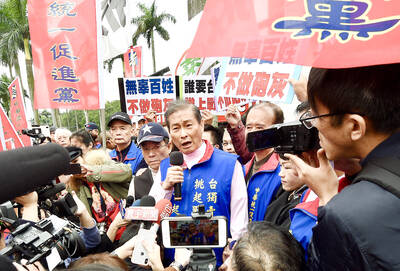
There are shadowy cabals plotting to sell out Taiwan to be annexed by China, by invasion if necessary. Fortunately, they are buffoons. In 2019, former Bamboo Union gangster and founder of the China Unification Promotion Party (CUPP), Chang An-le (張安樂, colorfully known as “White Wolf”), led a protest at the Legislative Yuan against comments made by then-premier Su Tseng-chang (蘇貞昌) that in the event of an attack by China, he would never surrender, but would protect the nation by fighting to the end, even if he only had a broom. Chang had party members bring a wooden casket that they
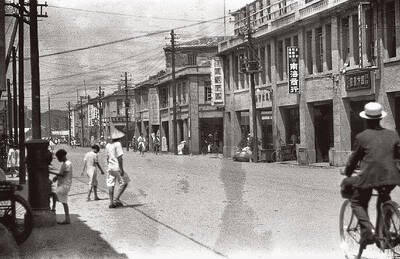
June 1 to June 7 "If all Taiwanese were as afraid of dying as you, then what would happen?” Physician Shih Chiang-nan (施江南) reportedly said this to his wife Chen Chiao-tung (陳焦桐) after she urged him to stop intervening on behalf of Taiwanese soldiers stranded overseas after serving in the Japanese Army during World War II. Shih had clashed with high-ranking officials over the issue, engaged in several heated arguments with Taiwan governor-general Chen Yi (陳儀) and allegedly shouted at general Ko Yuan-fen (柯遠芬), chief of staff of the Taiwan Garrison Command, over


 RSS
RSS