


The four-day Taiwan Automaton Intelligence and Robot Show (台灣智慧自動化與機器人展) opens Thursday with over a thousand booths from around the world showing the latest in robotics.
Taiwan is advancing in robotics applications for the healthcare, tourism, energy and metal and mechanical industries, according to organizers.
From Greater Taichung, Hiwin Technologies Corp. (上銀科技) presents a robotic gait-training system (下肢肌力訓練機), a contraption that helps seniors improve their physical fitness and helps a stroke patient relearn how to walk.
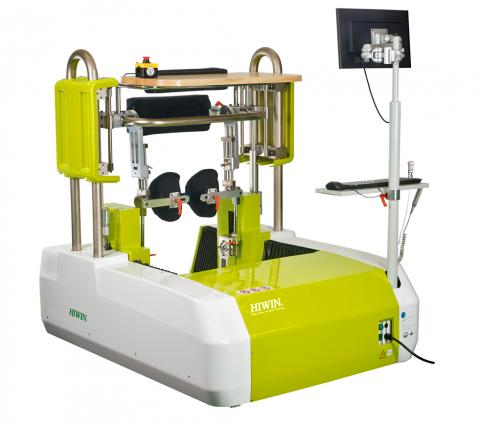
Photo courtesy of Hiwin Technologies Corp.
Hiwin’s new robotic endoscope holder (內視鏡扶持機器手臂) is another thing that could be coming to a hospital near you soon.
This device uses a magnetic electric brake to precisely control endoscope movements, freeing up the assistant to do other tasks.
“It can be micro-calibrated by software. It doesn’t navigate by itself — the surgeon still needs to do that,” said Hiwin general manager Chen Chiu-lien (陳秋蓮) in a telephone interview.
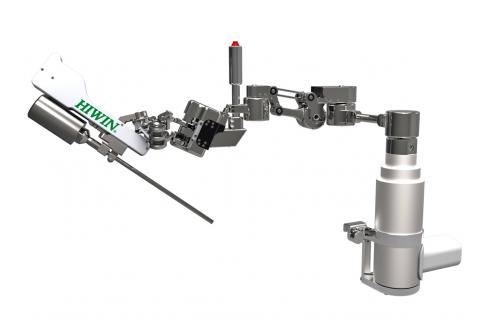
Photo courtesy of Hiwin Technologies Corp
“But it does mount the endoscope stably, avoiding inadvertent mistakes caused by, for example, shaking,” she said.
NEW FACE OF MANUAL LABOR
Taiwan’s first and only two-armed industrial robot, a newly completed project, is also set to debut at the show.
Researchers at the Precision Machinery Research & Development Center (PMC, 精密機械研究發展中心) have created a bot with two limbs that are connected to the same controller.
Each limb boasts flexible seven-axis joints that allows it to move in nimble and more human-like ways. Tools can be mounted to the arms for machining processes and other assembly work.
Across the globe, robots like these are in high demand. China, once considered the factory of the world, has been replacing manual laborers with industrial robots at a rapid rate.
China’s purchases jumped by 36 percent each year between 2008 and 2013, surpassing top-ranked Japan last year, according to latest figures from the International Federation of Robotics.
In other parts of the world, too, the demand for industrial robots is rising.
According to the Industrial Technology Research Institute (工業技術研究院), robot purchases in Taiwan will have increased by 7.7 percent between 2012 and 2015.
The international market is expected to add 200,000 robot units per year until 2020, mostly in the manufacturing sectors.
HELP WANTED
Meanwhile, the robotics and automaton industry is facing a shortage in human personnel.
“Robotics specialists are scarce because the work calls for a very broad skill set,” said Chen Wen-chen (陳文貞), show organizer and deputy secretary-general of the Taiwan Automation Intelligence and Robotics Association (台灣智慧自動化與機器人協會).
“You’re a programmer working for a client and maybe you’re creating a system for shoe manufacturing. You need to truly grasp what the shoe manufacturing industry needs,” she said.
As with past editions, the robot show aims at becoming a proving ground for professionals and a hunting ground for recruiters.
Organizers are hosting a series of public arena-style competitions for robot builders. On Sunday, there is a day-long “matchmaking session” for talent and robot producers.
Over 30 local firms related to robotics will seek to fill about 600 vacancies.
Vacancies are for mechanical engineers, service engineers, optical engineers in hardware and software, PLC (programmable logic controller) software engineers, sales personnel and draftees interested in doing alternative military service in research and development. Jobseekers are advised to bring a CV along with related projects and professional licenses.

This month the government ordered a one-year block of Xiaohongshu (小紅書) or Rednote, a Chinese social media platform with more than 3 million users in Taiwan. The government pointed to widespread fraud activity on the platform, along with cybersecurity failures. Officials said that they had reached out to the company and asked it to change. However, they received no response. The pro-China parties, the Chinese Nationalist Party (KMT) and Taiwan People’s Party (TPP), immediately swung into action, denouncing the ban as an attack on free speech. This “free speech” claim was then echoed by the People’s Republic of China (PRC),

Exceptions to the rule are sometimes revealing. For a brief few years, there was an emerging ideological split between the Democratic Progressive Party (DPP) and Chinese Nationalist Party (KMT) that appeared to be pushing the DPP in a direction that would be considered more liberal, and the KMT more conservative. In the previous column, “The KMT-DPP’s bureaucrat-led developmental state” (Dec. 11, page 12), we examined how Taiwan’s democratic system developed, and how both the two main parties largely accepted a similar consensus on how Taiwan should be run domestically and did not split along the left-right lines more familiar in
Many people in Taiwan first learned about universal basic income (UBI) — the idea that the government should provide regular, no-strings-attached payments to each citizen — in 2019. While seeking the Democratic nomination for the 2020 US presidential election, Andrew Yang, a politician of Taiwanese descent, said that, if elected, he’d institute a UBI of US$1,000 per month to “get the economic boot off of people’s throats, allowing them to lift their heads up, breathe, and get excited for the future.” His campaign petered out, but the concept of UBI hasn’t gone away. Throughout the industrialized world, there are fears that

Most heroes are remembered for the battles they fought. Taiwan’s Black Bat Squadron is remembered for flying into Chinese airspace 838 times between 1953 and 1967, and for the 148 men whose sacrifice bought the intelligence that kept Taiwan secure. Two-thirds of the squadron died carrying out missions most people wouldn’t learn about for another 40 years. The squadron lost 15 aircraft and 148 crew members over those 14 years, making it the deadliest unit in Taiwan’s military history by casualty rate. They flew at night, often at low altitudes, straight into some of the most heavily defended airspace in Asia.


 RSS
RSS