


Yilan International Children’s Folklore and Folkgame Festival (宜蘭國際童玩藝術節) is an annual event with traditional folk toys, water games and art shows for children. This year, featured artists include Lin Shuen-Long (林舜龍) — with his jumbo-sized boat in the form of a coconut — and Takahide Mizuuchi the “rainbow-maker,” who rigs up a hose and sprinkler system to create intense rainbows every day at a scheduled time. The main exhibition is the Hopping Village Picture Book Museum, a fully illustrated world that children can enter and explore as a storybook character. For a full list of events, visit www.yicfff.tw/2014/
■ Dongshan River Water Park (冬山河親水公園), 2, Chinhe Rd Sec 2, Yilan County (宜蘭市復興路2段101號), tel: (03) 9600-322. Daily from 9am to 7pm, General admission: NT$350, children’s admission: NT$250
■ Opens tomorrow. Until August 24
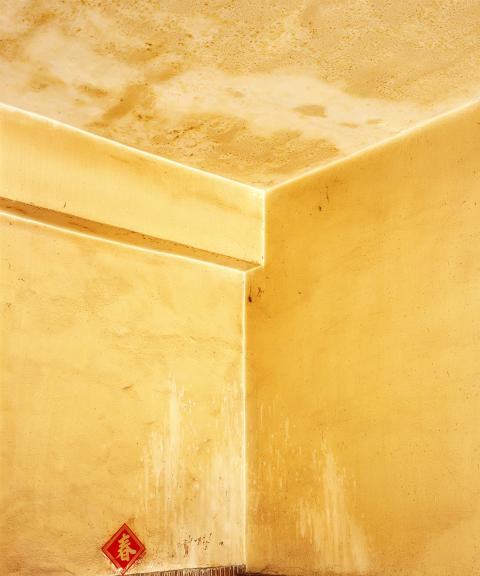
Photo courtesy of Eslite Gallery
Figure Babel is a solo show by Patricia Preze Eustaquio, a leading Filipino artist. Born in Manila in 1977, Eustaquio is acclaimed for her sculptures of lace and felt, as well as for paintings that magnify overlooked yet telling details in old paintings, such as a dead bird. For her Taipei exhibition, Eustaquio brings blueprints for flowers, trees and other various objects that are effectively concealed by abstract geometric shapes. The pieces embody the consumer market’s craving for both the physical and spiritual, both minimalism and excess — contrasting desires that result in an incoherent cry similar to the fallen people of Babel. In the Biblical story, the people of Babel once spoke a common language, but were punished with mutually incomprehensible languages after aspiring to build a tower that stretched to the sky.
■ Mind Set Art Center (安卓藝術), 16-1, Xinsheng S Rd Sec 3, Taipei City (台北市新生南路三段16-1號), tel: (02) 2365-6008. Open Tuesdays to Sunday from 2pm to 6pm, or by appointment
■ Until August 2
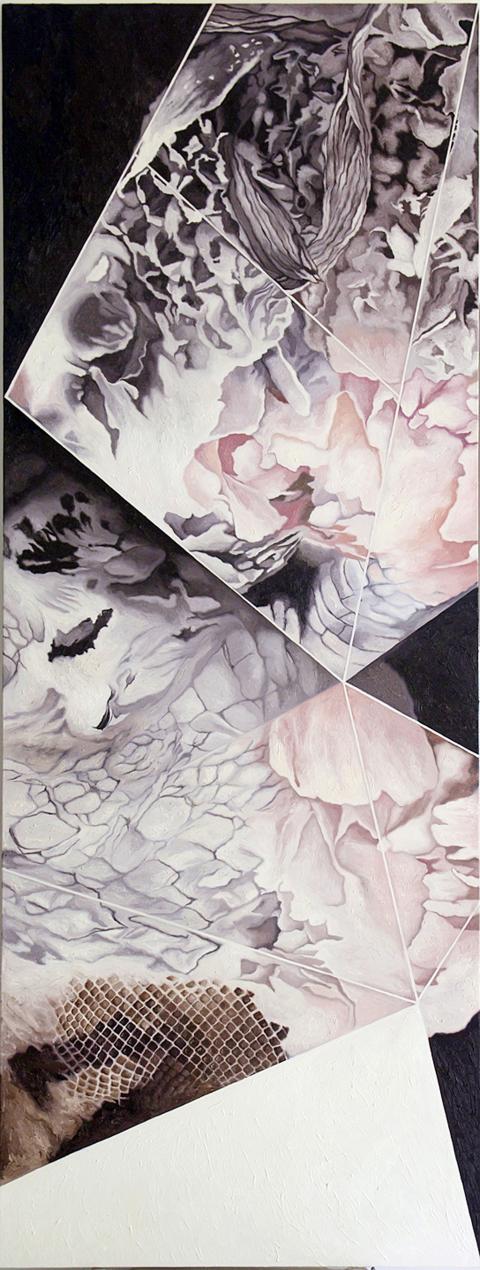
Photo courtesy of Mind Set Art Center
‘Whomen:’ In the Name of Asian Female Artists (以亞洲女性藝術之名) is a 48-artist exhibition marking the 20th anniversary of the Kaohsiung Museum of Fine Arts (高雄市立美術館). It’s a showcase of paintings, sculptures, films and installations that consider the relationship between women and the home. Some works — like a sturdy greenhouse filled with roses — depict the home as a comfortable and uncomplicated space, but in most the picture is ambivalent.
■ Kaohsiung Museum of Fine Arts, 80 Meishuguan Rd, Greater Kaohsiung (高雄市美術館路80號), tel: (07) 555-0331. Open Tuesdays to Sundays from 9am to 5pm
■ Until Sept. 28
Snuggle (依偎) is Taipei-born Sanssouci Horng’s (洪莫愁) solo exhibition about the secret language of legs. “The legs are simple and allow fewer gestures than hands … they are the honest reflection of their master,” writes Horng in the gallery notes. In a series of loud pop-art pieces, she presents legs that intimate loneliness, shyness, flirting, anger and love. Horng is a doctoral graduate of the Universite Paris-Sorbonne and a contemporary painter and printmaker based in Taiwan.
■ National Chiang Kai-shek Memorial Hall (國立中正紀念堂), tel: (02) 2343-1100. Open Tuesdays to Sundays from 9am to 6pm
■ Until July 13
Curated by Nobuo Takamori, The Lost Garden presents five rising Taiwanese artists who work with artifacts of personal and national history. Works include Chen Po-i’s (陳伯義) acclaimed photography series on the razed Hongmaogang (紅毛港) fishing village, and Lin Shu-kai’s (林書楷) miniature cities built with die-cast models from his father’s defunct factory. Lee Jo-mei (李若玫) films a family trip to Okinawa, Japan to visit the home of their ancestors and constructs the footage into a lyrical installation about people trying to close the gap between history and memory.
■ Eslite Gallery (誠品畫廊), 5F, 11 Songgao Rd, Taipei (台北市松高路11號5樓), tel: (02) 8789-3388 X1588. Open Tuesdays to Sundays from 11am to 7pm
■ Opens tomorrow. Aug. 10
Tasteful Life (情韻) is intricately painted pottery by Greater Kaohsiung native Yu Shan-fu (游善富). An ink-wash painter by trade, Yu began adapting his art for a new medium in 2010, transferring his elaborate street scenes and people in different walks of life to earthen pots.
■ Yingge Ceramics Museum (鶯歌陶瓷博物館), 200 Wenhua Rd, New Taipei City (新北市文化路200號), tel: (02) 8677-2727, open Mondays to Fridays from 9:30am to 5pm, Saturdays and Sundays from 9:30am to 6pm, closed first Monday of the month. Free admission
■ Until July 20

Taiwan’s English education system is being pulled apart by three opposing forces. Bilingual Nation 2030 pulls students toward English and global communication. Artificial Intelligence (AI) readiness pulls them toward digital judgment, verification and AI-mediated work. But Taiwan’s old exam culture pulls them back toward memorization, grammar drills, timed reading and correct answers. If the education system keeps using old exams to define success, it risks producing graduates who are neither genuinely bilingual nor genuinely AI-ready, but trained for tasks machines can already perform. The first force is Bilingual Nation 2030. Launched in 2018, the policy aimed to “help Taiwan’s workforce connect

It seems every few days one bumps into one of those “real man” comments in which Taiwan is urged to “face reality” or similar, and “make a deal,” with the speaker implying that soon it will be too late. “Deal” advocates always present themselves as having a superior grip on reality, and the manly ability to make the “hard choice.” Their testosterone-laden language often echoes that of Taiwan sellout advocates. Note that such commentary always specifies a process (“make a deal, work with, make progress”), never the end state of what occupation by a violent authoritarian colonialist state will entail. In
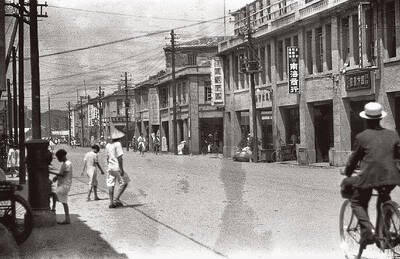
June 1 to June 7 "If all Taiwanese were as afraid of dying as you, then what would happen?” Physician Shih Chiang-nan (施江南) reportedly said this to his wife Chen Chiao-tung (陳焦桐) after she urged him to stop intervening on behalf of Taiwanese soldiers stranded overseas after serving in the Japanese Army during World War II. Shih had clashed with high-ranking officials over the issue, engaged in several heated arguments with Taiwan governor-general Chen Yi (陳儀) and allegedly shouted at general Ko Yuan-fen (柯遠芬), chief of staff of the Taiwan Garrison Command, over

“Taiwan’s Opposition Leader Comes to US With a Message Straight Out of Beijing” read a May 31 headline in the Wall Street Journal. Top US administration officials and members of Congress almost certainly read the WSJ, and if there was a bullet point takeaway that people in Washington should absorb ahead of Chinese Nationalist Party (KMT) Chair Cheng Li-wun’s (鄭麗文) arrival in DC on June 9, that headline is it. The last few columns have discussed this very topic, and the timing is not coincidental. While those top officials likely do not read the Taipei Times, judging by the number


 RSS
RSS