


On the premises where Toast Bar and Bistro used to stand, Yiamas Greeka Taverna brings a taste of Greece to a neighborhood dominated by Western-style restaurants such as Carnegie’s, The Diner (樂子) and Whalen’s. Opened earlier this month, the establishment’s menu, which mixes Greek-style dishes with classic brunch items, sandwiches, pasta, pizza and Mexican food, feels a bit odd, but, as we were told on a recent visit, its kitchen is currently undergoing a transition to become more Greek-focused. If the food keeps the same quality, Yiamas’ upcoming, revised menu is definitely something to look forward to.
Ambience-wise, the dimly lit restaurant has an intimate, relaxing comfort of a bar, accentuated by a slick palette of wooden brown, dark gray and white. Fluent in Mandarin and English, the wait staff appear both relaxed and attentive. With little knowledge of Greek cuisine, my dining companion and I relied on our server to make recommendations, which turned out to be just as delicious as promised.
We began our meal with rota salata (NT$320), said to be a popular Greek salad made up of fresh arugula, romaine and iceberg lettuce, sun-dried tomatoes, homemade candied walnuts served with shaved parmesan and Greek vinaigrette dressing. The dressing might be too sweet to some, but for people who claim to have a separate stomach for desserts like myself, it was nectar, and the candied walnuts were divine, adding a sense of excitement to the already cheerful mixture of flavors and textures.
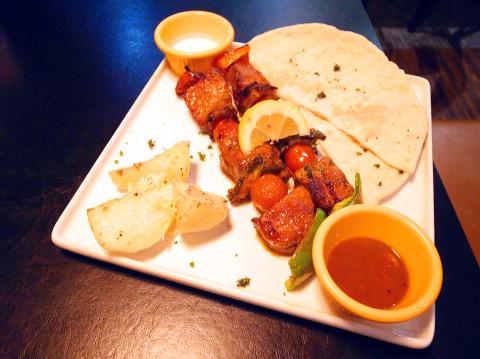
Photo: Ho Yi, Taipei Times
Then came the souvlaki. Served with homemade pita bread, yogurt garlic sauce and roasted potato, Yiamas’ rendition of souvlaki features chicken (NT$290), lamb (NT$350) and beef tenderloin (NT$350). The beef we tried was flavorful and went well with the caramelized bell peppers and onions, though the meat seemed to be cooked to the level of medium-well rather than medium that we ordered. The yogurt garlic sauce was good, but in my opinion, the well-flavored, grilled delight needs no other seasoning than the slices of lemon served on the side.
Another dish that’s highly recommended is the kotoupolo lemonato (NT$380), or Greek roasted chicken. Seasoned with lemon, oregano and garlic, the bird was roasted to a succulent, tender perfection with even the breast moist, while the fruity, sour fragrance of the lemon wonderfully complements the otherwise rich plate. The large serving — half a chicken — is best shared among a group.
Satisfied with what we had and having no room left for dessert, my dining companion and I look forward to returning soon to try the restaurant’s lauded gyros, which comes in one of four options — chicken (NT$180), lamb (NT$190) and beef or pork tenderloin (NT$230). The gyros is served with tomatoes, red onions, tzatziki sauce (yogurt mixed with cucumbers, garlic and salt), pita bread and roasted potatoes. The moussaka (NT$220) also looks tempting with layers of ground meat and roasted eggplant topped with bechamel sauce.
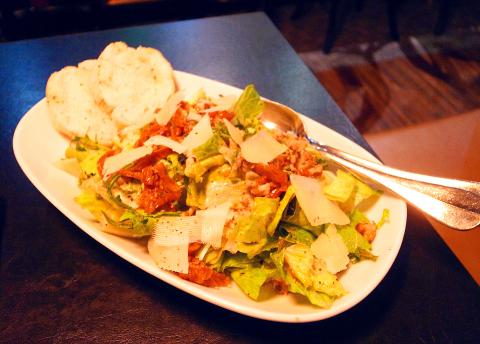
Photo: Ho Yi, Taipei Times
For dessert, diners can choose from Greek standards such as baklava (NT$190), made with layers of filo pastry filled with walnuts, cashew nuts and pistachio nuts and sweetened with lemon honey or yiaourti me meli (NT$190), which is composed of Greek drained yogurt, honey and candied walnuts. For tipplers, the restaurant carries a wide selection of cocktails, beer, wine, whiskey and other spirits.
Good food and drinks aside, Yiamas also hosts comedy hours on a regular basis. An English-language stand-up comedy show is set to take place at 7:30pm on Saturday, featuring talents from Republic of Comedy — Taiwan Standup. Admission is NT$350 per person and includes one drink.
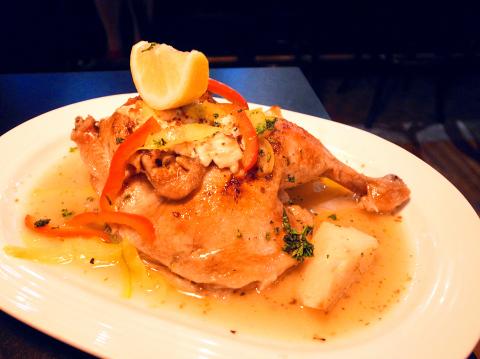
Photo: Ho Yi, Taipei Times

Taiwan’s English education system is being pulled apart by three opposing forces. Bilingual Nation 2030 pulls students toward English and global communication. Artificial Intelligence (AI) readiness pulls them toward digital judgment, verification and AI-mediated work. But Taiwan’s old exam culture pulls them back toward memorization, grammar drills, timed reading and correct answers. If the education system keeps using old exams to define success, it risks producing graduates who are neither genuinely bilingual nor genuinely AI-ready, but trained for tasks machines can already perform. The first force is Bilingual Nation 2030. Launched in 2018, the policy aimed to “help Taiwan’s workforce connect
It seems every few days one bumps into one of those “real man” comments in which Taiwan is urged to “face reality” or similar, and “make a deal,” with the speaker implying that soon it will be too late. “Deal” advocates always present themselves as having a superior grip on reality, and the manly ability to make the “hard choice.” Their testosterone-laden language often echoes that of Taiwan sellout advocates. Note that such commentary always specifies a process (“make a deal, work with, make progress”), never the end state of what occupation by a violent authoritarian colonialist state will entail. In

There are shadowy cabals plotting to sell out Taiwan to be annexed by China, by invasion if necessary. Fortunately, they are buffoons. In 2019, former Bamboo Union gangster and founder of the China Unification Promotion Party (CUPP), Chang An-le (張安樂, colorfully known as “White Wolf”), led a protest at the Legislative Yuan against comments made by then-premier Su Tseng-chang (蘇貞昌) that in the event of an attack by China, he would never surrender, but would protect the nation by fighting to the end, even if he only had a broom. Chang had party members bring a wooden casket that they
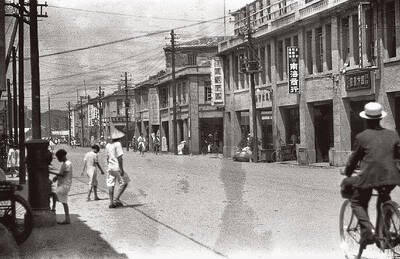
June 1 to June 7 "If all Taiwanese were as afraid of dying as you, then what would happen?” Physician Shih Chiang-nan (施江南) reportedly said this to his wife Chen Chiao-tung (陳焦桐) after she urged him to stop intervening on behalf of Taiwanese soldiers stranded overseas after serving in the Japanese Army during World War II. Shih had clashed with high-ranking officials over the issue, engaged in several heated arguments with Taiwan governor-general Chen Yi (陳儀) and allegedly shouted at general Ko Yuan-fen (柯遠芬), chief of staff of the Taiwan Garrison Command, over


 RSS
RSS