


The nominees for the 25th Golden Melody Awards have been announced, with the ceremony set for June 28. First, congratulations are in order to Funky Brothers for their two nominations as Best New Artist and Best Band. Released last year, Funky Brothers first eponymously titled album was the first in Taiwan to be crowdfunded, and the group is the only nominee in this year’s list to be self-released. In the Best Band category, Funky Brothers are up against at least one artist that plays stadium tours throughout China — Sodagreen (蘇打綠) — and several past winners, including Tizzy Bac, Chairman (董事長) and Chthonic (閃靈). The other nominees for best band are Fire EX (滅火器) and Mixer (麋先生). In the Best New Artist category, other nominees consist almost completely of manufactured starlets. It’s nice to see a band that is not only known for smoking hot live performances, but also writes its own songs and has developed its sound through constant gigging in the local scene, in this putatively elite mix.
Funky Brothers’ lead singer Airy Liu (劉怡伶) was fairly elated, writing on her Facebook, “For all my past hard work, a Golden Melodies nomination is a huge affirmation. I sincerely believe that both for myself and the Funky Brothers, this nominations is the biggest honor… That we’ve been able to come this far, is due to the efforts of those friends and supporters who in the past delivered us firewood through the snow. This affirmation is an affirmation of all of us.”
The Golden Melodies are generally considered the Grammies of Chinese pop music, but we should not forget that they are still essentially a Taiwanese government event. Many nations provide funding to music awards, though most other governments have the modest good sense to at least step back, let some local recording industry association put its stamp on it, and smile from the backstage champagne table that the interests of national culture are being served. But god forbid a Taiwanese government agency should fund anything and not take all the credit. The host organizations are The Ministry of Culture along with a second agency not exactly known for being hip, the National Center for Traditional Arts. The co-host is whichever local government is willing to pay for the awards ceremony, in this case Taipei City’s Culture Bureau. The real organizers are a television network, TTV, and the Recording Industry Foundation in Tawian.
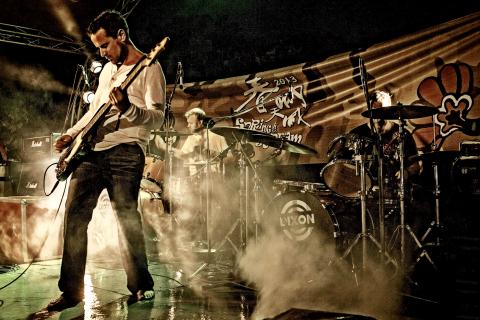
Photo courtesy of Collider
Several indie bands received multiple nominations. Tizzy Bac received five nominations for their album This is Because We Feel Pain (這是因為我們能感到疼痛), and Fire EX and Chairman each received two nominations. Some commentators noted that the awards are moving more in line with international trends — but by that, they of course meant hip hop.
SPACE ROCKOUT
Taiwan’s first and possibly only expat post-rockers, Collider, is due for one of its sporadic explosions onto the live scene tomorrow night, playing with Skycruiser and Soup Mother at The Park. Collider was formed seven years ago under the heavy influence of Mogwai, Godspeed! You Black Emperor and an unhealthy obsession with effects pedals. These days they prefer the label “space rock” and for the last year have used two drummers.
When I ask one of the drummers, Greg Russell, if the musical focus has shifted over the years, he ruminates, “Has the sound changed much? I wouldn’t say too much. With two drummers there are a lot more dynamics. Are we more dancey? No, definitely not that. Maybe more drum ‘n’ bass? We have one new song like that. That mainly comes from me. Also, Pia [Hsieh] from Roxymoron sings on a couple of songs. She’ll be there Saturday night.”
The tone for the evening will be sleazy electronic jams by musicians who dig on extended fuzzy bouts of musicianship and are not afraid to geek out in public. Russell in fact plays drums for all three bands in the lineup. Skycruiser is a Ween tribute band, drawing from Ween’s wealth of a 23-album back catalogue. Soup Mother takes its “Mother” from Frank Zappa and the Mothers and pursues a lineage of freaked out blues rock. The group features Terry Engel on vocals and guitar, DC Rapier on sax and flute, Cat Mars on keyboards, Russell on drums and Karim on bass.
■ Collider plays with Skycruiser and Soup Mother tomorrow night at The Park (公園展演空間), B1, 27 Fuxing S. Rd, Sec 2, Taipei (台北市復興南路二段27號B1). The show starts at 7:30pm and admission is NT$300.
THE LATEST FROM WHITE WABBIT: 2HRS
White Wabbit Records has been plowing the fields of Taiwanese post-rock for more than a decade, since label boss KK formed one of Taiwan’s first bands to play the genre, Nipples, while at the same time selling import CDs of Explosions in the Sky and many other similar bands. Next week they will launch a new band 2HRs, releasing both a full-length album and a Taipei debut of the band at Legacy.
While I have deep personal reservations about post-rock as a genre, the album, Quasar, will have definite local appeal. The first track, “Scintillation”, is an extremely clean and emotionally sweeping composition, perfect perhaps for a climactic, emotional moment on a film. Think for example of how the movie Friday Night Lights almost exclusively used music from Explosions in the Sky, taking post-rock mainstream once and for all. This music feels like it is waiting for a similar conduit to audiences who may know nothing about its indie scene origins, but will appreciate it nonetheless. “Scintillation” starts from clean instrumental loops — the kind Philip Glass used to give an electronic feel to instrumental music — then develops and builds its looping melodic lines of keys, violin and bass with convincing intensity.
The violin is featured prominently throughout the album, and though it perhaps intends to recall the music of the Dirty Three, in reality it is impossible to compare this music to the sheer, manic intensity of that reformed Australian drug fiend Warren Ellis. At times the mix of violin and distorted guitars feels like what would happen if part of a string quartet joined a post-rock band, and this is not a bad thing. In many ways it shows a peculiar potential that could achieve much more than, say, those rock bands who realize grandiose fantasies by bringing in a full chamber orchestra on songs that mainly end up as displays of hubris.
While several songs on Quasar are quite strong, the music of 2HRs too often feels tame and fledgling. While one notes how the band, like a good student, quotes its post-rock icons — for example, using samples of newscasts, a la Godspeed — it can seldom match the intensity. This happens especially toward the end of the album, when the production feels more hasty and the musical focus less sharp. But as a whole, the album shows promise. I’m sure it will sound great in cafes all over downtown Taipei.
■ 2HRs will perform with TuT on Thursday from 8pm at Legacy, 1, Bade Rd Sec 1, Taipei City (台北市八德路一段一號). Tickets are NT$600, or NT$400 in advance through www.indievox.com.
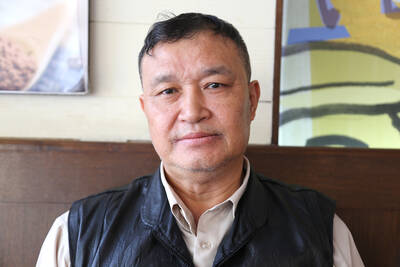
Taiwan has next to no political engagement in Myanmar, either with the ruling military junta nor the dozens of armed groups who’ve in the last five years taken over around two-thirds of the nation’s territory in a sprawling, patchwork civil war. But early last month, the leader of one relatively minor Burmese revolutionary faction, General Nerdah Bomya, who is also an alleged war criminal, made a low key visit to Taipei, where he met with a member of President William Lai’s (賴清德) staff, a retired Taiwanese military official and several academics. “I feel like Taiwan is a good example of
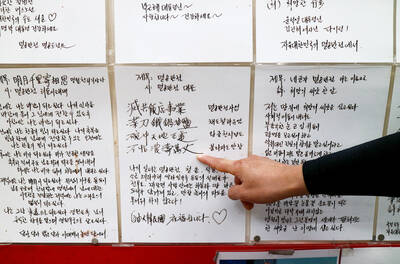
“M yeolgong jajangmyeon (anti-communism zhajiangmian, 滅共炸醬麵), let’s all shout together — myeolgong!” a chef at a Chinese restaurant in Dongtan, located about 35km south of Seoul, South Korea, calls out before serving a bowl of Korean-style zhajiangmian —black bean noodles. Diners repeat the phrase before tucking in. This political-themed restaurant, named Myeolgong Banjeom (滅共飯館, “anti-communism restaurant”), is operated by a single person and does not take reservations; therefore long queues form regularly outside, and most customers appear sympathetic to its political theme. Photos of conservative public figures hang on the walls, alongside political slogans and poems written in Chinese characters; South

Institutions signalling a fresh beginning and new spirit often adopt new slogans, symbols and marketing materials, and the Chinese Nationalist Party (KMT) is no exception. Cheng Li-wun (鄭麗文), soon after taking office as KMT chair, released a new slogan that plays on the party’s acronym: “Kind Mindfulness Team.” The party recently released a graphic prominently featuring the red, white and blue of the flag with a Chinese slogan “establishing peace, blessings and fortune marching forth” (締造和平,幸福前行). One part of the graphic also features two hands in blue and white grasping olive branches in a stylized shape of Taiwan. Bonus points for
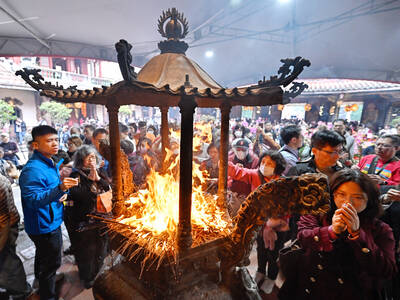
Taipei Mayor Chiang Wan-an (蔣萬安) announced last week a city policy to get businesses to reduce working hours to seven hours per day for employees with children 12 and under at home. The city promised to subsidize 80 percent of the employees’ wage loss. Taipei can do this, since the Celestial Dragon Kingdom (天龍國), as it is sardonically known to the denizens of Taiwan’s less fortunate regions, has an outsize grip on the government budget. Like most subsidies, this will likely have little effect on Taiwan’s catastrophic birth rates, though it may be a relief to the shrinking number of


 RSS
RSS