


It is a cold, grey and sleety February afternoon in Berlin, but Burmese-Taiwanese filmmaker Midi Z (趙德胤) appears to be bursting at the seams with a tropical enthusiasm. It is not surprising — the 31-year-old’s third feature film Ice Poison (冰毒) had been selected for inclusion in the city’s prestigious film festival and reviews had been warm.
We find ourselves chatting on the chilly stairs outside the film festival’s HQ, a renovated museum. Our path to the building’s inner sanctum, where the world’s filmmaking elite are gathered, is blocked by black-jacketed security officers. Having made several feature films in his native Myanmar, Midi Z is no stranger to steely-eyed officials and despite having no festival accreditation he has soon convinced the ear-piece wearing guards to allow me inside.
Hundreds of film sector big-wigs are conducting deals within the warmed-up interior and their smartphone chatter fills the hall. Midi Z leads me to a tiny corner of the venue where he has ensconced himself amid a small army of representatives from the Taiwanese film industry.
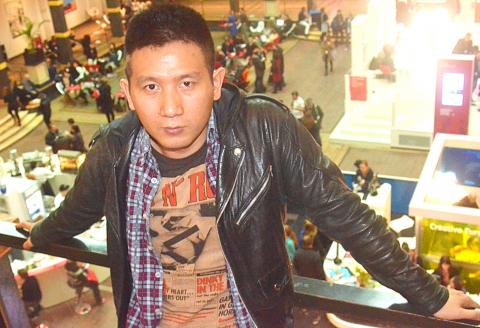
Photo: Sam Sky Wild
Variety magazine described Ice Poison as “simple, direct and involving” and the film — starring Wang Shin-hong (王興洪) as the son of an impoverished vegetable farmer, alongside theatre actress and dancer Wu Ke-xi (吳可熙) who plays Sanmei (a young woman returning to her homeland to bury her grandfather) — is currently playing at the well-respected Tribeca Film Festival in New York. It was also included in the Hong Kong Film festival as well as a series of other film events worldwide. Not bad for the youngest son of a cash-strapped Chinese family in Myanmar.
At the age of 16 — when Midi Z had just moved alone to Taipei to undertake his studies — he had to supplement his education with menial jobs while surreptitiously sleeping in student lodgings, without paying rent. Moving to Taiwan, says Midi Z, made him “more objective … and I think more realistic.” Something he feels that has bolstered his filmmaking.
The story of Midi Z’s early and surprisingly successful career in film is now relatively well known. He graduated from the Department of Industrial and Commercial Design at the National Taiwan University of Science and Technology (國立台灣科技大學) and his graduation film Paloma Blanca made its mark at a number of international film festivals; in 2009 he joined the Golden Horse Film Academy in Taipei, the brain-child of Hou Hsiao-hsien (侯孝賢), a leading figure on Taiwan’s New Wave cinema movement.
Evidently a survivor, Midi Z still found himself at a loss towards the end of 2010 and made his way back to Myanmar — the inspiration of all his creative endeavors.
“I couldn’t help but dream of returning to Myanmar to do something connected to the culture … but I arrived there and felt sad,” he says. “I couldn’t find any job connected to my career … [and] I felt a big gap because I had been living in Taipei, which is such a modern city and so different to my home town.”
His first feature film, Return to Burma (歸來的人), was inspired by his real-life journey and, like all his films since, was filmed on the fly with a shoestring budget in a country emerging from despotic rule where rules are still enforced by heavy-handed authorities. It is an approach that comes with a major element of risk.
Midi Z insists he has never bribed corrupt officials but says being in possession of the business cards of well-placed officials can come in handy.
GUERILLA FILMMAKING
“We were in a train station shooting Ice Poison and it was crowded and we were in the open ... The police came and they wanted to arrest us. I told them: ‘I’m just filming the view, it’s not political.’ I pretended to be a tourist … Then I told them that the technician had been invited by the military authorities to teach young filmmakers and showed them a military man’s card. They left us alone.”
In addition to his guerrilla filmmaking style, all his films are built around the themes of poverty, alienation and powerless, which define modern-day Myanmar. And he insists that his movies are a reflection of his own experiences.
“My life experience is as a poor boy, so most of the story ideas come from me when I’m exploring who I am.”
Ice Poison is a slow film — certainly for audiences raised on slick, heavily-edited Hollywood fare — and there are times when Midi Z’s extended shots feel like they continue for longer than perhaps they should. However, his films offer a rare glimpse of a society undergoing rapid change and his loose documentary style provides a sense of authenticity.
Midi Z is reflective on the subject of filmmaking which he says leaves him sad and “full of regret.” For the bubbly director, the creative process seems an incredibly draining one.
“There are so many limits — a very small budget, no permits to shoot. I feel so weak and exhausted. But when it’s finished and after the editing is over you feel so proud of your crew, of yourself. The creative process is like this even if you are a famous director, or a very small director like me. It’s the same.”
The diminutive filmmaker, who describes himself as a “student director,” relaxes onto the balcony where we are standing and takes in the hub-bub of the glitterati noise on the ground floor below.
“Back in 1989 when we heard the news about the Berlin Wall it was just a city far away — I could never imagine I would go there.”
Ice Poison is set to open at selected cinemas in Taiwan in mid-July.

Taiwan’s English education system is being pulled apart by three opposing forces. Bilingual Nation 2030 pulls students toward English and global communication. Artificial Intelligence (AI) readiness pulls them toward digital judgment, verification and AI-mediated work. But Taiwan’s old exam culture pulls them back toward memorization, grammar drills, timed reading and correct answers. If the education system keeps using old exams to define success, it risks producing graduates who are neither genuinely bilingual nor genuinely AI-ready, but trained for tasks machines can already perform. The first force is Bilingual Nation 2030. Launched in 2018, the policy aimed to “help Taiwan’s workforce connect
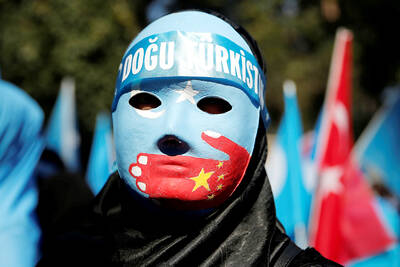
It seems every few days one bumps into one of those “real man” comments in which Taiwan is urged to “face reality” or similar, and “make a deal,” with the speaker implying that soon it will be too late. “Deal” advocates always present themselves as having a superior grip on reality, and the manly ability to make the “hard choice.” Their testosterone-laden language often echoes that of Taiwan sellout advocates. Note that such commentary always specifies a process (“make a deal, work with, make progress”), never the end state of what occupation by a violent authoritarian colonialist state will entail. In

There are shadowy cabals plotting to sell out Taiwan to be annexed by China, by invasion if necessary. Fortunately, they are buffoons. In 2019, former Bamboo Union gangster and founder of the China Unification Promotion Party (CUPP), Chang An-le (張安樂, colorfully known as “White Wolf”), led a protest at the Legislative Yuan against comments made by then-premier Su Tseng-chang (蘇貞昌) that in the event of an attack by China, he would never surrender, but would protect the nation by fighting to the end, even if he only had a broom. Chang had party members bring a wooden casket that they
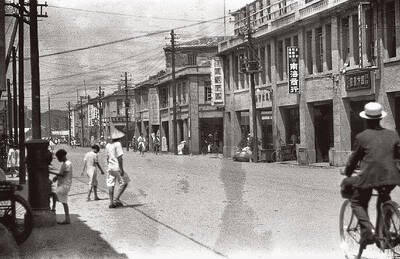
June 1 to June 7 "If all Taiwanese were as afraid of dying as you, then what would happen?” Physician Shih Chiang-nan (施江南) reportedly said this to his wife Chen Chiao-tung (陳焦桐) after she urged him to stop intervening on behalf of Taiwanese soldiers stranded overseas after serving in the Japanese Army during World War II. Shih had clashed with high-ranking officials over the issue, engaged in several heated arguments with Taiwan governor-general Chen Yi (陳儀) and allegedly shouted at general Ko Yuan-fen (柯遠芬), chief of staff of the Taiwan Garrison Command, over


 RSS
RSS