


Jason Tsai (蔡其宗), 56, is the inventor of a couple Miaoli County food specialties.
His bakery Pro Food (普羅蛋糕), which thrives quietly in Jhunan Township (竹南), won gold from the national Chinese Pastry and Food Skill Association (糕餅食品技術交流協會) for its fusion mochi (麻糬, glutinous rice) pastries and bite-sized mooncakes.
Last year, it won the Taiwan Chamber of Commerce’s Taiwan Best 100 (百大伴手禮) with Hakka-style crisps. These are thin, flat rectangles made with leicha (擂茶), a traditional Hakka drink that combines ground green tea with ground peanuts, and a bit of shredded pickled cabbage. Dressed with fresh-made kumquat preserve, they are sweet and savory crackers that crumble into a rich dust at first bite — an experimental item that’s become a local calling card.
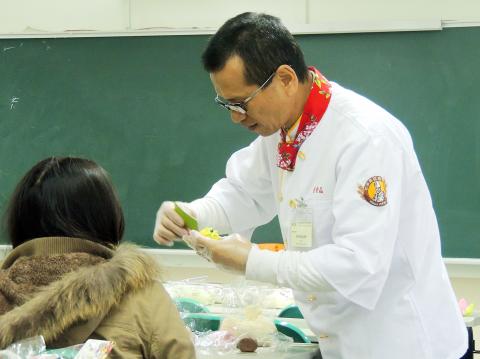
Photo: Enru Lin, Taipei Times
“I’ve been experimenting since the first month I started with the bakery,” Tsai told the Taipei Times. “I try to have a new item every month. There are so many ideas I want to test.”
The shop is a brightly lit den of curiosities, like Chinese flatbreads (shaobing, 燒餅) in the form of cinnamon buns. Tsai enjoys making eccentric, extravagant cakes — a plastic Barbie doll with a tremendous gown blossoming with pink frosted tulle.
One of his best-known concoctions is a play on the ancestral alter offering. He sculpts a pig or goose out of flour and bakes it to a tawny crisp.
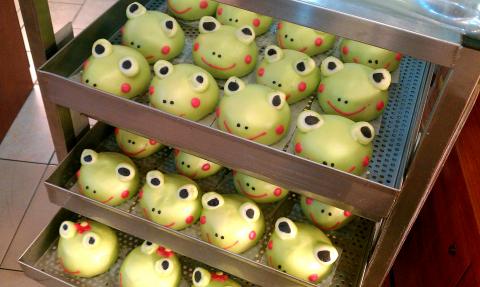
Photo courtesy of Pro Food
“It’s for families that are vegetarian,” Tsai said.
NO DOUGH HEAD
Tsai ran away from his home in Taichung with only a junior-high school diploma.
“When I was a child, I really liked sculpting. We had arts and crafts class in school and I loved that, but I wasn’t a good student in any other classes,” he said.
He was the son of a baker. In the 1960s, Taiwan had a small bread industry that offered simple items including the steamed bun, the stuffed bun, polo bread and Japanese influences such as soft white-flour loaves filled with bean paste. Tsai learned to make them all. Each morning, his father rose at 3am and took him to the bakery, where they worked side by side until it was time for school. In the afternoon, Tsai went straight from school to the bakery, where he worked alongside his father until 9pm.
“It sounds like a lot now, but back then, it was not an abnormal way of life and many people did that to get by,” he said.
“But my father was very strict. Extremely strict. He grew up in the Japanese colonial era and had a disciplinarian’s spirit — oh, that was unbearable,” Tsai said.
As a teen, Tsai shrunk from his father’s iron rule and decided he wanted nothing to do with bread. He left home and tried out several trades: steel-making, insurance, a stint as a dentist’s assistant.
“I tried everything,” Tsai said. “Then I went into the army, and during that time my father closed down the shop — he was getting old.”
After completing his military service, Tsai arrived in Taipei with a resume of odd jobs and no marketable skills except baking. Grudgingly, he took an apprenticeship at a bakery. While he was there, he discovered that the world of bread had transformed.
“That was around 1982,” he said. “I was in Taipei and all this new information was coming in about old flour, different kinds of baking.”
By the 1980s, Taiwan’s economy was booming, taking the bread industry with it. The China Wheat Products Research Development Institute (中華穀類食品工業技術研究所), manned by US-trained Taiwanese bakers, provided technical training in new methods of baking and milling. Increasingly, shops carried exotic tarts and crusty French loaves.
“Before, the emphasis was on quantity, and then it changed to a focus on quality. I found this type of bread-making very interesting. Breads were cute,” he said.
Within three months, Tsai was promoted to head pastry chef. After saving up capital, he relocated to a remote but affordable location in Miaoli to open his own bakery.
ANGRY BIRDS
Sixteen years later, things are continuing to change.
“I am taking classes now, so I can get my college degree,” Tsai said.
The state of the bread is changing, too. Consumers are moving toward whole grain breads and organic ingredients, he said. They are also embracing bread that aspires to be artistic.
For about a year now, he has ventured back into the world of steamed buns, molding Angry Birds and Kero Kero Keroppi frogs out of naturally dyed flour. He designs his own cartoon characters, too, and the round creations have sold — literally like hotcakes — to preschoolers for parties, to lovers on Valentine’s Day and to online shoppers.
“This is most fun, because I like sculpting so much,” he said.
He is not a professional artist, but in Tsai, a combination of skills and the appreciation for change have come together to form an effective business model: Pro Food has been profitable for the past 13 years.
“I am aware that a store that won’t change is a store waiting for death. I have seen so many traditional bread shops in which initially business is great, but after a while profits slide and the shops disappear,” he said.
“Bread is bread, of course — that’s constant, but with some attention, you can change the flavor or change the appearance and offer a new experience.”

This month the government ordered a one-year block of Xiaohongshu (小紅書) or Rednote, a Chinese social media platform with more than 3 million users in Taiwan. The government pointed to widespread fraud activity on the platform, along with cybersecurity failures. Officials said that they had reached out to the company and asked it to change. However, they received no response. The pro-China parties, the Chinese Nationalist Party (KMT) and Taiwan People’s Party (TPP), immediately swung into action, denouncing the ban as an attack on free speech. This “free speech” claim was then echoed by the People’s Republic of China (PRC),

Exceptions to the rule are sometimes revealing. For a brief few years, there was an emerging ideological split between the Democratic Progressive Party (DPP) and Chinese Nationalist Party (KMT) that appeared to be pushing the DPP in a direction that would be considered more liberal, and the KMT more conservative. In the previous column, “The KMT-DPP’s bureaucrat-led developmental state” (Dec. 11, page 12), we examined how Taiwan’s democratic system developed, and how both the two main parties largely accepted a similar consensus on how Taiwan should be run domestically and did not split along the left-right lines more familiar in

Most heroes are remembered for the battles they fought. Taiwan’s Black Bat Squadron is remembered for flying into Chinese airspace 838 times between 1953 and 1967, and for the 148 men whose sacrifice bought the intelligence that kept Taiwan secure. Two-thirds of the squadron died carrying out missions most people wouldn’t learn about for another 40 years. The squadron lost 15 aircraft and 148 crew members over those 14 years, making it the deadliest unit in Taiwan’s military history by casualty rate. They flew at night, often at low altitudes, straight into some of the most heavily defended airspace in Asia.
Many people in Taiwan first learned about universal basic income (UBI) — the idea that the government should provide regular, no-strings-attached payments to each citizen — in 2019. While seeking the Democratic nomination for the 2020 US presidential election, Andrew Yang, a politician of Taiwanese descent, said that, if elected, he’d institute a UBI of US$1,000 per month to “get the economic boot off of people’s throats, allowing them to lift their heads up, breathe, and get excited for the future.” His campaign petered out, but the concept of UBI hasn’t gone away. Throughout the industrialized world, there are fears that


 RSS
RSS