


The script, Christophe Paou says, was even more sexually explicit, so the French actor knew what he was getting himself into when he signed up for Alain Guiraudie’s film, Stranger By the Lake. Paou plays Michel, a handsome and charismatic man — with an extremely sinister side — who meets Franck, a younger man, at a cruising spot. Stranger By the Lake is one of two sexually-explicit films released this weekend, the other being Lars von Trier’s much-hyped Nymphomaniac, in which Charlotte Gainsbourg plays Joe, a sex addict. Both films use body doubles for the genital close-ups and the explicit scenes.
Nymphomaniac’s producer Louise Vesth said: “We shot the actors pretending to have sex and then had the body doubles, who really did have sex, and in post [production] we will digitally impose the two. So above the waist it will be the star and below the waist it will be the doubles.”
Gainsbourg said: “I was very, very nervous at first. I needed it to be very clear that actors were not going to perform sex. As long as that was clear, I was fine.” In another interview, she said: “The sex wasn’t hard. For me it was all the masochistic scenes [that were] embarrassing, a little humiliating. The blow job, the same thing, a bit humiliating too. Then having a prosthetic vagina ... two hours in the morning with someone working down there, that was the hard part.” Stacy Martin, who plays the younger Joe, said she made sure everything was agreed in advance — how much nudity there would be, a closed set, a body double, the use of prosthetics.

Photo: REUTERS
But still, the actors in both films seem to have been pushed further than in many sex scenes.
“If you have to hit somebody in the face for a film, you have to feel that you are going to hit him or her, but you don’t go that far,” says Paou. It was the same, he says, with sex: “We needed to feel love and desire.”
Paou was nervous about taking the part — deciding whether to do it or not was the most difficult part of the process, he says.
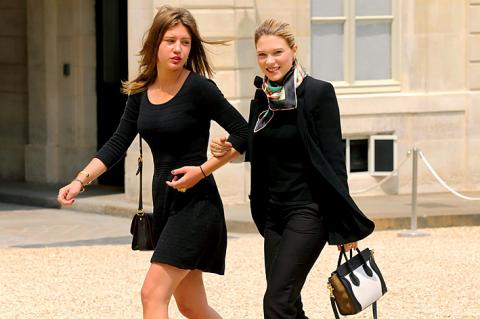
Photo: REUTERS
“I was wondering if I would be able to do it, because the script was very direct: ‘Michel sucks Franck,’ or whatever. You are wondering how we are going to do that.”
But once on set, he says, he was reassured. It was a small crew and there was privacy. He and Pierre Deladonchamps, who plays Franck, had a bit of time to get to know each other, and Guiraudie, so “we had been building that confidence together. We rehearsed for one week and chose together not to have sex [for real].”
Does he think Guiraudie wanted them to?
“Maybe he wanted to, but it’s not his way of working. He needs the actors, and himself, to be confident. I don’t know if ‘wanted’ is the word.” If he had that idea, says Paou, “he wasn’t very strong with it”. They tried acting with a prosthetic penis for one masturbation scene, but it didn’t work. “It was screwed onto a piece of metal. When I was moving my body, the false penis wasn’t moving.”
Body doubles — Paou calls them “stunt doubles” — were brought in for the explicit scenes, but unlike in Nymphomaniac, they were regular actors, not porn performers.
“Alain didn’t want to use pornographic actors because he wanted to keep the sensuality, the love story,” says Paou. “He was a bit afraid to have some guys who would have done it like in porn, which might [look] very mechanical.”
OVERSTEPPING BOUNDARIES
If some actors are being asked to go further than before, not all speak so warmly of their director afterwards. The two female leads in last year’s Blue is the Warmest Color, the critically acclaimed love story, which won the Palme D’Or at Cannes, said they would never work with its director, Abdellatif Kechiche, again. In one interview, the actor Lea Seydoux said: “You have to give everything. And if you don’t give everything, you’re fired.”
It wasn’t just the much-discussed seven-minute sex scene, which took 10 days to film, she was talking about. She told the Independent last year, “it was kind of humiliating sometimes, I was feeling like a prostitute. Of course, he uses that sometimes. He was using three cameras, and when you have to fake your orgasm for six hours ... I can’t say that it was nothing.”
The demands made on actors, particularly young women, have changed, thinks the anonymous Miss L, who runs the Casting Call Woe Web site. She has been an actor for eight years, and last year set up the site to share the kind of adverts for acting jobs she came across: one posted this week said it was looking for actors who are “the very definition of sluts.”
“It wasn’t at this level when I started out,” she says. “We now have TV program like Game of Thrones, where there are more sexually suggestive [scenes], and it trickles down to the other sections of the industry. The smaller film-makers see it and go, ‘That’s what people are doing,’ and the problem is, at the lower levels, there is less regulation, particularly in short films and student films, about what’s acceptable and what actors should be doing.”
There isn’t a day that goes by, she says, where she doesn’t see a casting call asking for nudity or sex scenes, and it’s more often that it’s required of the female character.
“It feels as if the women are written to look nice or be the sexual element. There is a lot of, ‘You will be expected to be in your underwear,’ or, ‘You will be naked.’”
IMPACT of PORN INDUSTRY
Why does she think this is? The impact of porn on general culture can’t be underestimated, she thinks.
“We’re in a generation now where porn is more readily accessible and it has infiltrated what audiences see now — we’ve become a bit more dulled to things so they need to keep pushing the boundaries, whereas 40 years ago, if a woman was in a short skirt, that would be seen as suggestive; now you’d have to be naked to get the same point across.”
Unsurprisingly, given the other double standards that exist for women in the entertainment industry, the focus — and attacks — on female actors after a famous sex scene usually far outweighs anything their male counterparts face.
Margo Stilley, who was in 9 Songs, Michael Winterbottom’s 2004 investigation of a relationship, told through music and real sex scenes, has often in interviews had to justify her decision to make the film, and has described the abuse she received at the time (abuse that wasn’t, it’s worth noting, levelled at her male co-star, Kieran O’Brien).
“People were really angry with me ... I got told I was a whore and a slut and asked how could I do it, or what kind of role model did I think I was giving young women?” Stilley said.
Kerry Fox, who starred in Intimacy, the 2001 adaptation of Hanif Kureishi’s short stories, was being asked questions about the real oral sex scene with Mark Rylance years later; in interviews with Rylance, it’s rarely mentioned. For both actors, who remain proud of their respective films, it appears that it wasn’t the experience of filming that was traumatic, but the reaction to it afterwards. In Stilley’s case, this involved newspapers tracking down her family to get their response. In an interview with the Guardian in 2009, Fox described the reaction as “a very narrow response” and “horrible.”
Chloe Sevigny has said of her unsimulated oral sex scene with Vincent Gallo in The Brown Bunny, the 2003 film he also directed, “I seem to question myself every day why I crossed the line, but I really believed in the director as an artist ... Making it for me was not difficult, but the reaction from the public has been very difficult for me to handle. I think a lot of people talk about it without having seen it, and that’s part of the problem.”
The last couple of years have seen the releases of Travis Mathews’s I Want Your Love and Interior Leather Bar (directed with James Franco). Droo Padhiar, head of publicity of Peccadillo Pictures, the distributor of those films, as well as Stranger By the Lake, says these releases are part of a more liberal attitude to more extreme sex scenes.
“Ten years ago, they would have gone straight to DVD, nobody would have given it a chance [at the cinema],” she says.
THE REAL THING
As long as the sex is there as part of the narrative — in Stranger by the Lake it is intrinsic, she says — and it has done the rounds at festivals and won critics over, “cinema programmers are more willing to play a film with high sexual content. Demand is there, especially when people are given the green light that it’s a film worth seeing, and not just smut.”
This, in turn, she says, gives film-makers the confidence to make the kind of films they want to. “We support a lot of independent film-makers from the start of their projects. Travis Mathews’s films contain real sex, but also had theatrical presence. So it has given Travis the idea that this is something audiences are hungry for. It’s close to him, he wants to make films about sex and love. Nobody is afraid any more, when you see there is an audience for it.”
Others aren’t convinced we’re entering a new wave of boundary-crossing cinema. When David Cooke became director of the British Board of Film Classification (BBFC) in 2004, one of his first difficult decisions was rating 9 Songs. The principle has always been, he says, “that at 18 level, if it’s not porn and it’s not harmful and doesn’t break the law, then adults should be free to choose [to watch something]. That’s the way we approached 9 Songs all those years ago, and that’s how we approached Nymphomaniac.”
Winterbottom’s film didn’t mark the first time real sex had been passed uncut for an 18 rating — the first, thinks Cooke, was Ai No Corrida, the Japanese film that had been censored by the BBFC but passed in 1991, “so it has happened for a while.” There had also been Von Trier’s The Idiots in 1998, Romance a year later, followed by Intimacy and the French film Baise-moi — all of which contained scenes of unsimulated sex.
“It is different if we think it’s porn. The definition of porn that we use is: ‘Is the primary purpose of the film sexual arousal?’ Porn is shot in a different way, and it’s clear to me that 9 Songs wasn’t porn.”
He doesn’t necessarily believe the British public is becoming more tolerant of explicit sex. With Blue Is the Warmest Color, “there was the case for [rating it] a 15 but the view we took in the end was that the sex scenes were just too long. So I think that does suggest that the public does still want us to be fairly vigilant.”

Michael slides a sequin glove over the pop star’s tarnished legacy, shrouding Michael Jackson’s complications with a conventional biopic that, if you cover your ears, sounds great. Antoine Fuqua’s movie is sanctioned by Jackson’s estate and its producers include the estate’s executors. So it is, by its nature, a narrow, authorized perspective on Jackson. The film ends before the flood of allegations of sexual abuse of children, or Jackson’s own acknowledgment of sleeping alongside kids. Jackson and his estate have long maintained his innocence. In his only criminal trial, in 2005, Jackson was acquitted. Michael doesn’t even subtly nod to these facts.

Writing of the finds at the ancient iron-working site of Shihsanhang (十 三行) in New Taipei City’s Bali District (八里), archaeologist Tsang Cheng-hwa (臧振華) of the Academia Sinica’s Institute of History and Philology observes: “One bronze bowl gilded with gold, together with copper coins and fragments of Tang and Song ceramics, were also found. These provide evidence for early contact between Taiwan aborigines and Chinese.” The Shihsanhang Web site from the Ministry of Culture says of the finds: “They were evidence that the residents of the area had a close trading relation with Chinese civilians, as the coins can be

The March/April volume of Foreign Affairs, long a purveyor of pro-China pablum, offered up another irksome Beijing-speak on the issues and solutions for the problems vexing the People’s Republic of China (PRC) and the US: “America and China at the Edge of Ruin: A Last Chance to Step Back From the Brink” rang the provocative title, by David M. Lampton and Wang Jisi (王緝思). If one ever wants to describe what went wrong with US-PRC relations, the career of Wang Jisi is a good place to start. Wang has extensive experience in the US and the West. He was a visiting

The January 2028 presidential election is already stirring to life. In seven or eight months, the primary season will kick into high gear following this November’s local elections. By this point next year, we will likely know the Democratic Progressive Party (DPP) candidate and whether the Taiwan People’s Party (TPP) will be fielding a candidate. Also around this time, the Chinese Nationalist Party (KMT) will either have already completed their primary, or it will be heading into the final stretch. By next summer, the presidential race will be in high gear. The big question is who will be the KMT’s


 RSS
RSS