


Eighteen years ago I was putting the finishing touches to a post-graduate thesis on bohemianism and literature. My argument was that bohemianism — voluntary, youthful poverty, and a life devoted to the arts and intoxication — was recurrent. First seen in Paris in the 1830s, it re-emerged in London in the 1890s, internationally in the 1920s (the Jazz Age), and then on an enormous scale in the 1960s with the hippies, the first pan-global, non-Marxist, radical youth movement.
Now, with record youth unemployment in the West, it’s surely all set to appear again. But in The First Bohemians Gatrell is concerned instead with origins, arguing that 18th-century London, in particular the area around Covent Garden, saw the world’s first example of the phenomenon.
The claim, however, is little more than an excuse for a catchy title. Gatrell is really an art historian, and he’s conducted an enormously detailed investigation into the Covent Garden area of the period, a district you could — and still can — walk across in ten minutes. An awesome appendix lists 146 artists and engravers, plus some print-shop owners who lived in the area, with their addresses, dates, and fathers’ occupations where known (thus giving an idea of their social origins). His specialty is satirical prints, and he must have seen most specimens of this art that still exist.
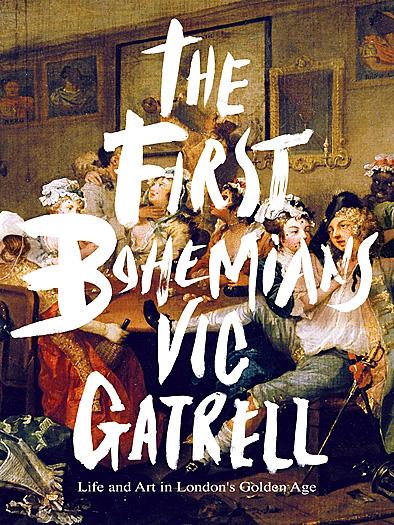
One slight problem is that he’s already published one highly-successful book on the subject — City of Laughter: Sex and Satire in Eighteenth-Century London (2007). This contained innumerable anecdotes and illustrations showing the ribald and licentious goings-on of a tolerant age (tolerant, at least, in this small area of London). Was there really enough material not included there to make this second book?
The reason Gatrell has managed his sequel so triumphantly is that whereas in 2007 he had to photograph each print himself, this time he’s had access to the roughly 2,000,000 items the British Library has put online, and that anyone can copy without payment.
Covent Garden was an area of prostitutes as well as artists — the latter drew and painted the former, while the former entertained the latter in no uncertain manner. They all caroused together in the taverns, coffee-houses and bath-houses, and fought for seats in the intensely fashionable theaters. There was plenty of poverty and plenty of licentiousness. At least two artists were hanged, even the novelist Henry Fielding — later a magistrate — couldn’t evade two weeks behind bars for debt, and the great landscape and portrait painter Thomas Gainsborough narrowly escaped dying from gonorrhea.
Inevitably, as Gatrell admits, writers and the theater get short measure — his knowledge of visual art is simply too extensive, and what he has to say about it too fascinating. There are chapters on Hogarth, Rowlandson and Turner — the last, who died in 1851, admittedly rather late for the author’s timeframe. But Turner was born in Covent Garden, and Gatrell clearly couldn’t resist the opportunity to include him.
Hogarth is at the heart of the book – a man who consistently looked low-life in the face, but whose personal tastes seem to have been unusually abstemious. As for Rowlandson — “a Dickens without sentimentality or sexual reticence” — Gatrell himself, apparently, contributed to the modern restoration of his reputation. He calls him the most prolific English eroticist whose work has survived. Most of these artists in fact made erotic prints. Until recently they’ve tended to be kept out of printed books, though not this one.
Some artists are kept on the sidelines. Blake, for example, isn’t really suited to the author’s focus on low-life drawing, and Gillray’s distortions of reality are clearly not Gatrell’s cup of tea. Both as a result get just a few pages.
There are many rich jokes here. The actor Edmund Kean’s mother “divided her time between acting and prostitution,” while the Duke of Norfolk “never washed if he could help it” and “got clean only when he took a girl or girls to a bagnio [bathhouse] or when his servants hosed him down when he was drunk, which luckily was often.” A contemporary called Turner’s landscapes “Pictures of nothing, and very like” (i.e. a good likeness).
The era, Gatrell believes, effectively ended with the anti-Catholic Gordon Riots of 1780. The army was brought in and 25 rioters were hanged within a month, several of them young boys. The radical Charles James Fox still maintained, however, that he’d rather be ruled by a mob than by a standing-army.
Literature could well have featured more prominently. England’s first novel, Defoe’s Moll Flanders, detailed the life of a whore, and both Richardson and Fielding, Defoe’s great successors, put an examination of sexual appetite close to the heart of their most famous novels. It took Victorian puritanism to excise this interest from popular reading, leading the topic to flourish in clandestine pornography such as the mysteriously anonymous gay novel Teleny.
Today Covent Garden is, according to Gatrell, a meretricious tourist-trap, while Leicester Square — just beyond Covent Garden, but where the enormously successful portrait painter Reynolds once had his mansion — is “a sorry mess.” He also gives it as his opinion that few modern artists depict the lives of the poor in the way their 18th-century predecessors did.
The First Bohemians is a deeply fascinating account. There can be few historians who know as much as Gatrell about who painted the clothing, the hands, and the landscape backgrounds of English 18th-century portraits, leaving just the face to be done by the accredited artist, or about who copied which satirical drawing from whom and sold it in which print-shop. Such matters are often the subject of cold academic study, but Gatrell fortunately combines his historical expertise with a zest for colorful (and especially erotic) detail, and the result is a magnificent book that’s very hard indeed to put down.

Taiwan’s English education system is being pulled apart by three opposing forces. Bilingual Nation 2030 pulls students toward English and global communication. Artificial Intelligence (AI) readiness pulls them toward digital judgment, verification and AI-mediated work. But Taiwan’s old exam culture pulls them back toward memorization, grammar drills, timed reading and correct answers. If the education system keeps using old exams to define success, it risks producing graduates who are neither genuinely bilingual nor genuinely AI-ready, but trained for tasks machines can already perform. The first force is Bilingual Nation 2030. Launched in 2018, the policy aimed to “help Taiwan’s workforce connect

It seems every few days one bumps into one of those “real man” comments in which Taiwan is urged to “face reality” or similar, and “make a deal,” with the speaker implying that soon it will be too late. “Deal” advocates always present themselves as having a superior grip on reality, and the manly ability to make the “hard choice.” Their testosterone-laden language often echoes that of Taiwan sellout advocates. Note that such commentary always specifies a process (“make a deal, work with, make progress”), never the end state of what occupation by a violent authoritarian colonialist state will entail. In
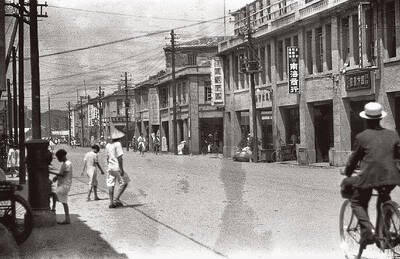
June 1 to June 7 "If all Taiwanese were as afraid of dying as you, then what would happen?” Physician Shih Chiang-nan (施江南) reportedly said this to his wife Chen Chiao-tung (陳焦桐) after she urged him to stop intervening on behalf of Taiwanese soldiers stranded overseas after serving in the Japanese Army during World War II. Shih had clashed with high-ranking officials over the issue, engaged in several heated arguments with Taiwan governor-general Chen Yi (陳儀) and allegedly shouted at general Ko Yuan-fen (柯遠芬), chief of staff of the Taiwan Garrison Command, over

“Taiwan’s Opposition Leader Comes to US With a Message Straight Out of Beijing” read a May 31 headline in the Wall Street Journal. Top US administration officials and members of Congress almost certainly read the WSJ, and if there was a bullet point takeaway that people in Washington should absorb ahead of Chinese Nationalist Party (KMT) Chair Cheng Li-wun’s (鄭麗文) arrival in DC on June 9, that headline is it. The last few columns have discussed this very topic, and the timing is not coincidental. While those top officials likely do not read the Taipei Times, judging by the number


 RSS
RSS