


Two creations by Jan Fabre, an avant-garde artist, choreographer and designer, will be performed this month at Taipei’s Experimental Theater as part of the National Theater Concert Hall’s 2013 World View Series: Belgium.
The 55-year-old Fabre first gained fame in Belgium in the 1970s for what he called his “action” or performance art, such as his Money series in which he collected money from the audience, burned it and then painted with the ashes. He began writing plays about the same time, but he did not establish his theater company, Troubleyn/Jan Fabre, until 1986. In 2007 he established Troubleyn/Laboratorium in Antwerp to expand the scope of his operations.
Many of his productions, whether text or dance-centric are more like installation pieces, what he calls “real time performances.” Fabre says he sees theater as encompassing dialogue as well as dance, music, opera, performance and improvisation. His creations often focus on the body and the taboos of modern society. And while they may verge on the chaotic, they remain centered on discipline and repetition.
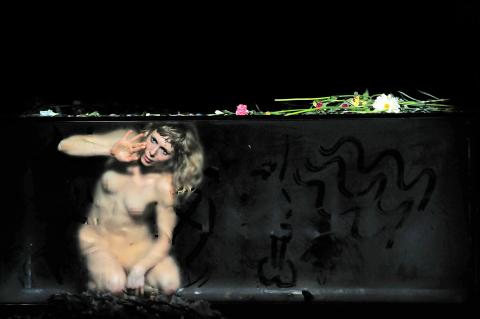
Photo Courtesy of the National Theater Concert Hall
The company’s first production in Taipei will be Preparatio Mortis (死亡練習曲), a 60-minute solo he created in 2010 for French dancer Annabelle Chambon. The work grew out of a 15-minute piece that he had created for Festival of Avignon in 2005. Five years later he expanded the piece into a full-length work for the Festival Romaeuropa in Italy and the Next Festival in Lille, France.
As its title implies, Preparatio Mortis examines modern Western society’s perspective on death — or rather its avoidance of it — and its obsession with life. Fabre has often been quoted as saying that creating art for him means preparing for death.
The stage is set with what appears to be a bank of flowers. After several minutes of darkness, the flowers begin to shift and move as Chambon’s arm appears from underneath them. She eventually emerges, clad only in black bra and panties, from atop clear coffin and dances/moves about in the field of flowers. Her appearance raises the question of whether it is a rebirth or a refusal to succumb to death.
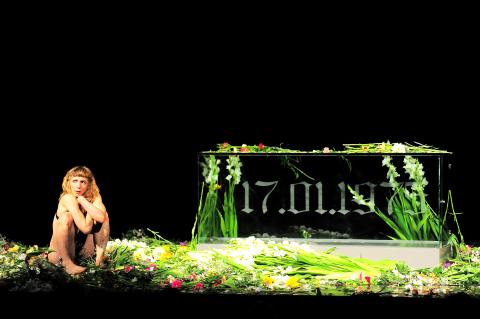
Photo Courtesy of the National Theater Concert Hall
Preparatio Mortis is set to an organ music score by composer and organist Bernard Foccroulle, the director of the Aix-en-Provence opera festival.
A question-and-answer session will follow the Nov. 17 matinee.
Troubleyn’s second production, Drugs Kept Me Alive (藥讓我活下去), begins its four-show run on Nov. 21. It is also a solo work in which death, or the avoidance of it, plays a key part.
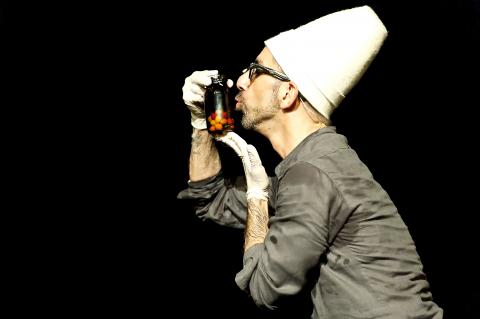
Photo courtesy of the National Theater Concert Hall
Fabre created the piece last year for his long-time friend and former Frankfurt Ballet dancer Antony Rizzi and it recounts the tale of a man battling HIV as he relives his life and fantasies and tries to work out his escape routes.
The bad news for procrastinators is that all four shows are already sold out.
The World Series View: Belgium series concludes next month with Lisbeth Gruwez/Voetvolk, a company made up of dancer Gruwez and composer Maarten Van Cauwenberghe, who are artists in residence at Fabre’s Troubleyn /Laboratorium.
Gruwez will perform It’s Going to Get Worse and Worse and Worse, My Friend (壞到底), a solo set to fragments of a speech by US televangelist Jimmy Swaggart, from Dec. 5 to Dec. 8 in the Experimental Theater.

As mega K-pop group BTS returns to the stage after a hiatus of more than three years, one major market is conspicuously missing from its 12-month world tour: China. The omission of one of the group’s biggest fan bases comes as no surprise. In fact, just the opposite would have been huge news. China has blocked most South Korean entertainment since 2016 under an unofficial ban that also restricts movies and the country’s popular TV dramas. For some Chinese, that means flying to Seoul to see their favorite groups perform — as many were expected to do for three shows opening
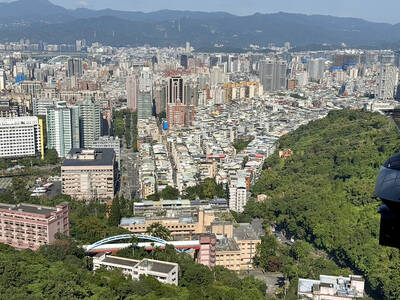
A recent report from the Environmental Management Administration of the Ministry of Environment highlights a perennial problem: illegal dumping of construction waste. In Taoyuan’s Yangmei District (楊梅) and Hsinchu’s Longtan District (龍潭) criminals leased 10,000 square meters of farmland, saying they were going to engage in horticulture. They then accepted between 40,000 and 50,000 cubic meters of construction waste from sites in northern Taiwan, charging less than the going rate for disposal, and dumped the waste concrete, tile, metal and glass onto the leased land. Taoyuan District prosecutors charged 33 individuals from seven companies with numerous violations of the law. This
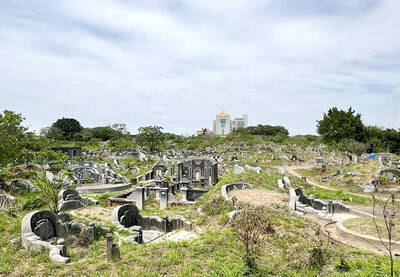
Apr. 13 to Apr. 19 From 17th-century royalty and Presbyterian missionaries to White Terror victims, cultural figures and industrialists, Nanshan Public Cemetery (南山公墓) sprawls across 95 hectares, guarding four centuries of Taiwan’s history. Current estimates show more than 60,000 graves, the earliest dating to 1642. Besides individual tombs, there are also hundreds of family plots, one of which is said to contain around 1,000 remains. As the cemetery occupies valuable land in the heart of Tainan, the government in 2018 began asking families to relocate the graves to make way for development. That
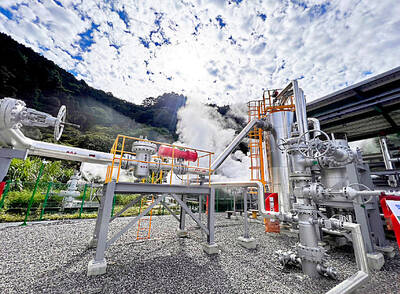
Taiwan’s semiconductor industry consumes electricity at rates that would strain most national grids. Taiwan Semiconductor Manufacturing Co (TSMC) alone accounted for more than 9 percent, or 2,590 megawatts (MW), of the nation’s power demand last year. The factories that produce chips for the world’s phones and servers run around the clock. They cannot tolerate blackouts. Yet Taiwan imports 97 percent of its energy, with liquefied natural gas reserves measured in days. Underground, Taiwan has options. Studies from National Taiwan University estimate recoverable geothermal resources at more than 33,000 MW. Current installed capacity stands below 10 MW. OBSTACLES Despite Taiwan’s significant geothermal potential, the


 RSS
RSS