


Even if you haven’t seen Zone Pro Site (總舖師), you probably know Chen Yu-hsun’s (陳玉勳) work. The acclaimed commercials maker is responsible for iconic characters like Lady Meng Jiang (孟姜女) — who needs cough drops before she can bring down the Great Wall with robust wailing — and the beloved ramen snack girl, Chang Chun-ya (張君雅小妹妹).
Chen, 51, started his career with a stint in filmmaking. He debuted Tropical Fish (熱帶魚) in 1995 and followed up with the less-than-successful Love Go Go (愛情來了) in 1997. Chen then retreated to the territory of television commercials, where he displayed a flair for humorous portraits of the average Jane and Joe, but where he never felt completely fulfilled.
Sixteen years later, Chen has returned to cinema with Zone Pro Site, an excellent comedy revolving around the art of bandoh (辦桌), the traditional Taiwanese outdoor banquet. The movie is poised to become one of the biggest blockbusters of the year, and has drawn rave reviews since it opened over a week ago — not just from critics, but also from the ticket-buying public.
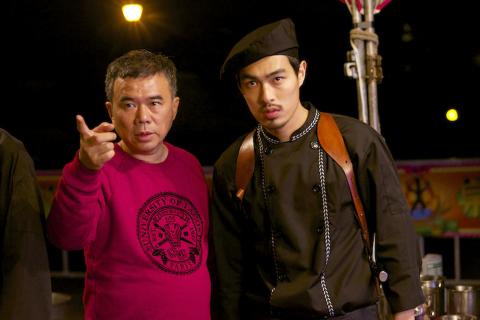
Photo courtesy of Activator Marketing Company
Chen is aware of the audience reaction. “My first two movies were made in the last century when the world had no Facebook and micro-blogging. Now I know how audiences feel and think right away. Everybody sees different things or likes different characters [in the movie]. That to me is the greatest pleasure,” he says.
Serious profession
Like many Taiwanese youngsters, Chen grew up in a family that believed lawyers, doctors, teachers and public servants have the only worthy occupations in the world. He was mostly unhappy as a teen: He didn’t do well at school, fell in love with the music of Pink Floyd, Led Zeppelin and Deep Purple and spent hours imagining himself as a rock star, lying next to a record player in his room.
As a young adult, Chen tried to be serious. He aspired to make respectable arthouse feature films akin to those of the Taiwanese New Wave.
“When people, especially young people, make films, they put a big burden on themselves, hoping that others will take them seriously. If you make serious films, people will respect you. But if you make popular comedies, they think you are shallow,” he notes.
So Chen took an internship at director Wang Hsiao-ti’s (王小棣) studio and got his first job working on the set of Tsai Ming-liang’s (蔡明亮) early television drama. Later, he was admitted into a filmmaking workshop, and had Ang Lee (李安) as his adviser.
“Ang Lee read my script and said it was pretentious,” he says, “but that was what I wanted to do — making films that others thought tasteful and that seemed to have deep meaning.”
It was a three-day experience working on Hou Hsiao-hsien’s (侯孝賢) 1993 The Puppetmaster (戲夢人生) that proved a turning point for the director.
“I saw and learned lots of things from Hou. I realized that even though I love the path he chose, it is not the right path for me. I am more suitable for something fun and goofy,” Chen says.
But being a funnyman is not exactly a noble profession, he says. It took Chen over a decade after meeting Hou to create Zone Pro Site — a public embrace of his destiny as a comedian and not an art-house auteur.
New directions
In today’s grassroots cinema industry, the main challenge is offering audiences something new. Many people had hesitated before going to see Zone Pro Site, possibly because they are tired of its genre, according to Chen.
Since the success of Cape No. 7 (海角七號) in 2008, the local film industry has produced many lookalike movies inspired by local culture and people. “Grassroots movies have repeated themselves, and the viewer doesn’t necessarily approve of them all. Movies ought to be diverse. We should try new things,” the director notes.
If everything goes well with Zone Pro Site, Chen’s next feature film will be a mega-budget martial arts comedy.
The genre of political satire also interests Chen, who has always been outspoken on sociopolitical issues like the Wenlin Yuan (文林苑) urban renewal project and the cross-strait service trade pact. Last year, Chen joined a group of writers, artists and fellow directors including Ko Yi-cheng (柯一正), Leon Dai (戴立忍) and Wu Yi-feng (吳乙峰) in organizing a flash mob on Ketagalan Boulevard (凱達格蘭大道) against nuclear power.
For Chen, fresh ideas come naturally by paying attention to society. He likes to study people, a habit picked up during his compulsory military service. “There were so many interesting people from all walks of life. Some grew vegetables; some painted houses, and some sold fish for a living. Their lives were so different from mine and really fun too,” he recalls.
Regardless of genre, he is the same director — the kind who truly cares about his audience.
“If you don’t care about others, your works will be cold and indifferent, and no one will care about them,” Chen says.

Taiwan’s English education system is being pulled apart by three opposing forces. Bilingual Nation 2030 pulls students toward English and global communication. Artificial Intelligence (AI) readiness pulls them toward digital judgment, verification and AI-mediated work. But Taiwan’s old exam culture pulls them back toward memorization, grammar drills, timed reading and correct answers. If the education system keeps using old exams to define success, it risks producing graduates who are neither genuinely bilingual nor genuinely AI-ready, but trained for tasks machines can already perform. The first force is Bilingual Nation 2030. Launched in 2018, the policy aimed to “help Taiwan’s workforce connect
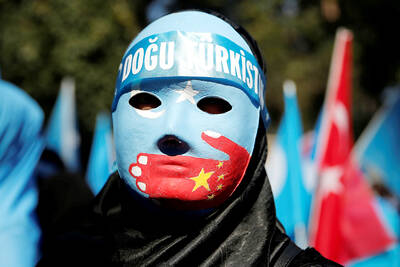
It seems every few days one bumps into one of those “real man” comments in which Taiwan is urged to “face reality” or similar, and “make a deal,” with the speaker implying that soon it will be too late. “Deal” advocates always present themselves as having a superior grip on reality, and the manly ability to make the “hard choice.” Their testosterone-laden language often echoes that of Taiwan sellout advocates. Note that such commentary always specifies a process (“make a deal, work with, make progress”), never the end state of what occupation by a violent authoritarian colonialist state will entail. In
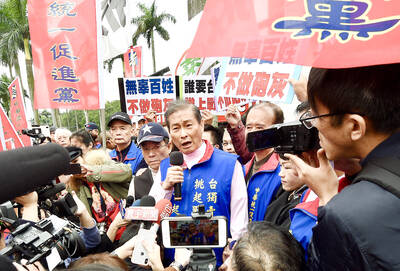
There are shadowy cabals plotting to sell out Taiwan to be annexed by China, by invasion if necessary. Fortunately, they are buffoons. In 2019, former Bamboo Union gangster and founder of the China Unification Promotion Party (CUPP), Chang An-le (張安樂, colorfully known as “White Wolf”), led a protest at the Legislative Yuan against comments made by then-premier Su Tseng-chang (蘇貞昌) that in the event of an attack by China, he would never surrender, but would protect the nation by fighting to the end, even if he only had a broom. Chang had party members bring a wooden casket that they
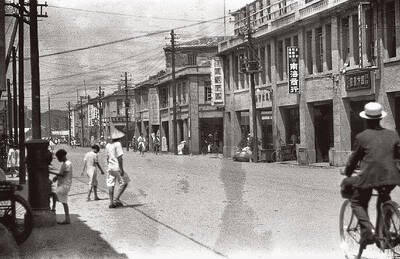
June 1 to June 7 "If all Taiwanese were as afraid of dying as you, then what would happen?” Physician Shih Chiang-nan (施江南) reportedly said this to his wife Chen Chiao-tung (陳焦桐) after she urged him to stop intervening on behalf of Taiwanese soldiers stranded overseas after serving in the Japanese Army during World War II. Shih had clashed with high-ranking officials over the issue, engaged in several heated arguments with Taiwan governor-general Chen Yi (陳儀) and allegedly shouted at general Ko Yuan-fen (柯遠芬), chief of staff of the Taiwan Garrison Command, over


 RSS
RSS