


Skipping school parties, where groups of students sneak out of classes and gather at predetermined destinations, are a rite of passage for almost all high-school students in the West. In the fall of 2009, DJ Dave Nada (real name David Villegas) was asked by his young cousins to deejay at a skipping party. When Nada arrived, he noticed that the intoxicated teens were engrossed in the reggaeton music the DJ was playing, which was at a much slower tempo than the music he planned to play. When he got behind the controller, he slowed down his electro songs to the speed of reggaeton and made all the kids go crazy until the party got too wild and was shut down. Nada had created a musical genre that’s known today as moombahton.
“Moombahton sounds like house music on sizzurp and reggaeton on crack,” Nada said in an e-mail interview with the Taipei Times.“Moombahton music has gotten me more in touch with my Latin roots, as well as introduced me to so many amazing people and music. It’s been an enriching experience and continues to inspire me.”
Nada, who plays at Formoz Festival tonight and Havana pool party tomorrow, got his start as a radio DJ in 2011 at the University of Maryland’s WMUC 88.1FM. He played hardcore punk records on his show and often just hung out at the on-campus studio.

Photo Courtesy of Guru Singh
“I would watch the other DJs’ radio shows that used to spin underground hip-hop, house, and drum and bass,” he said. “That was my first real taste in watching and appreciating the art of deejaying. I was so impressed and wanted to learn. Soon enough, I saved money for turntables and started buying vinyl records. I was obsessed with Afrobeat, funk and soul, so I would try to mix that with hip-hop. I absolutely loved looking for records and mixing them. It was so much fun. Soon enough I felt comfortable enough to play out at parties and I have been hooked ever since.”
With a few years of deejaying Baltimore club music, ghetto house and techno under his belt, Nada got introduced to Matt Nordstrom by DJ Tittsworth and they started working together as Nadastrom.
“Titts felt like we had a lot in common, music wise, and said we should get to know each other,” Nada said. “He was right and ever since then, we have been deejaying together and trading ideas for production.”
Since 2007, Nadastrom has been the focus of Nada’s work. “I don’t really produce just Dave Nada material these days … We are a DJ and production duo and I like to think we have great chemistry in the studio, deejaying and as friends.”
Together, they make Moombahton, that “addictive undeniable groove,” said Nada.
After the party in 2009, Nada realized he was onto something special with his slowed-down electro. He started producing moombahton songs and even got Diplo’s label, Mad Decent, to release an album’s worth of tracks from him and his friends.
The genre caught on quickly and organically, according to Nada. “I know producers, veterans and new kids alike, that were inspired by moombahton and it helped them find their groove as artists. To me, that’s awesome,” said Nada, who today still works in the genre.
“Producers and artists owe it to themselves to make the kind of music they feel inspired to make, regardless of genre. Plus, those that really love moombahton music don’t ever move on from it,” he said.
DJ Dave Nada performs tonight at the Formoz Festival from 1am to 3am near Taipei’s Yuanshan MRT Station (圓山站). Three-day passes are NT$3,600 in advance or NT$3,900 at the venue. Single day tickets are NT$2,500 in advance or NT$2,800 at the door. Nada will be performing Havana pool party tomorrow from noon to 11pm at Happy World Riverside Pool (大新店游泳池), 112-1, Huanhe Rd, New Taipei City (新北市新店區環河路112-1號). Admission is free from noon to 4:00pm. After 4pm, admission is NT$300 for women and NT$400 for men and includes a drink.

Taiwan’s English education system is being pulled apart by three opposing forces. Bilingual Nation 2030 pulls students toward English and global communication. Artificial Intelligence (AI) readiness pulls them toward digital judgment, verification and AI-mediated work. But Taiwan’s old exam culture pulls them back toward memorization, grammar drills, timed reading and correct answers. If the education system keeps using old exams to define success, it risks producing graduates who are neither genuinely bilingual nor genuinely AI-ready, but trained for tasks machines can already perform. The first force is Bilingual Nation 2030. Launched in 2018, the policy aimed to “help Taiwan’s workforce connect

It seems every few days one bumps into one of those “real man” comments in which Taiwan is urged to “face reality” or similar, and “make a deal,” with the speaker implying that soon it will be too late. “Deal” advocates always present themselves as having a superior grip on reality, and the manly ability to make the “hard choice.” Their testosterone-laden language often echoes that of Taiwan sellout advocates. Note that such commentary always specifies a process (“make a deal, work with, make progress”), never the end state of what occupation by a violent authoritarian colonialist state will entail. In

There are shadowy cabals plotting to sell out Taiwan to be annexed by China, by invasion if necessary. Fortunately, they are buffoons. In 2019, former Bamboo Union gangster and founder of the China Unification Promotion Party (CUPP), Chang An-le (張安樂, colorfully known as “White Wolf”), led a protest at the Legislative Yuan against comments made by then-premier Su Tseng-chang (蘇貞昌) that in the event of an attack by China, he would never surrender, but would protect the nation by fighting to the end, even if he only had a broom. Chang had party members bring a wooden casket that they
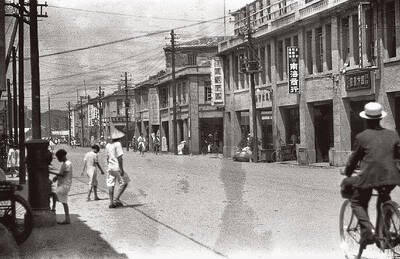
June 1 to June 7 "If all Taiwanese were as afraid of dying as you, then what would happen?” Physician Shih Chiang-nan (施江南) reportedly said this to his wife Chen Chiao-tung (陳焦桐) after she urged him to stop intervening on behalf of Taiwanese soldiers stranded overseas after serving in the Japanese Army during World War II. Shih had clashed with high-ranking officials over the issue, engaged in several heated arguments with Taiwan governor-general Chen Yi (陳儀) and allegedly shouted at general Ko Yuan-fen (柯遠芬), chief of staff of the Taiwan Garrison Command, over


 RSS
RSS