


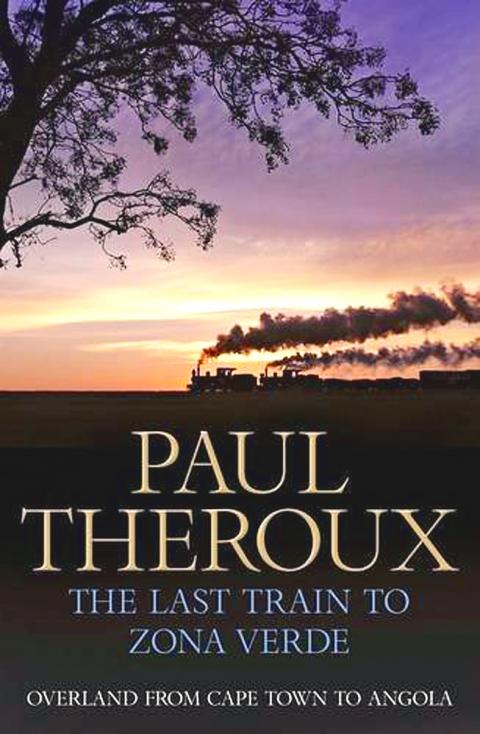
I’ve always been an enormous fan of Paul Theroux. It’s true he sometimes produces a relative dud (A Dead Hand comes to mind), but these are more than made up for by his numerous successes, marked by caustic observations, incisive wit and obsessive truth-telling. Now, at 72, he’s come up with a companion-piece to Dark Star Safari (2002), which saw him travel from Cairo to Cape Town. That time he made his way down Africa’s east side; this time he ventures northwards up the west, from South Africa, through Namibia, into Angola.
From the start, however, there are signs that all may not be well. Theroux repeatedly refers to his age, and in addition displays a time-consuming concern with African words, their meanings and their etymologies. Would he rather be spending his declining years in a library?
In addition, some of the old fire is in short supply. In the opening chapters of The Pillars of Hercules (1995), for example, he spectacularly insults a fellow passenger on a bus, and then a few pages later pens the most insightful analysis of Surrealism I’ve ever read. There isn’t the equal of either display in this new book.
You get the feeling, too, that Theroux is aware of this. He’s constantly girding his loins for a brutal set-piece assault, only to feel the need at the last moment to be reasonable and state both sides of the argument (over the value of aid to Africa, for instance). He’s clearly determined the book shouldn’t go off like a damp squib, but his old compulsion to tell the truth as he sees it tends to bring him nowadays to the reasonable and balanced position.
First he surveys Cape Town, visiting shantytowns and finding that slum-tourism is quite the fashion. He concludes that, despite the ubiquitous African contrast between rich and poor, the place has measurably improved since he was there last.
Then off he sets, riding, true to his old form, on public buses. He talks to all and sundry, stops off to meet up with old contacts, and arrives in Namibia reasonably pleased with what he’s seen. Of course there are slums hidden away behind Namibia’s orderly facade — this is Africa, after all — but nevertheless he understands why a million foreigners visit the country every year. He goes to the coast, to Swakopmund where Brad Pitt and Angelina Jolie went for the birth of their daughter Shiloh in 2006. But the elegance doesn’t stretch far, he discovers, and he soon finds squalor to more than make up for the Weiner schnitzel and loin of springbok.
Back on the road again, he visits an ultra-luxury safari camp where the guests ride African elephants for several thousand US dollars a day. And then, as if forming the journey’s high point, he encounters a sub-group of the African bushmen, the Ju/’hoansi. These, the “earth’s oldest folk,” and the most intensely studied of all tribal peoples anywhere, take him on a bush walk that Theroux also features in the book’s introductory section.
These people, he later reveals, who not so long ago were hunted as “sport” by some South Africans, haven’t in reality been true hunter-gatherers since the 1950s. But they briefly exchange their American baseball hats and T-shirts for animal skins to give tourists a “genuine” experience, and even Theroux initially falls for the ruse.
So the book hasn’t yet found its climax, and Theroux crosses the border into Angola not quite knowing what he’ll find. What he does find, however, gives him just what he needs.
Angola, he writes, is hell on earth. After nearly 30 years of war, in which the Cubans battled the South Africans causing appalling human suffering, the country is now, Theroux thinks, living out a nightmare. Enormously rich in oil, gold and diamonds, it still displays atrocious poverty and deprivation alongside the flamboyant wealth of the few.
Luanda, the capital, is so horrific that Theroux goes into a flat spin. This is what the world will look like when it ends, he prophesizes, taking the hint from a highly literate local. And soon it becomes the archetype for all African cities — “slums of extreme danger and pure horror,” corrupt police, “no plumbing, no clinics, no schools, no security” and the people the victims of vulgarly affluent dictators. Here at last, in other words, is the chance for Theroux to compose his set-piece. Almost no foreigners have written about this country, he says, and compares those who have to doctors who specialize in afflictions of the anus.
Nor does it stop here. The whole world is going to be like this soon, he predicts, because most people now live in cities, and cities are everywhere horrific. What’s the point of traveling at all, he asks in his closing pages. And what, in particular, is the point of traveling further north up Africa’s benighted west coast, into Nigeria, equally oil-rich and equally awful, towards Mali’s Timbuktu, earlier on seen as a possible final destination?
And so it is that Theroux, feeling his age no doubt, but also feeling the dyspepsia characteristic of advancing years, throws in the towel. He never gets to “zona verde” (the Angolan bush). He returns quickly to Cape Town, and thence home to the US. One day, he thinks, he’ll research the ultra-poor of his own country.
It’s a bleak note for Theroux to conclude his 47th book on. The last pages are a crescendo of increasingly general abuse — savaging the colonial record of the Portuguese, offering no hope to endangered species, discovering his credit card had been copied and US$48,000 of debts run up and finally hearing that three of the men he’d befriended on the trip are now dead.
After recently being exposed to what felt like synchronized attempts by both the BBC and CNN to raise the African profile, it was sobering to find Theroux taking such a jaundiced view. Even so, and despite the best of media intentions, I know whose opinion, if I had to choose, I’d in the last analysis really trust.

Taiwan’s English education system is being pulled apart by three opposing forces. Bilingual Nation 2030 pulls students toward English and global communication. Artificial Intelligence (AI) readiness pulls them toward digital judgment, verification and AI-mediated work. But Taiwan’s old exam culture pulls them back toward memorization, grammar drills, timed reading and correct answers. If the education system keeps using old exams to define success, it risks producing graduates who are neither genuinely bilingual nor genuinely AI-ready, but trained for tasks machines can already perform. The first force is Bilingual Nation 2030. Launched in 2018, the policy aimed to “help Taiwan’s workforce connect
It seems every few days one bumps into one of those “real man” comments in which Taiwan is urged to “face reality” or similar, and “make a deal,” with the speaker implying that soon it will be too late. “Deal” advocates always present themselves as having a superior grip on reality, and the manly ability to make the “hard choice.” Their testosterone-laden language often echoes that of Taiwan sellout advocates. Note that such commentary always specifies a process (“make a deal, work with, make progress”), never the end state of what occupation by a violent authoritarian colonialist state will entail. In
June 1 to June 7 "If all Taiwanese were as afraid of dying as you, then what would happen?” Physician Shih Chiang-nan (施江南) reportedly said this to his wife Chen Chiao-tung (陳焦桐) after she urged him to stop intervening on behalf of Taiwanese soldiers stranded overseas after serving in the Japanese Army during World War II. Shih had clashed with high-ranking officials over the issue, engaged in several heated arguments with Taiwan governor-general Chen Yi (陳儀) and allegedly shouted at general Ko Yuan-fen (柯遠芬), chief of staff of the Taiwan Garrison Command, over

“Taiwan’s Opposition Leader Comes to US With a Message Straight Out of Beijing” read a May 31 headline in the Wall Street Journal. Top US administration officials and members of Congress almost certainly read the WSJ, and if there was a bullet point takeaway that people in Washington should absorb ahead of Chinese Nationalist Party (KMT) Chair Cheng Li-wun’s (鄭麗文) arrival in DC on June 9, that headline is it. The last few columns have discussed this very topic, and the timing is not coincidental. While those top officials likely do not read the Taipei Times, judging by the number


 RSS
RSS