


Taipei dance fans are not just spoiled for choice this weekend, they are drowning in it. But what a way to go.
Belgium’s Ultima Vez troupe has taken over the main stage at the National Theater, upstairs in the Experimental Theater. This weekend also marks the start of the National Theater Concert Hall’s (NTCH) New Idea Dance series.
Across town, and an easy ride on the MRT from the Chiang Kai-shek Memorial Station to the Gongguan Station, Dance Forum Taipei (舞蹈空間) has taken over the Taipei City Shuiyuan (Wellspring) Theater (台北市水源劇場) for their latest production, NOs.

Photo Courtesy of NMTH
A fan with the time, money and determination can see all three productions, and it would be worth the effort.
The New Idea Dance series will showcase the work of three up-and-coming choreographers over three weekends. First up is Chen Yun-ju (陳韻如) and her piece, In∞out (呼∞吸).
The 29-year-old Taipei National University of the Arts (TNUA) dance graduate has been bouncing back and forth the past few years between Berlin, Germany, where she dances with the Anhaltisches Theater Dessau, and Taipei, where she has worked with one of her former professors, Ho Hsiao-mei (何曉玫), on several projects.
The Greater Kaohsiung native has been honing her choreographic skills in Germany and at home, with pieces such as the solo Playback and the duet Breathing (呼吸) in Ho’s last two New Choreographer shows. For her work, Chen draws upon a dance background that includes ballet, modern dance and street dance, as well as Aikido.
In∞out is her first full-length piece, but it builds upon last year’s Breathing, again focusing on the act of inhaling and exhaling.
“Breathing is the most important thing in life to me. It is everywhere. I immerse in breathing and that is when I am closest to myself. When I quiet down, let the breathing soothe me, and it just makes me realize the simplicity of life,” Chen says in the program notes.
The piece incorporates live music and dance, with Chen performing along with Liu Yancheng (劉彥成), Berlin-based performer and sound composer Alessio Castellacci and percussionist Coordt Linke, who has worked extensively with Akram Kahn.
Meanwhile, the Taipei Dance Forum is performing NOs, the latest work by its former artistic director and TNUA professor Yang Ming-lung (楊銘隆). Yang’s work has always had a distinctive look that blends East and West, Chinese classicalism and modern dance, with bits of Taichi, Zen and martial arts moves thrown in.
However, Yang often rejects such categorizing, saying in interviews that he sees his work as a return to the basic body structure and principles of physical movement, and that he is simply trying to make dance more organic.
NOs is in three parts — Without a Trace (無蹤), Nameless (無名) and Departed (無間) — and is set to a score of Chinese classical music, including a pipa solo.
Not having access to their Crown Theater home because of Taipei City’s crackdown on building codes, Taipei Dance Forum has picked what appears to be Taipei dance world’s new favorite venue, the Shuiyuan (Wellspring) Theater.
Performance Notes
What: In∞out (呼∞吸)
When: Friday and Saturday at 7:30pm, Saturday and Sunday at 2:30pm
Where: Experimental Theater (國家戲劇院實驗劇場), 21-1 Zhongshan S Rd, Taipei City (台北市中山南路21-1號)
Admission: NT$500; available through NTCH ticketing and online at www.artsticket.com.tw or 7-Eleven ibon kiosks
What: NOs
When: Friday and Saturday at 7:30pm, Sunday at 2:30pm
Where: Taipei City Shuiyuan Theater (台北市水源劇場), 10F, 92, Roosevelt Rd Sec 4, Taipei City (台北市羅斯福路四段92號10樓)
Admission: NT$600; available through NTCH ticketing and online at www.artsticket.com.tw or 7-Eleven ibon kiosks

Taiwan’s English education system is being pulled apart by three opposing forces. Bilingual Nation 2030 pulls students toward English and global communication. Artificial Intelligence (AI) readiness pulls them toward digital judgment, verification and AI-mediated work. But Taiwan’s old exam culture pulls them back toward memorization, grammar drills, timed reading and correct answers. If the education system keeps using old exams to define success, it risks producing graduates who are neither genuinely bilingual nor genuinely AI-ready, but trained for tasks machines can already perform. The first force is Bilingual Nation 2030. Launched in 2018, the policy aimed to “help Taiwan’s workforce connect
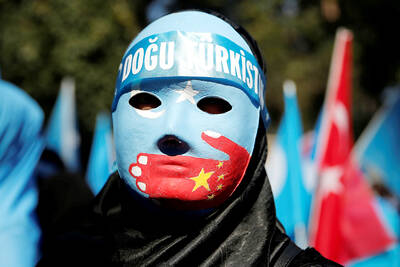
It seems every few days one bumps into one of those “real man” comments in which Taiwan is urged to “face reality” or similar, and “make a deal,” with the speaker implying that soon it will be too late. “Deal” advocates always present themselves as having a superior grip on reality, and the manly ability to make the “hard choice.” Their testosterone-laden language often echoes that of Taiwan sellout advocates. Note that such commentary always specifies a process (“make a deal, work with, make progress”), never the end state of what occupation by a violent authoritarian colonialist state will entail. In

There are shadowy cabals plotting to sell out Taiwan to be annexed by China, by invasion if necessary. Fortunately, they are buffoons. In 2019, former Bamboo Union gangster and founder of the China Unification Promotion Party (CUPP), Chang An-le (張安樂, colorfully known as “White Wolf”), led a protest at the Legislative Yuan against comments made by then-premier Su Tseng-chang (蘇貞昌) that in the event of an attack by China, he would never surrender, but would protect the nation by fighting to the end, even if he only had a broom. Chang had party members bring a wooden casket that they
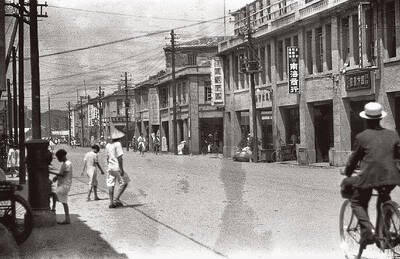
June 1 to June 7 "If all Taiwanese were as afraid of dying as you, then what would happen?” Physician Shih Chiang-nan (施江南) reportedly said this to his wife Chen Chiao-tung (陳焦桐) after she urged him to stop intervening on behalf of Taiwanese soldiers stranded overseas after serving in the Japanese Army during World War II. Shih had clashed with high-ranking officials over the issue, engaged in several heated arguments with Taiwan governor-general Chen Yi (陳儀) and allegedly shouted at general Ko Yuan-fen (柯遠芬), chief of staff of the Taiwan Garrison Command, over


 RSS
RSS