


Mandarin pop king Jay Chou (周杰倫) sees himself as a chef designing the menu for his restaurant.
His latest album, Opus 12, serves up the love ballads for which he’s known and that his fans want. But he’s trying new styles, too.
“There is a continuation of the Chou-styled ballads, R&B songs,” he says, along with using styles he says he hadn’t tried before.

Photo: Pan shao-tang, Taipei times
“It’s like a chef serving up dishes for customers. He needs to continue with what the customers like, while inserting some new ideas,” he said during an interview in Taipei.
Chou’s signature of mixing tradition Chinese sounds with hip hop and R&B shows on tracks like Gong Gong with a Headache and Hong Chen Ke Zhan.
“I’m very pleased to say that I’ve maintained my standard,” he said, adding that Hong Chen Ke Zhan could hold its own against Blue and White Porcelain and Chrysanthemum Terrace.
One of Mandarin pop’s biggest-selling artists, Chou also repeated a call for Chinese media to increase their focus on Mandarin pop rather than K-pop, which has reigned on Asian musical charts in recent years. His remarks were viewed as anti-Korean pop, but Chou clarified that he likes to hear other music and is simply competitive.
“I’m a part of Mandarin pop, so I feel like I have a mission,” he said. “I think it’s good to pay attention to each other’s films or music. Now K-pop is having its moment, but we can’t lose. So I want to call on Mandarin pop singers and say we need to work harder.”
Chou has also debuted a new look: bleached platinum blond hair and a muscular physique that have made him hardly recognizable to fans. He said the reason for the drastic change was that it externally symbolizes his musical reinvention.
“It shows that I can run even faster in my music, surpass my past achievements,” he said. “Because my physique has surpassed my old self, it represents that I’m going to do the same musically.”
Chou admits when people first saw the change they were a bit shocked. “Do musicians need to do that? No, but I wanted to give myself a challenge.”
Opus 12, his 12th album, was released in Asia on Dec. 28, and Chou is currently promoting it in Taiwan, Hong Kong and China.

Taiwan’s English education system is being pulled apart by three opposing forces. Bilingual Nation 2030 pulls students toward English and global communication. Artificial Intelligence (AI) readiness pulls them toward digital judgment, verification and AI-mediated work. But Taiwan’s old exam culture pulls them back toward memorization, grammar drills, timed reading and correct answers. If the education system keeps using old exams to define success, it risks producing graduates who are neither genuinely bilingual nor genuinely AI-ready, but trained for tasks machines can already perform. The first force is Bilingual Nation 2030. Launched in 2018, the policy aimed to “help Taiwan’s workforce connect
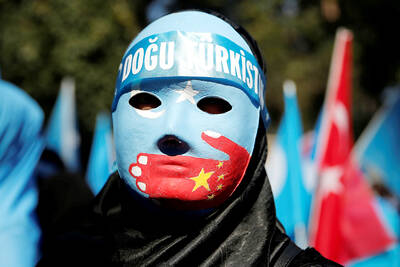
It seems every few days one bumps into one of those “real man” comments in which Taiwan is urged to “face reality” or similar, and “make a deal,” with the speaker implying that soon it will be too late. “Deal” advocates always present themselves as having a superior grip on reality, and the manly ability to make the “hard choice.” Their testosterone-laden language often echoes that of Taiwan sellout advocates. Note that such commentary always specifies a process (“make a deal, work with, make progress”), never the end state of what occupation by a violent authoritarian colonialist state will entail. In

There are shadowy cabals plotting to sell out Taiwan to be annexed by China, by invasion if necessary. Fortunately, they are buffoons. In 2019, former Bamboo Union gangster and founder of the China Unification Promotion Party (CUPP), Chang An-le (張安樂, colorfully known as “White Wolf”), led a protest at the Legislative Yuan against comments made by then-premier Su Tseng-chang (蘇貞昌) that in the event of an attack by China, he would never surrender, but would protect the nation by fighting to the end, even if he only had a broom. Chang had party members bring a wooden casket that they
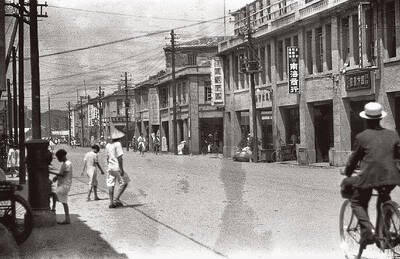
June 1 to June 7 "If all Taiwanese were as afraid of dying as you, then what would happen?” Physician Shih Chiang-nan (施江南) reportedly said this to his wife Chen Chiao-tung (陳焦桐) after she urged him to stop intervening on behalf of Taiwanese soldiers stranded overseas after serving in the Japanese Army during World War II. Shih had clashed with high-ranking officials over the issue, engaged in several heated arguments with Taiwan governor-general Chen Yi (陳儀) and allegedly shouted at general Ko Yuan-fen (柯遠芬), chief of staff of the Taiwan Garrison Command, over


 RSS
RSS