


For eco-artist Vincent J.F. Huang (黃瑞芳), all the world’s a stage — from the beaches of Tuvalu to the conference halls of major climate conferences. This week he’s in Qatar to attend a UN climate conference, where he’s been invited to exhibit his work.
While Taiwan does not have many climate activists working in the international arena, Huang is a climate artist with a vision and he’s out to put his stamp on public awareness issues worldwide. Now in his early 40s, the Nantou County native went overseas to study art in Scotland where he received a master’s degree from Grays School of Art. Huang’s goal is to help wake up the world — and his native Taiwan — about the possible dangers of unchecked climate change and global warming in the future.
With these issues in mind, Huang will travel to Qatar this week to participate in the Qatar Sustainability Expo as part of the UN Conference of the Parties (COP 18), where he will make a plea for more attention to be paid to people of the Pacific island of Tuvalu. In September, Huang visited the island nation where he exhibited some of his works on a picturesque beach and met with government officials.
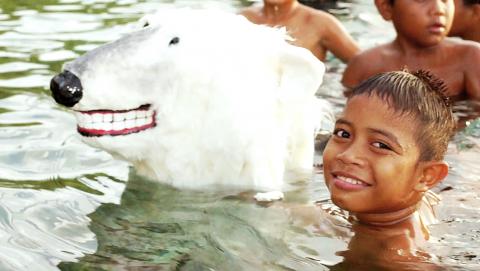
Photo Courtesy of Vincent Huang
Art with impact
In a recent interview with the Taipei Times, Huang said that he felt at home there and came back to Taipei impressed by the people of Tuvalu, and their approach to the environment.
“The government and islanders were both very supportive of my two visits, one in 2010 and one this September, and they appreciated the eco-art projects I created to try to draw more international attention to the situation Tuvalu is facing in regard to climate change and rising sea levels,” Huang said.
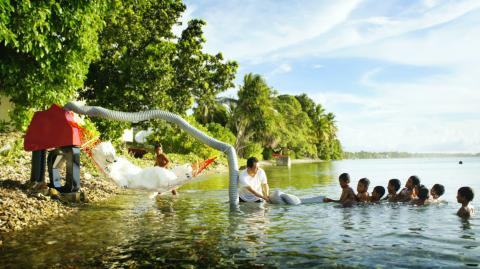
Photo Courtesy of Vincent Huang
When asked what kind of impact he feels his eco-art has on viewers worldwide, Huang said that as an artist, he believes in the power of art to effect change in attitudes.
“The art installations can lead people around the world to not only pay more attention to the crisis Tuvalu is facing on a daily basis, but also to picture more vividly the global problems of climate change,” he said.
Setting up art installations on a remote Pacific island and traveling to Qatar takes time and money. Huang received a travel grant from the Taipei Yuan Shan Rotary Club (台北圓山扶輪社) to fund his two visits to Tuvalu, he said, and for that he’s grateful. Taiwan’s ambassador in Tuvalu, Larry Tseng (曾瑞利), was also very helpful, he said.
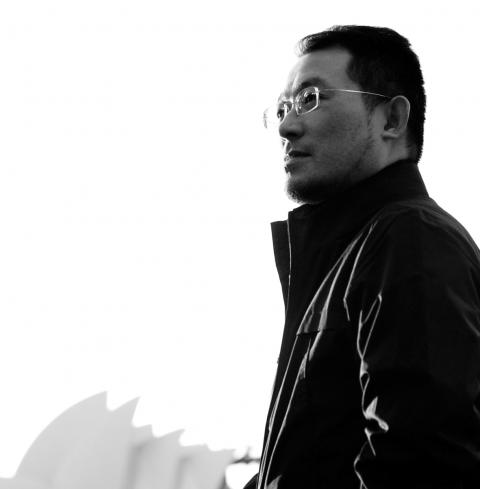
Photo Courtesy of Vincent Huang
However, in general, it’s difficult for independent artists like Huang to get funding in Taiwan since his climate-related works are not for sale or for art collectors.
“It’s ironic that many corporate enterprises here in Taiwan talk a lot about eco-friendly beliefs but very few CEOs want to do things like Britain’s Sir Richard Branson,” Huang said.
“Branson puts his money where his mouth is, and uses his public relations clout and his money to sponsor socially-relevant events and eco-art projects.”
Huang said that most people in Taiwan today don’t believe that what is happening to Tuvalu could ever happen to this island nation. “As an artist, I’m surprised that people here still don’t get it and that is a main reason I am doing my art projects. I want to wake people up in Taiwan, too. We are very much part of the ocean world, too.”
Eco ambassador
When asked how he goes about the time-consuming and arduous task of contacting government officials in a small country like Tuvalu, Huang said he relied on patience and help from the Taiwanese embassy there in conducting what he calls “art diplomacy.”
“My 2010 eco-art project in Tuvalu helped connect me with governmental ministers there, and those connections enabled me to go there again this fall,” he said.
“It took me about 10 months of communicating back and forth via email with Tuvaluan officials and our Taiwanese embassy. Unfortunately, I don’t always succeed with art diplomacy like this, as the government of China tries to interfere.”
Huang was born in 1971 in the small town of Shuili (水里) in Nantou County (南投). When recently asked what led him to pursue the winding path of an artist, Huang said that what really got him going as a young man was the devastating earthquake of September 21, 1999, noting: “The 921 quake destroyed a lot of buildings and homes in Nantou and other counties — and my home, too, was destroyed.
The earthquake made me start to think hard about the relationships between man and nature. As an art major, as a man who wanted to become an artist, I decided I needed to say something about the destructive power of nature through my work.”
Waking people up
When asked whether he considers himself a climate activist or an eco-artist, Huang said he wasn’t looking for a label. “An artist who has an awareness and a sense of responsibility about social or environmental issues takes action to intervene and wake up the world, to act as a bridge on global issues and to offer people a way to see beyond what they normally see in everyday life. I see my job as being to remind people that we are all global citizens who should be aware of and responsible for current and future environmental problems.”
In Tuvalu, Huang set up an installation art piece on a beach that consisted of a fuel truck nozzle tied in a knot. The 4m by 2m artwork also featured an image of a polar bear relaxing in a hammock, symbolizing “the end of the world’s reliance on oil and a move back toward a life of simplicity,” he said.
An earlier project, The Modern Atlantis Project, featured an aquarium installation and revealed his concerns about the excessive use of fossil fuels.
“The closed aquarium symbolized the Earth, our Earth, from which human beings in the name of ‘civilization’ and ‘capitalism’ consume nature freely and limitlessly, and as my project showed, the aquarium itself will gradually be consumed, too,” he said.
Huang said he wanted to present viewers with the idea that our world is doomed if we go on consuming limited natural resources as if there were no tomorrow, greedily and without regard for what life on Earth is all about.
“I’m not a scientist. I’m an artist, so I can’t predict the future in any real way,” he said. “But as an artist who cares about climate change and its impact, I think we need some new approaches to wake people up.”
Vincent Huang’s work will be exhibited at the Doha Exposition Center as part of the Qatar Sustainability Expo from tomorrow until Dec. 7. On the Net: www.qatarsustainability.com
Taiwan has next to no political engagement in Myanmar, either with the ruling military junta nor the dozens of armed groups who’ve in the last five years taken over around two-thirds of the nation’s territory in a sprawling, patchwork civil war. But early last month, the leader of one relatively minor Burmese revolutionary faction, General Nerdah Bomya, who is also an alleged war criminal, made a low key visit to Taipei, where he met with a member of President William Lai’s (賴清德) staff, a retired Taiwanese military official and several academics. “I feel like Taiwan is a good example of
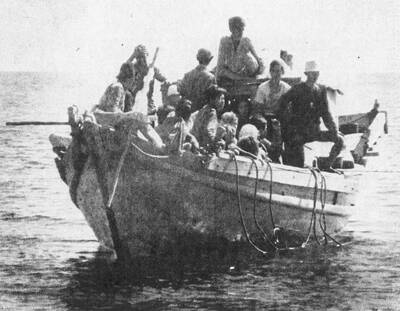
March 2 to March 8 Gunfire rang out along the shore of the frontline island of Lieyu (烈嶼) on a foggy afternoon on March 7, 1987. By the time it was over, about 20 unarmed Vietnamese refugees — men, women, elderly and children — were dead. They were hastily buried, followed by decades of silence. Months later, opposition politicians and journalists tried to uncover what had happened, but conflicting accounts only deepened the confusion. One version suggested that government troops had mistakenly killed their own operatives attempting to return home from Vietnam. The military maintained that the
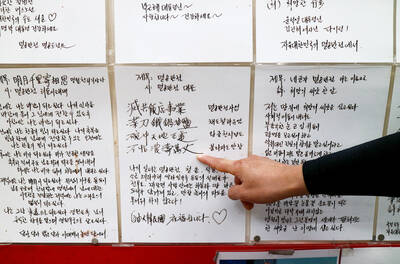
“M yeolgong jajangmyeon (anti-communism zhajiangmian, 滅共炸醬麵), let’s all shout together — myeolgong!” a chef at a Chinese restaurant in Dongtan, located about 35km south of Seoul, South Korea, calls out before serving a bowl of Korean-style zhajiangmian —black bean noodles. Diners repeat the phrase before tucking in. This political-themed restaurant, named Myeolgong Banjeom (滅共飯館, “anti-communism restaurant”), is operated by a single person and does not take reservations; therefore long queues form regularly outside, and most customers appear sympathetic to its political theme. Photos of conservative public figures hang on the walls, alongside political slogans and poems written in Chinese characters; South
Taipei Mayor Chiang Wan-an (蔣萬安) announced last week a city policy to get businesses to reduce working hours to seven hours per day for employees with children 12 and under at home. The city promised to subsidize 80 percent of the employees’ wage loss. Taipei can do this, since the Celestial Dragon Kingdom (天龍國), as it is sardonically known to the denizens of Taiwan’s less fortunate regions, has an outsize grip on the government budget. Like most subsidies, this will likely have little effect on Taiwan’s catastrophic birth rates, though it may be a relief to the shrinking number of


 RSS
RSS