


This weekend, the Commonwealth countries observe Remembrance Day, which falls every year on Nov. 11, to honor those who fought in World War II.
Here in Taiwan, there will also be a series of events to commemorate Allied soldiers who fought in Asia, particularly those imprisoned by the Japanese.
From 1942 to 1945, during its colonial rule, Japan brought more than 4,300 prisoners of war (POW) to Taiwan, interning them in camps across the island.
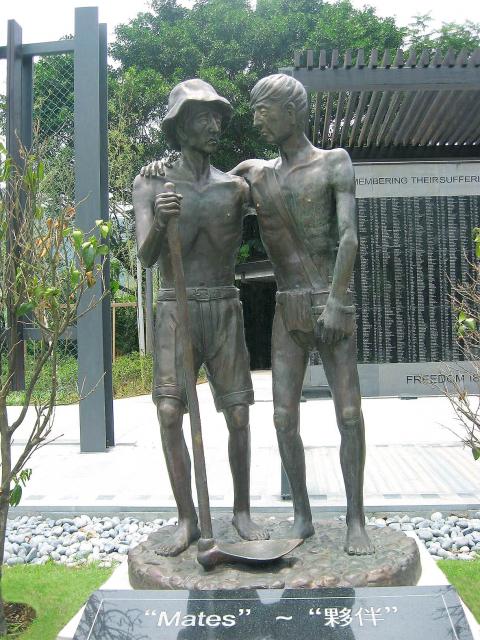
Photo courtesy of taiwan pow camps memorial society
The Taiwan POW Camps Memorial Society is holding its annual commemorative activities this week, which includes a Remembrance Day service on Sunday at the Taiwan Prisoner of War Memorial Park at New Taipei City’s Jinguashih (金瓜石), near Jiufen (九份). The event is being held in cooperation with the New Zealand Commerce and Industry Office.
The Society, founded and run by Canadian expat Michael Hurst, first brought attention to POW camps in Taiwan by successfully campaigning to build the country’s first POW memorial in Jinguashih in 1997.
Since then, Hurst and the society has established contact with more than 300 former POW survivors and their families, and identified and located all 14 of the Japanese-run camps in Taiwan.
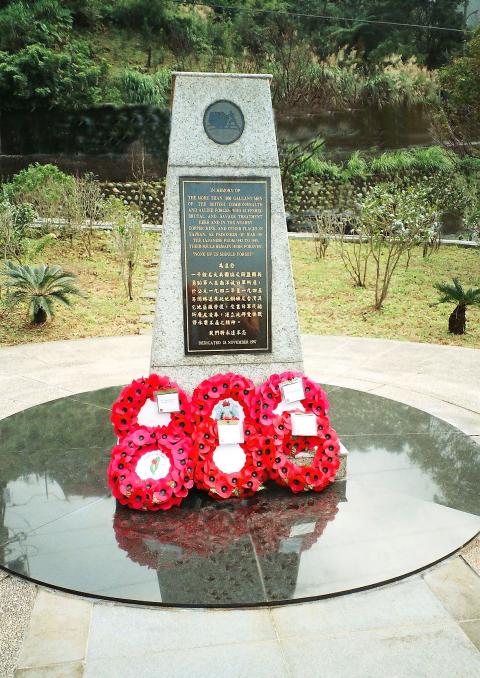
Photo courtesy of taiwan pow camps memorial society
To date, the Society has built seven POW memorials, including a 17m-long memorial wall at Jingguashih, which was inaugurated last year and is inscribed with the names of all POWs who were imprisoned in Taiwan, often under dire conditions.
“That’s what this is all about, making sure their story is told and they’re remembered,” said Hurst, a businessman who has lived in Taiwan for 24 years and is considered the de facto expert on the history of allied POWs in Taiwan.
The event of note this year by the Society will be the unveiling of the Karenko POW Camp Memorial in Hualien on Monday.
Karenko, located at a present-day military base, was used by the Japanese to imprison high-level military officers and government officials representing Allied forces in the region, says Hurst.
Among those prisoners was Merton Beckwith-Smith, a Major-General with the British 18th Division. Members of Beckwith-Smith’s family will be at the ceremony in Hualien on Monday.
At the Karenko camp, the Japanese army subjected the POWs to hard labor and “delighted in humiliating the senior officers,” said Hurst.
And as Japan did not sign the Geneva Convention, those at Karenko were not protected by the treaty’s call for humane treatment of POWs.
“Working them to death, starving them to death, withholding medicine — it was all part of the generic way that the Japanese treated the Allied prisoners of war right from Thailand to Manchuria,” he said.
But healing is very much one of the central aims of the Taiwan POW Camps Memorial Society, says Hurst, who is also in regular contact with Taiwanese veterans who served under the Japanese.
Over the past decade, the Society has escorted POW survivors to the sites of their former imprisonment in Taiwan, but fewer are returning these days as many of the veterans are in their 90s, and are unable to travel.
Hurst has also established friendships with many POWs during his fifteen years of research and involvement with the Society.
“For me, the greatest honors or rewards that I have is having met these heroes, having met these men who overcame these horrific conditions of starvation and brutality, and illness and disease,” he said.
All are welcome to join the dedication ceremony for the Karenko POW Camp Memorial in Hualien on Monday. The ceremony, co-sponsored by the Ministry of Defense, takes place at 2pm at the Ministry of Defense Military Court East Coast Office (國防部北部地方軍事法院檢察署東部檢察官辦公室), located at 643 Jhongjheng Rd, Hualien City (花蓮市中正路643號).
Tomorrow’s Remembrance Day service at Jinguashih takes place at 11am. The event is open to the public, and visitors from Taipei can reach the site by taking the 1062 bus from the Zhongxiao Fuxing MRT Station (忠孝復興捷運站), Exit 1. Fare is NT$95 one-way and travel time is around 90 minutes.
More information on the events, as well as the history of Allied POWs in Taiwan, can be found at www.powtaiwan.org
It seems every few days one bumps into one of those “real man” comments in which Taiwan is urged to “face reality” or similar, and “make a deal,” with the speaker implying that soon it will be too late. “Deal” advocates always present themselves as having a superior grip on reality, and the manly ability to make the “hard choice.” Their testosterone-laden language often echoes that of Taiwan sellout advocates. Note that such commentary always specifies a process (“make a deal, work with, make progress”), never the end state of what occupation by a violent authoritarian colonialist state will entail. In
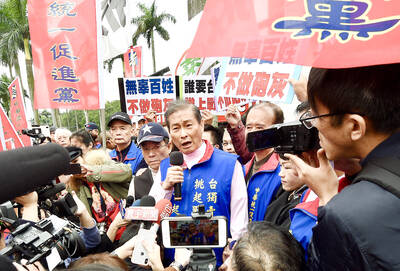
There are shadowy cabals plotting to sell out Taiwan to be annexed by China, by invasion if necessary. Fortunately, they are buffoons. In 2019, former Bamboo Union gangster and founder of the China Unification Promotion Party (CUPP), Chang An-le (張安樂, colorfully known as “White Wolf”), led a protest at the Legislative Yuan against comments made by then-premier Su Tseng-chang (蘇貞昌) that in the event of an attack by China, he would never surrender, but would protect the nation by fighting to the end, even if he only had a broom. Chang had party members bring a wooden casket that they
June 1 to June 7 "If all Taiwanese were as afraid of dying as you, then what would happen?” Physician Shih Chiang-nan (施江南) reportedly said this to his wife Chen Chiao-tung (陳焦桐) after she urged him to stop intervening on behalf of Taiwanese soldiers stranded overseas after serving in the Japanese Army during World War II. Shih had clashed with high-ranking officials over the issue, engaged in several heated arguments with Taiwan governor-general Chen Yi (陳儀) and allegedly shouted at general Ko Yuan-fen (柯遠芬), chief of staff of the Taiwan Garrison Command, over
Food prices have often played a major role in Taiwan’s history. The first major wave of migration from China occurred in 1628. A moderate drought, the Ming Dynasty maritime ban that prohibited fishing and trading (intended to reduce piracy) and a temporary tax, conspired to exhaust local resources, leading to famine in Fujian Province. The famed pirate and trader Zheng Zhilong (鄭芝龍), scooped up starving people from Fujian and transported them across the Taiwan Strait, where they settled under the Dutch. Two factors enabled Zheng. First, by 1624 he had settlements around today’s Beigang (北港) in Yunlin County with a small


 RSS
RSS