


If Taiwan has a national dish, it would very likely be beef noodles. How a dish featuring beef as a central ingredient might become so central to the cuisine of a country that, in the past at least, rarely ate beef, is a story that Jiao Tung (焦桐), one of Taiwan’s foremost food writers, explores in his introduction to Taiwan’s Top Beef Noodles Restaurants (台灣牛肉麵評鑑), his overview of the top beef noodle restaurants in Taiwan.
The book is the result of five years of research by Jiao and a team of 11 critics who have scoured the country for the best beef noodles on the market.
With an estimated 50,000 beef noodle establishments, this is no easy task. It must be said that a random pick of a beef noodle restaurant is unlikely to provide much of a culinary treat, and of the 173 that make it into the book, only eight achieve the highest five star rating, and another 14 the four star rating. Even for a dish as seemingly simple as a bowl of beef noodles, excellence is still a tough ask, and while many establishments try, Jiao Tung clearly feels that all but a few have been found wanting.
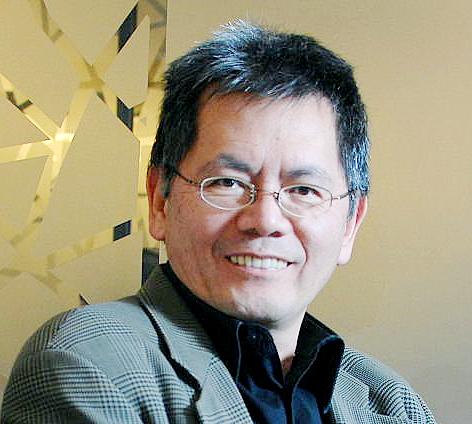
photo courtesy of 2 fishes
Of course, what constitutes a bowl of tasty beef noodles is often a very subjective thing, and inevitably in leafing through the book there seems to be unforgivable omissions or inexplicable ratings. It does not help that beef noodles come in a vast array of preparations, and one might be forgiven for failing to recognize a bowl of beef noodles in clear broth from the fashionable Chef Show Kitchen (阿正廚坊) in Taipei as the same dish as a blood red concoction with pulled noodles from Jiang Tai Tai (江太太牛肉麵店), an old-fashioned outlet in Hualien on Taiwan’s east coast.
For Taiwanese, cattle were a tool of agricultural labor and were seldom eaten. It was the Japanese who first tried to introduce the eating of beef. But it was only when the Nationalists came to Taiwan around 1949 that there was an influx of Chinese from parts of China in which the eating of beef was common.
For a lot of retired soldiers, selling various preparations of a simple convenience food of beef and noodles seemed like an easy way of making a living.
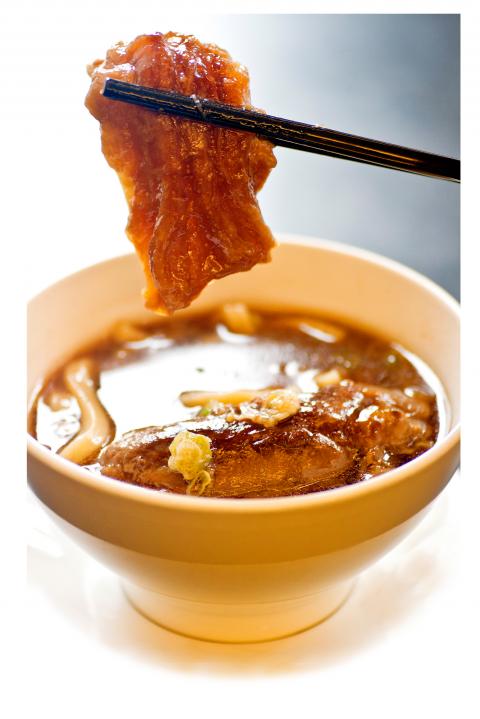
photo courtesy of 2 fishes
For some, the appeal of beef noodles was a mythologized linked to home. The addition of fermented bean paste (豆瓣醬), often with chili, became described as Sichuan-style beef noodles, a label still often seen around Taiwan.
“This dish had never existed in Sichuan,” Jiao Tung said, but went on to suggest that it is this nostalgia for another, far off, or even inaccessible place that gave beef noodles their original appeal.
“Beef noodles are strongly associated with veterans’ villages. This is a very special association, which is redolent of the sense of diaspora, a mood of being an outsider … Beef noodles generate this sense of nostalgia for a far away place, a separateness from the immediate environment. It is a very special nuance; it is a recollection of a hometown of the imagination.
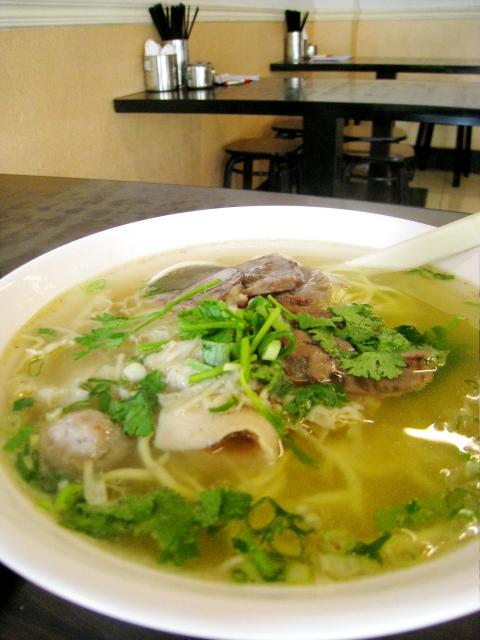
Photo: Ian Bartholomew, Taipei Times
In this sense it is very poetical. Beef noodles are tightly bound up with many currents of cultural change,” Jiao said, explaining why he thought beef noodles were such an important culinary phenomenon in Taiwan.
As to why he decided to write the book assessing the best beef noodle restaurants in Taiwan, he said it came from a sense of profound frustration. “It started as a notebook for my own reference,” Jiao said. “I didn’t trust many of the TV or newspaper reports, for most times I would visit some place recommended in the press, I would find that the beef noodles weren’t that good. I wanted to create a reference I could believe in.”
Jiao’s choice has its idiosyncrasies, and his comments don’t always make it very clear why a particular rating has been applied. Given the huge price range covered by beef noodles (one establishment even has a NT$10,000 bowl), Jiao said his main concern in assessing a bowl of beef noodles was that the price reflected the quality of the ingredients and that it had been made with care.
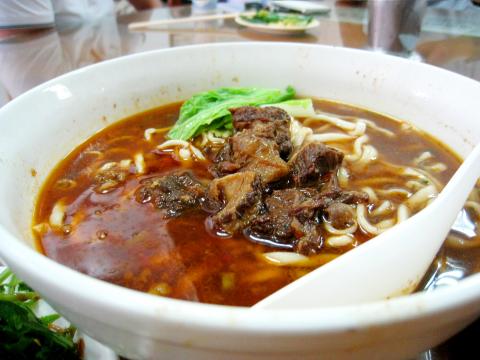
Photo: Ian Bartholomew, Taipei Times
While all of the five star selections are refined establishments, it was nice to see a personal favorite, Lin Dong Fang (林東芳牛肉麵), an extremely grubby and uncomfortable establishment on Taipei’s Bade Road, getting a four star rating for its outstanding flavor and ambiance.
While most beef noodle establishments try to establish a nominal connection with northern China, Jiao’s was also able to incorporate Shang Jia Shiang (尚家香), an establishment which boasts an interesting range of Yunnan style noodle dishes, and whose beef offal in clear broth is a strong competitor in the mid-range of Jiao’s selection.
Jiao said that he had adhered as best he could to anonymous visits by his crew of critics, and Shang Yue-ying (尚月瑩), the proprietress of Shang Jia Shiang told the Taipei Times that she had known nothing about the book until she was invited to the launch. “But of course we couldn’t go as it was during working hours,” she said, clearly delighted to see her establishment up in lights, so to speak.
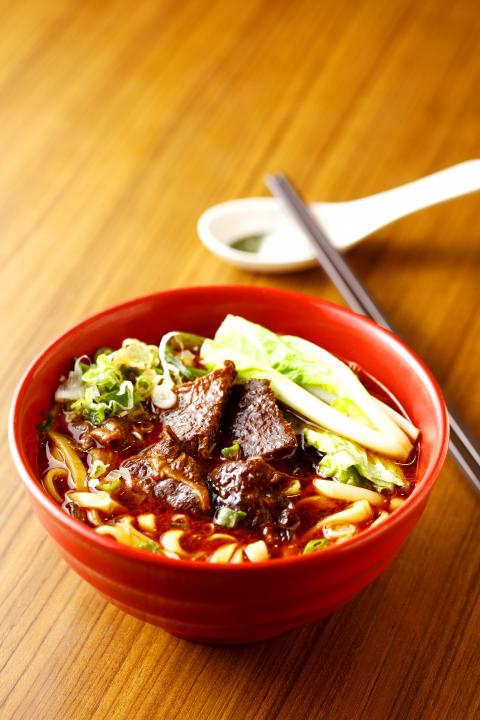
photo courtesy of 2 fishes
No lover of beef noodles will agree with all Jiao’s ratings, but as a starting point for foodies to explore the many establishments, from the luxuriously appointed to the greasy spoon, and from bowls costing NT$500 and up to those priced at NT$80 and down, Taiwan’s Top Beef Noodles Restaurants provides as good a starting point as any.
For non-Chinese readers, Jiao said that he would provide the copyright to the book without charge for the government to publish versions in English and Japanese.
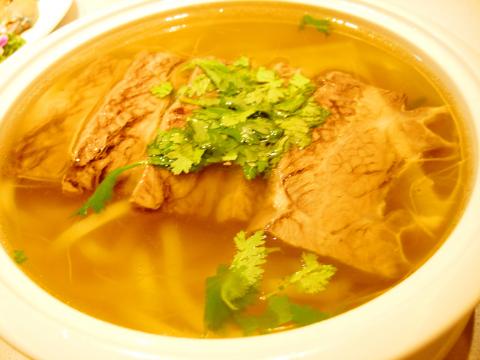
photo courtesy of 2 fishes
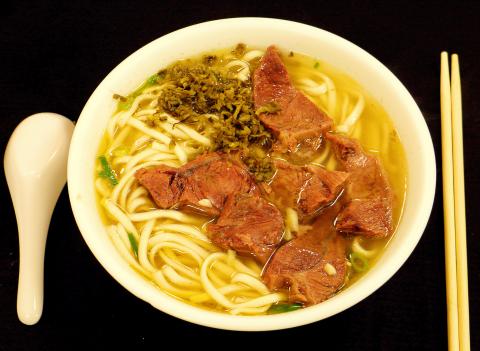
photo courtesy of 2 fishes
It seems every few days one bumps into one of those “real man” comments in which Taiwan is urged to “face reality” or similar, and “make a deal,” with the speaker implying that soon it will be too late. “Deal” advocates always present themselves as having a superior grip on reality, and the manly ability to make the “hard choice.” Their testosterone-laden language often echoes that of Taiwan sellout advocates. Note that such commentary always specifies a process (“make a deal, work with, make progress”), never the end state of what occupation by a violent authoritarian colonialist state will entail. In
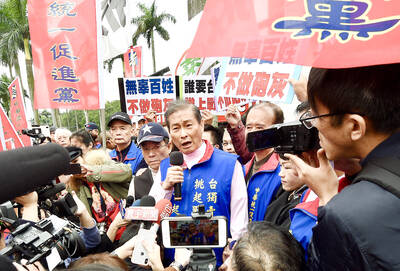
There are shadowy cabals plotting to sell out Taiwan to be annexed by China, by invasion if necessary. Fortunately, they are buffoons. In 2019, former Bamboo Union gangster and founder of the China Unification Promotion Party (CUPP), Chang An-le (張安樂, colorfully known as “White Wolf”), led a protest at the Legislative Yuan against comments made by then-premier Su Tseng-chang (蘇貞昌) that in the event of an attack by China, he would never surrender, but would protect the nation by fighting to the end, even if he only had a broom. Chang had party members bring a wooden casket that they
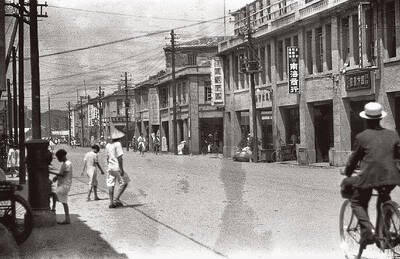
June 1 to June 7 "If all Taiwanese were as afraid of dying as you, then what would happen?” Physician Shih Chiang-nan (施江南) reportedly said this to his wife Chen Chiao-tung (陳焦桐) after she urged him to stop intervening on behalf of Taiwanese soldiers stranded overseas after serving in the Japanese Army during World War II. Shih had clashed with high-ranking officials over the issue, engaged in several heated arguments with Taiwan governor-general Chen Yi (陳儀) and allegedly shouted at general Ko Yuan-fen (柯遠芬), chief of staff of the Taiwan Garrison Command, over

Food prices have often played a major role in Taiwan’s history. The first major wave of migration from China occurred in 1628. A moderate drought, the Ming Dynasty maritime ban that prohibited fishing and trading (intended to reduce piracy) and a temporary tax, conspired to exhaust local resources, leading to famine in Fujian Province. The famed pirate and trader Zheng Zhilong (鄭芝龍), scooped up starving people from Fujian and transported them across the Taiwan Strait, where they settled under the Dutch. Two factors enabled Zheng. First, by 1624 he had settlements around today’s Beigang (北港) in Yunlin County with a small


 RSS
RSS