


Mi Cocina is the latest venture by Rainbow Lin (林虹惠), who wants to offer a more upscale alternative to her long-running Western eatery on Shida Road (師大路), Grandma Nitti’s.
Whatever one may think of Grandma Nitti’s, which has both die-hard fans and detractors, Mi Cocina will feel like a refreshing and welcome change to a neighborhood filled with burger joints and cheap cafes, although this looks to be changing with the recent crackdown on businesses in the Shida area.
Located on Xinhai Road (辛亥路) near Dingzhou Road (汀州路), the restaurant lives up to its Chinese name, “New York Bistro”(紐約小館), for both the decor — simple and stylish — as well as the menu, which is mostly American dishes inspired by French country cooking. It’s basically comfort food, but a bit healthier and a little fancier.
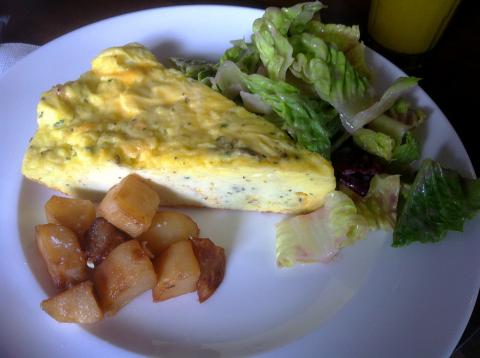
Photo: David Chen, Taipei Times
Another reason that Mi Cocina is worth a visit is its chef, 31-year-old Lisa Nolasco, a New York City native who is responsible for the restaurant’s homemade goodness, and whom patrons will spot working in the open-air kitchen.
On a lunch visit, don’t hesitate to try the roasted pork panini (NT$250). The stringy, tender pork is melt-in-your-mouth delicious, with generous amounts sandwiched between two slices of freshly baked focaccia. Swiss Cheese and a creamy but not-too-full-on sauce made with garlic and jalapeno round out this near-perfect sandwich. Mine could have stayed in the grill half a minute longer (one small portion in the middle was cold), and the side of fries were a tad undercooked and not quite golden enough — but these are minor shortcomings given how tasty the sandwich was.
A return visit with friends for dinner left me more impressed. The menu choices are simple: steak, chicken, fish, rice or pasta, and everything our party of three ordered was well-received. The pan-roasted chicken breast (NT$350) was surprisingly tender. (Nolasco says her trick is simply to cook the chicken on the bone and not to overcook it.) It comes topped with assorted roast vegetables strewn on top and creamy mashed potatoes.
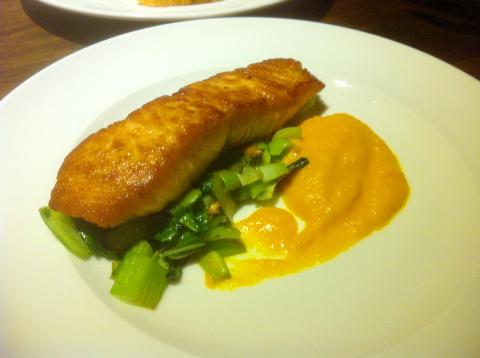
Photo: David Chen, Taipei Times
As much as I liked the chicken, I couldn’t help but envy one of my dining companions for her dinner of pan-seared risotto cakes (NT$280). Though on paper the recipe for this dish is simply what you do with leftover risotto, Mi Cocina does this vegetarian-friendly item right. The risotto is shaped into two small patties and pan-fried on both sides to a golden brown. Nolasco says she was inspired to add this item to the menu after having a local breakfast staple, radish cake (蘿蔔糕). The similarity is apparent in texture — it’s crispy on the outside and soft on the inside. But flavor-wise, it’s a couple of steps ahead of radish cake, with a rich, buttery flavor. It also comes with roasted vegetables on the side.
My other dining companion enjoyed the pan-seared salmon (NT$300), which was cooked just right, judging from the few bites I had. She wasn’t impressed with the accompanying stir-fried bok choy as it seemed a little too commonplace and not quite the right match for salmon, but was impressed with the carrot-ginger puree, which looked gorgeous and had a nice zing.
On Saturday and Sundays, Mi Cocina has a brunch special for NT$300 that includes fresh juice, coffee and a main entree. Choices include lox and bagel, roasted pork panini, French toast and frittata. We had the latter, but were left underwhelmed because it was a little overcooked and, for a quiche-like dish, it felt a bit short on the cheese and vegetable filling.
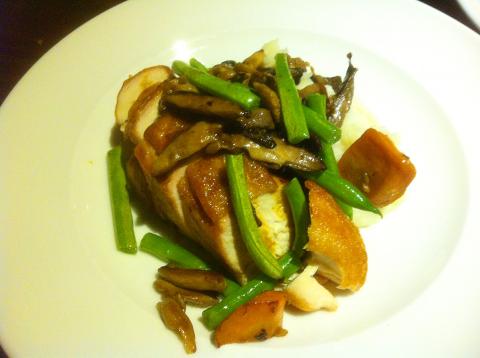
Photo: David Chen, Taipei Times
Your mileage may vary, though, as Nolasco and Lin continue to tinker with the menu and recipes. Since my last visit, there are already new additions to the menu, of which the zucchini lasagna (NT$280) sounds the most enticing. It’s made with pesto, oven-roasted tomatoes and homemade ricotta cheese. Nolasco says the dish is suited to Buddhist vegetarians that abstain from garlic and onions. Another new item that sounds good is the “pan-seared herb-crusted pork tenderloin” (NT$380), which comes with taro root puree and apple and bacon chutney on the side.
The desserts will be familiar to regulars at Lin’s other cafe, My Sweetie Pie, which supplies Mi Cocina’s cakes and pies. Prices average around NT$100 per slice. Mi Cocina’s vibe will also feel familiar — like My Sweetie Pie and Grandma Nitti’s, the restaurant has an outdoor patio — albeit tiny — well-suited for gazing at passersby while having a cup of coffee or glass of beer.

Taiwan’s English education system is being pulled apart by three opposing forces. Bilingual Nation 2030 pulls students toward English and global communication. Artificial Intelligence (AI) readiness pulls them toward digital judgment, verification and AI-mediated work. But Taiwan’s old exam culture pulls them back toward memorization, grammar drills, timed reading and correct answers. If the education system keeps using old exams to define success, it risks producing graduates who are neither genuinely bilingual nor genuinely AI-ready, but trained for tasks machines can already perform. The first force is Bilingual Nation 2030. Launched in 2018, the policy aimed to “help Taiwan’s workforce connect
It seems every few days one bumps into one of those “real man” comments in which Taiwan is urged to “face reality” or similar, and “make a deal,” with the speaker implying that soon it will be too late. “Deal” advocates always present themselves as having a superior grip on reality, and the manly ability to make the “hard choice.” Their testosterone-laden language often echoes that of Taiwan sellout advocates. Note that such commentary always specifies a process (“make a deal, work with, make progress”), never the end state of what occupation by a violent authoritarian colonialist state will entail. In

There are shadowy cabals plotting to sell out Taiwan to be annexed by China, by invasion if necessary. Fortunately, they are buffoons. In 2019, former Bamboo Union gangster and founder of the China Unification Promotion Party (CUPP), Chang An-le (張安樂, colorfully known as “White Wolf”), led a protest at the Legislative Yuan against comments made by then-premier Su Tseng-chang (蘇貞昌) that in the event of an attack by China, he would never surrender, but would protect the nation by fighting to the end, even if he only had a broom. Chang had party members bring a wooden casket that they
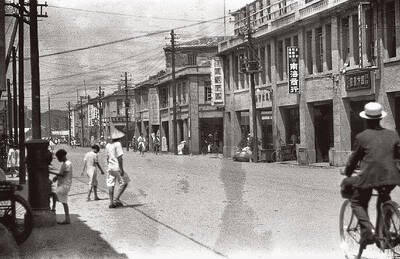
June 1 to June 7 "If all Taiwanese were as afraid of dying as you, then what would happen?” Physician Shih Chiang-nan (施江南) reportedly said this to his wife Chen Chiao-tung (陳焦桐) after she urged him to stop intervening on behalf of Taiwanese soldiers stranded overseas after serving in the Japanese Army during World War II. Shih had clashed with high-ranking officials over the issue, engaged in several heated arguments with Taiwan governor-general Chen Yi (陳儀) and allegedly shouted at general Ko Yuan-fen (柯遠芬), chief of staff of the Taiwan Garrison Command, over


 RSS
RSS