


The tears are often held tremulously back and the many hurts smiled away in First Position, an appealing, largely upbeat documentary about young ballet dancers duking it out, sometimes on point and in tulle, for top honors at the Youth America Grand Prix.
Each year, this prominent competition hands out both actual contracts and more than a quarter of a million dollars in scholarships to dance schools. Soloists, 9 to 19, from Australia to Ukraine have up to two and a half minutes (ensembles have up to six) to wow the judges and perhaps change their lives. In First Position, they have 94 minutes to win you over, first as a group as seemingly alike as the cygnets in Swan Lake, and later as stars.
At center, leaping and turning, are six children, all irresistible and, in their different ways, also heart-melters. There’s the youngest of the bunch, Jules Jarvis Fogarty (then 10), a cheerful Californian who clearly doesn’t care much about his moves, and older contestants like Joan Sebastian Zamora, 16, a thoughtful Colombian who cares so deeply he moved to New York without his family to study. For more than a year, the director, Bess Kargman, followed Jules, Joan and four other children from their homes to their studios while they prepared for the 2010 Grand Prix finals in New York. (The most recent event was in April.) A seventh child, Gaya Bommer Yemini, 11, a charmer from Israel, hovers around the edges.
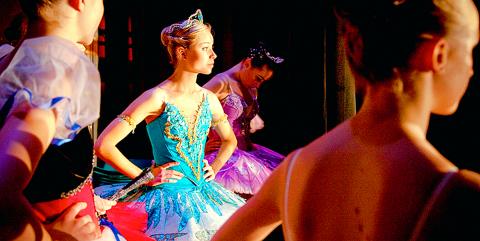
Photo : Bess Kargman/Ifc Films
Several children, including Aran Bell, 11, and Michaela DePrince, 14, could have been spun off into separate documentaries. A wisp of a blond boy and the son of endearingly young, supportive parents (including his military doctor father), Aran captures your attention with his gravity and drops your jaw with his extraordinary physical lightness — he seems untethered by gravity. For her part, Michaela, an orphan from Sierra Leone adopted by older Americans (a quick, somewhat comical introductory shot of a menorah indiscreetly suggests the unsaid), may leave you a puddled mess by the time she finishes telling her story. But it’s how she came to ballet — through the image of a ballerina in an old magazine — that does you in and shows off Kargman’s storytelling instincts.
Kargman’s approach is straightforward, almost matter-of-factly prosaic. Shooting in digital and working with the director of photography Nick Higgins, she tagged after her subjects, traveling across the United States as well as to Europe and Latin America. This gives the movie a sense of depth, as when she follows Joan home to Colombia; but because she chased six different children, ceaselessly cutting from one to another, it also means she could only skim the surface. She’s an efficient filmmaker, however, and using batches of on-screen text and some ruthless editing — the competition dances are, unfortunately, cut down — she manages to create pocket portraits of children whose dedication to their art is by turns inspiring, daunting and, at times, a little frightening.
Children are of course among the most seductive film subjects, inspiring oohs and ahs just by their presence. Wee ones who compete against one another like those in First Position — their little lips trembling with effort, small bodies straining against cruel odds — are even more irresistible, which makes the movie something of a slam dunk when it comes to audience love. This partly explains recent competition-oriented documentaries like Mad Hot Ballroom (about ballroom dance); Spellbound (spelling bee); Whiz Kids (science); Koran by Heart (memorization); and Brooklyn Castle (chess). Given that documentary filmmaking is itself a competitive field, with its makers vying for grants, production money, festival slots, distribution deals, awards and audiences, it’s a subject that is clearly near and dear to the documentarian heart.

Photo : Bess Kargman/Ifc Films
That may explain how Kargman, who danced ballet when she was younger and graduated from Columbia’s Graduate School of Journalism in 2008, was inspired to make First Position. More simply, she has said her curiosity was piqued when she saw a banner for the Grand Prix three years ago. That moment of serendipity led her first to the Grand Prix and one of its founders, Larissa Saveliev. Saveliev liked Kargman’s approach and said, in an article that ran in The New York Times, that filmmakers usually “want to see the fights, the teachers, anorexia,” angles that the Grand Prix was not interested in supporting for a movie. Saveliev also helped Kargman winnow the contestants to find those who would work as documentary subjects.
Saveliev’s participation wasn’t obvious to me from watching First Position — and it should have been. First Position isn’t a sponsored production, which turn some documentaries into veritable advertisements, and it isn’t any less likable as a viewing experience because it was sanctioned by the very organization that coordinates the contest driving these children. Yet by not underscoring Saveliev’s input, Kargman obscured crucial information in a story that she otherwise serves well. And it leaves unanswered whether Saveliev’s involvement accounts for the movie’s aspirational, almost boosterish vibe and why Kargman didn’t include substantive criticisms of ballet competitions, which are, as it turns out, not universally supported in the dance world.

Taiwan’s English education system is being pulled apart by three opposing forces. Bilingual Nation 2030 pulls students toward English and global communication. Artificial Intelligence (AI) readiness pulls them toward digital judgment, verification and AI-mediated work. But Taiwan’s old exam culture pulls them back toward memorization, grammar drills, timed reading and correct answers. If the education system keeps using old exams to define success, it risks producing graduates who are neither genuinely bilingual nor genuinely AI-ready, but trained for tasks machines can already perform. The first force is Bilingual Nation 2030. Launched in 2018, the policy aimed to “help Taiwan’s workforce connect
It seems every few days one bumps into one of those “real man” comments in which Taiwan is urged to “face reality” or similar, and “make a deal,” with the speaker implying that soon it will be too late. “Deal” advocates always present themselves as having a superior grip on reality, and the manly ability to make the “hard choice.” Their testosterone-laden language often echoes that of Taiwan sellout advocates. Note that such commentary always specifies a process (“make a deal, work with, make progress”), never the end state of what occupation by a violent authoritarian colonialist state will entail. In

June 1 to June 7 "If all Taiwanese were as afraid of dying as you, then what would happen?” Physician Shih Chiang-nan (施江南) reportedly said this to his wife Chen Chiao-tung (陳焦桐) after she urged him to stop intervening on behalf of Taiwanese soldiers stranded overseas after serving in the Japanese Army during World War II. Shih had clashed with high-ranking officials over the issue, engaged in several heated arguments with Taiwan governor-general Chen Yi (陳儀) and allegedly shouted at general Ko Yuan-fen (柯遠芬), chief of staff of the Taiwan Garrison Command, over

“Taiwan’s Opposition Leader Comes to US With a Message Straight Out of Beijing” read a May 31 headline in the Wall Street Journal. Top US administration officials and members of Congress almost certainly read the WSJ, and if there was a bullet point takeaway that people in Washington should absorb ahead of Chinese Nationalist Party (KMT) Chair Cheng Li-wun’s (鄭麗文) arrival in DC on June 9, that headline is it. The last few columns have discussed this very topic, and the timing is not coincidental. While those top officials likely do not read the Taipei Times, judging by the number


 RSS
RSS