


Taiwan’s democracy is at risk.
Be very alarmed. This is not a drill.
The current constitutional crisis progressed slowly, then suddenly. Political tensions, partisan hostility and emotions are all running high right when cool heads and calm negotiation are most needed.
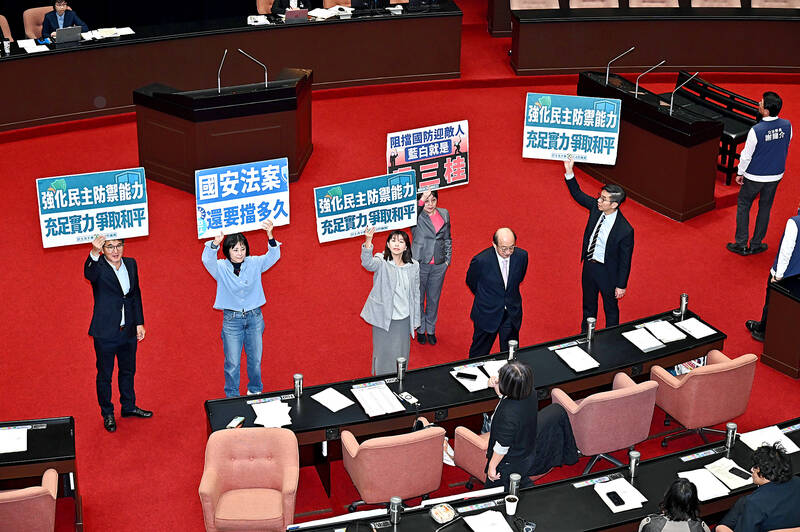
Photo: Tu Chien-jung, Taipei Times
Oxford defines brinkmanship as: “The art or practice of pursuing a dangerous policy to the limits of safety before stopping, especially in politics.” It says the term comes from a quote from a 1956 Cold War interview with then-American Secretary of State John Foster Dulles, when he said: ‘The ability to get to the verge without getting into the war is the necessary art… We walked to the brink and we looked it in the face.’
SETTING THE TRAP
This column examined some of the reasons we got here on Thursday (Dec. 18, page 12) in “Taiwan’s alarming constitutional crisis turns hot.”
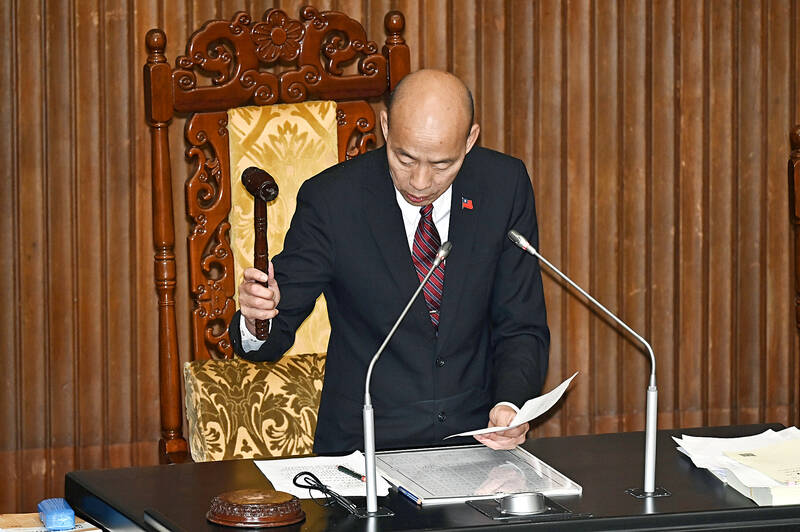
Photo: Tu Chien-jung, Taipei Times
Briefly, last year’s national election saw the re-election of the Democratic Progressive Party (DPP) to the presidency, but majority control of the legislature passed to the pan-blue coalition of the Chinese Nationalist Party (KMT) and their junior partners, the Taiwan People’s Party (TPP).
Until 2016, the legislature was controlled by pan-blue alliances led by the KMT, so that even during the administration of the DPP’s president Chen Shui-bian (陳水扁) they held a powerful check on the executive branch. Like the current legislature and today’s administration under President William Lai (賴清德), the pan-blue alliance worked to hobble the administration as much as they could get away with, without reaching the level of paralysis of state functions that would impact daily lives to such a degree that public opinion would turn against them.
Ideologues in the KMT are deeply opposed to what they consider Chen and Lai’s “dangerous Taiwan independence agenda,” which is similar to — but not identical to — the ideological aims of the Chinese Communist Party (CCP). This group does not want more money spent on the military to avoid “provoking” Beijing and ultimately seek the aim of “national reunification” with China.
Others have a more practical aim; the age-old democratic tactic of tying one’s opposition into knots, then blaming them for their failures.
Stymied by laws intended to expand the power of the legislature being rejected as unconstitutional by the Constitutional Court, the pan-blue bloc passed a law requiring a minimum quorum on the court, then twice rejected the president’s nominees to fill vacancies needed to meet that quorum, which effectively neutered it.
The Lai administration followed the constitution in promulgating the legislature’s laws, including the one regarding the Constitutional Court. What followed were more laws that were constitutionally questionable, but with no court to rule on them, the government was backed into a corner.
For over a year and a half, this struggle continued, and every time the government would promulgate the legislature’s laws.
Finally, the administration felt backed into a corner as a law was passed that was estimated to incur debts that were beyond what the government could legally spend, which would have put them in the situation of having to break one law to fulfill the other, or vice versa. It was a trap.
So the administration pulled a constitutionally questionable move of their own. In one part of the constitution it says the executive must promulgate laws duly passed by the legislature, but in another laws must be countersigned by the premier to reach the president’s desk. Premier Cho Jung-tai (卓榮泰) refused to sign, killing the bill in its tracks.
By this interpretation, the executive branch has an effective veto on any legislation, and with the Constitutional Court out of action, there is no one to overrule their interpretation, and the executive holds the levers of power in implementation.
Cho then essentially dared the opposition to launch a vote of no confidence in the Executive Yuan (aka the Cabinet). This could bring down the cabinet, but the president would then constitutionally be allowed to dissolve the legislature, forcing new elections.
The president backed the premier’s decisions.
Yesterday, the pan-blue alliance struck back, filing a request with the Control Yuan to impeach Cho. This is a curious choice, as they have been opposed to the existence of this oversight branch of government and slashed its budget drastically. Even if successful, most likely Cho will receive a slap on the wrist in the form of fines or reprimands, as they can not bring criminal proceedings — though theoretically they might be able to have Cho removed.
They will also initiate impeachment proceedings against the president in the legislature, which theoretically could remove him, but it will not happen. They must gain the approval of two-thirds of lawmakers before being forwarded to the Constitutional Court to be adjudicated. That would require DPP lawmakers to vote for it. And, of course, they ensured the court can not function.
QUESTION OF INTENT
Did the pan-blue bloc intentionally force the administration to act? That is likely, as it’s impossible to believe that they weren’t aware of the countersignature provision Cho cited.
Until this point, the KMT and TPP have been claiming Lai is a dictator leading an autocratic DPP regime, but with precious little evidence to back this up. The administration has been promulgating their laws, the KMT won the recall elections fairly and their claims of Lai “weaponizing the judiciary” to “shut down” political opponents are weak at best.
Now they have something to point to to back their claims. As KMT Caucus Convener Fu Kun-chi (傅崐萁) put it: “William Lai has made himself emperor. He has shown that he has no regard for public opinion.”
They may be gambling that with public exhaustion at both DPP rule and the constant infighting, they will come out ahead in the blame game.
The DPP was founded on opposing martial law and establishing democracy, and this runs deep in the DNA of the party and is deeply embedded in their public image.
The KMT has used a string of constitutionally questionable laws to ultimately push the DPP into using a constitutionally questionable tactic to fight back — and one backed by the branch of government with full power to execute laws, unlike the legislature.
They know the DPP is held to a higher standard in this regard, and may have calculated that this will blow up in their faces and wreck their brand. The KMT’s antics in the legislature comes across to many as “that’s just the way they are,” and are more forgiving — at least that appears to be what the party is hoping for.
They may also feel the wind is at their back after their wins in the “Great Recall” in the summer that both humbled the DPP and boosted the KMT and TPP in the polls. This calculation also likely propelled the hardline ideologue Cheng Li-wun (鄭麗文) to victory in the KMT party chair race.
Did the pan-blue alliance force this situation for short-term political gain and as an exercise of power? Hopefully, that would leave open the possibility of negotiation.
Do they have a longer-term agenda with the aim of undermining democracy and sowing disunity to set the stage for “national reunification” or even a populist run to restore autocratic rule? Hopefully not, but neither can be entirely ruled out, given the extreme political stances of both Fu and Cheng.
In the next column, we will examine several scenarios as to how this could play out, some peaceful, some ugly.
For now, it appears that brinkmanship over Taiwan’s constitutional democracy is only escalating. Neither side gives the slightest indication they intend to back down.
Brinksmanship stops being brinksmanship the moment it goes over the brink.
The question is: will the nation’s legislators pull back before that happens?
Donovan’s Deep Dives is a regular column by Courtney Donovan Smith (石東文) who writes in-depth analysis on everything about Taiwan’s political scene and geopolitics. Donovan is also the central Taiwan correspondent at ICRT FM100 Radio News, co-publisher of Compass Magazine, co-founder Taiwan Report (report.tw) and former chair of the Taichung American Chamber of Commerce. Follow him on X: @donovan_smith.

Ajay Verma, a consultant gastroenterologist at Kettering general hospital in Northamptonshire, says our gut is a “complex machine.” “It is constantly providing us with the nutrition we need, initially to grow and develop, and then for us to survive, thrive and repair from injury and illness.” How can we keep it functioning well? Put simply: “Make sure what you put into it is balanced, and that you clear out its waste products adequately,” Verma says. “In a general gastroenterology clinic, the most common conditions we see are irritable bowel syndrome (IBS), gastroesophageal reflux disease, inflammatory bowel disease and constipation,” says Nisha
The arithmetic is straightforward and uncomfortable. By the end of 2025, Taiwan had committed itself to a 50-30-20 electricity mix — half natural gas, 30 per cent coal, 20 per cent renewables. The Ministry of Economic Affairs’s (MOEA) own monthly energy reports tell a different story. Natural gas reached 47.8 per cent of generation last year. Coal stood at 35.4 per cent, comfortably above its target ceiling. Renewables came in at 13.1 per cent, well short of the 20 per cent Taipei had pledged a decade earlier. Installed renewable capacity reached roughly half of the 12 gigawatts (GW) the government

Last week US President Donald Trump was asked by a reporter whether he would speak on the phone to the President of Taiwan. “l’ll speak to him. I speak to everybody. We have that situation very well in hand,” Trump said. This marked the second time in a couple of weeks he had said he would talk to the President of Taiwan. In 2016 he famously took a call from then-president Tsai Ing-wen (蔡英文), when he was president-elect. Despite warnings that the apocalypse was nigh because of a phone call, the world quickly forgot about the conversation between two democratically-elected presidents.
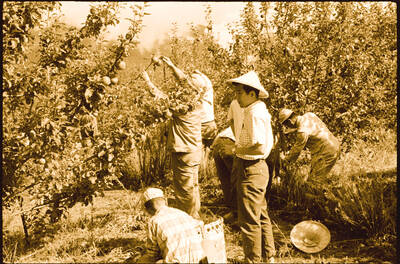
May 25 to May 31 Few believed that apples could be cultivated on a commercial scale in Taiwan’s high mountains. When horticulturalist Cheng Chao-hsiung (程兆熊) first proposed the idea in 1955, both American and Taiwanese colleagues dismissed it as implausible, arguing that temperate fruit could not be reliably grown on a subtropical island, especially on rugged terrain. However, it was this terrain in the Central Mountain Range where many Chinese Civil War veterans were resettled in the late 1950s. With limited job prospects and no family in Taiwan, they were placed on cooperative farms aimed toward self-sufficiency. Some say the conditions


 RSS
RSS