


The humble shopping bag might seem like an unlikely topic for an exhibition, but the Taipei Story House (台北故事館) has turned this ordinary object into a symbol of Taiwan’s cultural and economic development.
The Story of Carrier Bags, which opened on July 7 and runs until Oct 28, takes its inspiration from the Taiwanese custom of carrying a shopping bag or reusable canvas tote along with a purse or satchel.
“We worried at first that people wouldn’t understand why we wanted to do an exhibit devoted to carrier bags, but we found that a lot of people actually enjoy collecting them,” says Jasmine Lee (李揵葳) of the Taipei Story House’s exhibition department. “They might spend a lot of money on a leather bag for holding valuable items, but they reuse shopping bags to carry things like their lunch.”
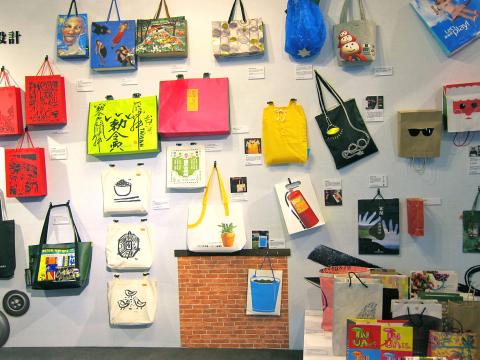
Photo: Catherine Shu, Taipei Times
The exhibit starts with bags woven from the broad leaves of the shell-flower plant or fragrant rushes, with some on loan from the Yuanli Township Triangle Rush Exhibition Hall (苑裡鎮藺草文化館). Weavers incorporated stylish motifs into their totes, including floral patterns and checks. Though the bags are still popular as a fashion accessory, the rush-weaving industry in Taiwan is quickly disappearing as production is outsourced to China.
As Taiwan modernized, more people began to favor bags made from plastic instead of natural materials. Farmers carried seeds and tools in sturdy red, green and blue striped totes called ka-ji a (茄芷) in Hoklo (commonly known as Taiwanese). Ka-ji a have since become emblematic of working class Taiwanese culture. Events like the T.K. Rock Festival (台客搖滾嘉年華) sell small versions of the bags as souvenirs.
Plastic shopping bags with jaunty red and transparent stripes are ubiquitous in night markets and stores, and have also become a symbol of Taiwanese daily life — but at a cost to the environment. The impact of consumerism on the environment is explored in a section of the exhibit featuring bags created by artists and designers.
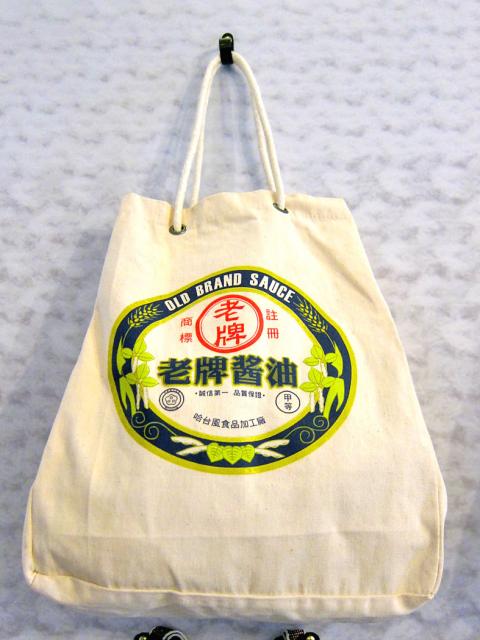
Photo: Catherine Shu, Taipei Times
Some are more conceptual, like 25togo’s bags that have an eyeglass-shaped cutout on one side and can be flipped upside-down and worn as masks. They are a cheeky nod to the bags used by alleged criminals to shield their faces during perp walks.
Other bags were created for practical reasons. The Taoyuan County Fire Bureau commissioned a playful trompe l’oeil bag that makes the person carrying it look as if he or she is hauling along a fire extinguisher. Instructions for the device are printed on the side of the bag, which is made from durable coated paper.
An interactive touchscreen display features photos of pedestrians on the streets of Taipei with carrier bags in tow.
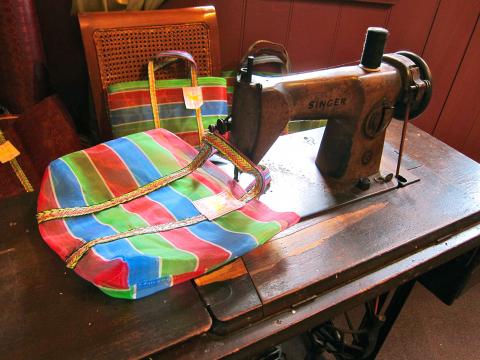
Photo: Catherine Shu, Taipei Times
“We’ll pick an attractive bag to use, even if it’s just to hold our lunch,” says Lee. “In that small way, we show how design and aesthetics have influenced our day-to-day lives.”
Taiwanese companies quickly realized the potential bags offered for free advertising. Shopping bags used in Taiwan during the 1960s and 1970s were covered in colorful, eye-catching graphics. Several are on display in Taipei Story House, including a bag from Far Eastern department store, now known as FE21 (遠東百貨). Hardware stores created sturdy canvas workbags printed with their name and phone number to hand out to customers.
As Taiwan became more prosperous, bags grew increasingly elaborate. The Story of Carrier Bags looks at how different companies use shopping bags to reinforce their brand identity.
Some stores, like Eslite (誠品), issue limited edition bags. Made from fabric or featuring images of works by artists like Cai Guoqiang (蔡國強), these carriers are presented as collectibles.
Even government offices have started creating their own bags, which are used to hold gifts presented to visiting dignitaries. Some of the designs can be surprising. The Pingtung District Court created a chic black canvas handbag covered with its English name spelled out in white sans serif font.
The exhibit’s most popular section turns its focus from marketing to the memories bags hold for their owners. Artists, designers and musicians were asked to lend Taipei Story House purses or totes that carry a special meaning for them. These range from the army kit bag Mandopop singer Sky Wu’s (伍思凱) carried while serving his compulsory military service to a black leather Prada purse that belongs to designer Chen Jun-liang’s (陳俊良) mother.
“Bags are something we all use starting from when we are very young. Each represents a part of our life,” says Sally Chen (陳淑美), a publicist for Taipei Story House. “Each of them contains the story of Taiwan.”

Taiwan’s English education system is being pulled apart by three opposing forces. Bilingual Nation 2030 pulls students toward English and global communication. Artificial Intelligence (AI) readiness pulls them toward digital judgment, verification and AI-mediated work. But Taiwan’s old exam culture pulls them back toward memorization, grammar drills, timed reading and correct answers. If the education system keeps using old exams to define success, it risks producing graduates who are neither genuinely bilingual nor genuinely AI-ready, but trained for tasks machines can already perform. The first force is Bilingual Nation 2030. Launched in 2018, the policy aimed to “help Taiwan’s workforce connect
It seems every few days one bumps into one of those “real man” comments in which Taiwan is urged to “face reality” or similar, and “make a deal,” with the speaker implying that soon it will be too late. “Deal” advocates always present themselves as having a superior grip on reality, and the manly ability to make the “hard choice.” Their testosterone-laden language often echoes that of Taiwan sellout advocates. Note that such commentary always specifies a process (“make a deal, work with, make progress”), never the end state of what occupation by a violent authoritarian colonialist state will entail. In
June 1 to June 7 "If all Taiwanese were as afraid of dying as you, then what would happen?” Physician Shih Chiang-nan (施江南) reportedly said this to his wife Chen Chiao-tung (陳焦桐) after she urged him to stop intervening on behalf of Taiwanese soldiers stranded overseas after serving in the Japanese Army during World War II. Shih had clashed with high-ranking officials over the issue, engaged in several heated arguments with Taiwan governor-general Chen Yi (陳儀) and allegedly shouted at general Ko Yuan-fen (柯遠芬), chief of staff of the Taiwan Garrison Command, over

“Taiwan’s Opposition Leader Comes to US With a Message Straight Out of Beijing” read a May 31 headline in the Wall Street Journal. Top US administration officials and members of Congress almost certainly read the WSJ, and if there was a bullet point takeaway that people in Washington should absorb ahead of Chinese Nationalist Party (KMT) Chair Cheng Li-wun’s (鄭麗文) arrival in DC on June 9, that headline is it. The last few columns have discussed this very topic, and the timing is not coincidental. While those top officials likely do not read the Taipei Times, judging by the number


 RSS
RSS