


The exciting action in the gossip press this week came from the reporters themselves.
For several years, the paparazzi have been trying to nail down photographic evidence of a romance between director Leon Dai (戴立忍) and actress Guey Lun-mei (桂綸鎂). The couple (if they really are an item, that is) have strictly maintained a low profile when it comes to their personal lives.
Popular speculation is that they are staying mum on the romance because of their age difference: Dai, a venerated actor and director, is 45; Guey, Taiwan’s quintessential girl-next-door actress, is 28.

Photo: Liberty Times
Our sister paper, the Liberty Times, came close to getting photos of the two together last week, but wound up having to apologize for a physical altercation between one of its reporters and a garage mechanic.
The paper’s gossip reporters spotted Guey, who had just made an appearance at a promotional event for her latest film Girlfriend, Boyfriend (女朋友.男朋友). They followed Guey, who got into a chauffeured Lexus and was driven to a car garage, where Dai happened to be waiting.
The pair were spotted sitting at a table inside the garage, “talking and laughing” with the owner and his family, who were apparently friends of Dai. But the reporters only got a brief glimpse — a mechanic spotted them and closed the front shutter door.
Naturally, that didn’t deter one of the reporters, who climbed on top of a car parked just outside of the garage to catch a peek through a crack in the roll-down metal door. The garage owner, identified only by his surname of Wu (吳), caught on and came out to confront the reporter (whose name wasn’t given), after which a confrontation ensued.
The rest of the story falls into a murky rehashing of back and forth accusations between the reporter and Dai, speaking on behalf of the garage owner on Facebook — the reporter says Mr. Wu injured his arm and demanded that he hand over his camera; Dai says Mr. Wu’s “oily hands” didn’t allow him to get a grip on the reporter. The police both stepped in to settle the dispute, which ended on a note of “good will,” in the words of a lawyer hired by the Liberty Times reporter.
Still, both sides fired off parting shots. Dai wrote on his Facebook page that he regretted dragging the garage owner and his family through such trouble, all for the sake of an “unscrupulous” reporter.
In its article reporting the incident, the Liberty Times defended the reporter, who was “loyal and dutiful in the pursuit of the facts and had to face conflict,” and asked why Dai had not bothered to acknowledge that Guey was there with him in his Facebook post. After all, the article intoned, enquiring minds had a right to know.
It’s not a good week to be a Taiwanese corporate executive, at least for Far Eastern Airlines (遠東航空) president Chang Kang-wei (張綱維), who has found his name plastered all over the entertainment pages instead of the business section.
Chang has reportedly been having an affair with a flight attendant from his own company. Why did this garner hits in the gossip corners of the Web? Chang has left in the cold his actress/model girlfriend Rachel Shen (沈韋汝). They have a one-year-old son, who Chang hasn’t even seen in six months, according to Shen.
Shen offered an understandably bitter comment after the Apple Daily (蘋果日報) published photos of Chang and his new flight attendant “friend” having dinner and visiting a massage parlor together. “A bar girl wearing makeup isn’t worth waiting around for. He’ll be back to see his child,” she said.

Taiwan’s English education system is being pulled apart by three opposing forces. Bilingual Nation 2030 pulls students toward English and global communication. Artificial Intelligence (AI) readiness pulls them toward digital judgment, verification and AI-mediated work. But Taiwan’s old exam culture pulls them back toward memorization, grammar drills, timed reading and correct answers. If the education system keeps using old exams to define success, it risks producing graduates who are neither genuinely bilingual nor genuinely AI-ready, but trained for tasks machines can already perform. The first force is Bilingual Nation 2030. Launched in 2018, the policy aimed to “help Taiwan’s workforce connect
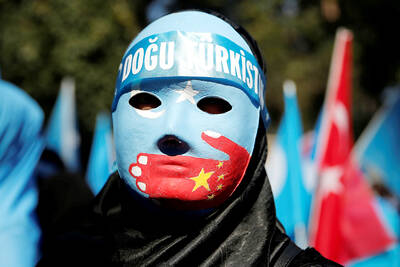
It seems every few days one bumps into one of those “real man” comments in which Taiwan is urged to “face reality” or similar, and “make a deal,” with the speaker implying that soon it will be too late. “Deal” advocates always present themselves as having a superior grip on reality, and the manly ability to make the “hard choice.” Their testosterone-laden language often echoes that of Taiwan sellout advocates. Note that such commentary always specifies a process (“make a deal, work with, make progress”), never the end state of what occupation by a violent authoritarian colonialist state will entail. In
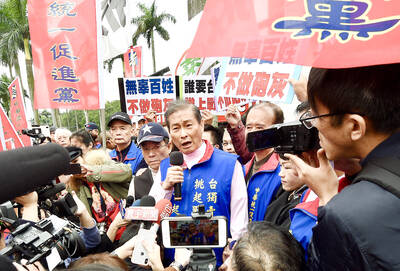
There are shadowy cabals plotting to sell out Taiwan to be annexed by China, by invasion if necessary. Fortunately, they are buffoons. In 2019, former Bamboo Union gangster and founder of the China Unification Promotion Party (CUPP), Chang An-le (張安樂, colorfully known as “White Wolf”), led a protest at the Legislative Yuan against comments made by then-premier Su Tseng-chang (蘇貞昌) that in the event of an attack by China, he would never surrender, but would protect the nation by fighting to the end, even if he only had a broom. Chang had party members bring a wooden casket that they
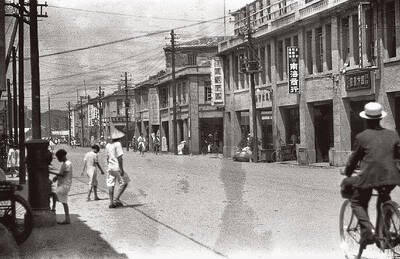
June 1 to June 7 "If all Taiwanese were as afraid of dying as you, then what would happen?” Physician Shih Chiang-nan (施江南) reportedly said this to his wife Chen Chiao-tung (陳焦桐) after she urged him to stop intervening on behalf of Taiwanese soldiers stranded overseas after serving in the Japanese Army during World War II. Shih had clashed with high-ranking officials over the issue, engaged in several heated arguments with Taiwan governor-general Chen Yi (陳儀) and allegedly shouted at general Ko Yuan-fen (柯遠芬), chief of staff of the Taiwan Garrison Command, over


 RSS
RSS