


Tucked away in a lane in Gongguan (公館) close to the intersection of Roosevelt Road and Xinsheng South Road, Yangon (仰光滇緬料理) serves up delicious Burmese-style food with Thai and Yunnan influences. Owner Tsun Dai-hua (寸待華) came to Taiwan more than 30 years ago to study Chinese and liked the country so much that after a stint slicing and dicing at restaurants in Japan, he returned to Taiwan and opened up his restaurant 18 years ago. His family, which hails from Yunnan, fled to Myanmar following the Chinese Civil War.
I’ve eaten at Yangon several times over the years and have never been disappointed by its fresh and spicy food, excellent service and warm interior of terra-cotta tiled floors and dark wood tables. But it’s the restaurant’s fusion of flavors and textures that make it stand out.
Take Yangon’s seafood salad (NT$280), for example, which is more Thai than Burmese, yet doesn’t suffer as a result. Ample portions of cuttlefish, clams and shrimp are mixed with a moderate amount of tomato, onion, cucumber and chopped basil. Served with a tangy homemade chili sauce, the seafood is prepared in such a way as to bring out its different textures — firm slices of the cuttlefish contrasting nicely with the soft shrimp and chewy clams.
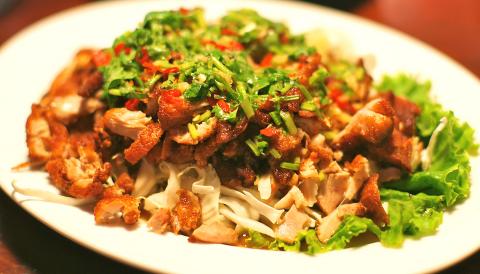
Photo: Noah Buchan, Taipei Times
From firm and soft to moist and crunchy, one bite of the deep-fried chicken with spicy sauce (NT$250) and you’ll understand why it ranks as one of Yangon’s most popular dishes. Not too greasy nor too oily, the chicken breast was juicy on the inside, and crispy outside. Resting on a bed of sliced cabbage and drizzled with a spicy sauce made from cilantro, garlic, ginger, chili and lime, it disappeared from the plate very quickly.
Though it might not be the prettiest dish you’ve ever seen, the flavor of the stir-fried pork (NT$220, NT$230 for chicken, NT$250 for beef) with chili paste more than makes up for its lack of aesthetic appeal. The robust chili taste is tempered by slightly acidic tomato and sweet basil. On previous visits, I’ve tried the steamed lemon perch (NT$380), which was delightfully sour, and fried chicken in coconut cream (NT$230), which I found somewhat oily and rather tasteless — the only disappointing dish I’ve ever had at the restaurant.
Yangon has four lunch specials (NT$120), which include deep-fried chicken with spicy sauce, stir-fried beef in chili paste, fried pork with bamboo shoot and Yunnan-style stir-fried pork with homemade pickles. Lunch specials come with rice, two vegetable dishes, soup and dessert. And for those of you who want to try Tsun’s recipes at home, be sure to pick up a copy of Let’s Eat Burmese Cuisine (來吃滇緬菜), his cookbook published by Kingstone (膳書房).
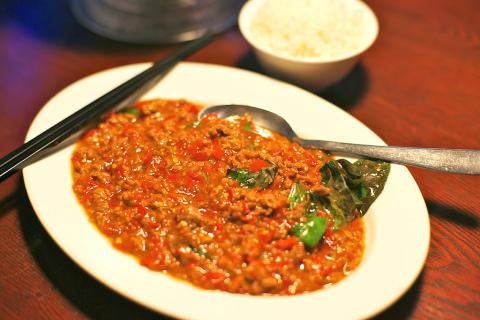
Photo: Noah Buchan, Taipei Times
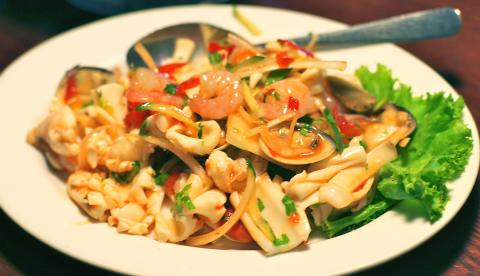
Photo: Noah Buchan, Taipei Times
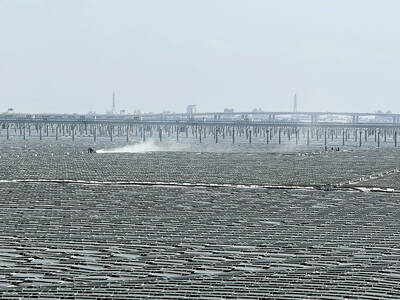
The arithmetic is straightforward and uncomfortable. By the end of 2025, Taiwan had committed itself to a 50-30-20 electricity mix — half natural gas, 30 per cent coal, 20 per cent renewables. The Ministry of Economic Affairs’s (MOEA) own monthly energy reports tell a different story. Natural gas reached 47.8 per cent of generation last year. Coal stood at 35.4 per cent, comfortably above its target ceiling. Renewables came in at 13.1 per cent, well short of the 20 per cent Taipei had pledged a decade earlier. Installed renewable capacity reached roughly half of the 12 gigawatts (GW) the government
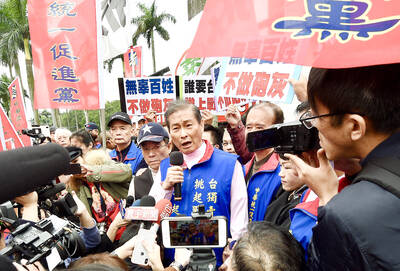
There are shadowy cabals plotting to sell out Taiwan to be annexed by China, by invasion if necessary. Fortunately, they are buffoons. In 2019, former Bamboo Union gangster and founder of the China Unification Promotion Party (CUPP), Chang An-le (張安樂, colorfully known as “White Wolf”), led a protest at the Legislative Yuan against comments made by then-premier Su Tseng-chang (蘇貞昌) that in the event of an attack by China, he would never surrender, but would protect the nation by fighting to the end, even if he only had a broom. Chang had party members bring a wooden casket that they
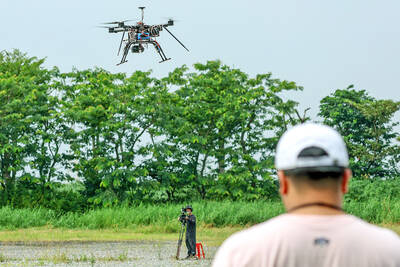
Taiwan’s drone exports are taking off, fuelled by the war in Ukraine, as Taiwanese companies seek a stake in the fast-growing global market for unmanned aerial vehicles (UAV). Low-cost drones used for reconnaissance and strikes are in high demand as governments around the world boost defense spending in the face of intensifying conflicts. A relative new player in the increasingly competitive industry, Taiwan’s pitch is to be an “Asian hub” for the production of UAVs and components free of Chinese materials, or “non-red.” That means its UAVs can be up to three times more expensive than their Chinese competitors, like the world’s biggest
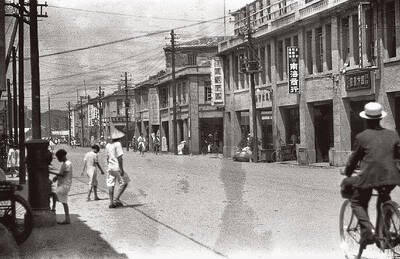
June 1 to June 7 "If all Taiwanese were as afraid of dying as you, then what would happen?” Physician Shih Chiang-nan (施江南) reportedly said this to his wife Chen Chiao-tung (陳焦桐) after she urged him to stop intervening on behalf of Taiwanese soldiers stranded overseas after serving in the Japanese Army during World War II. Shih had clashed with high-ranking officials over the issue, engaged in several heated arguments with Taiwan governor-general Chen Yi (陳儀) and allegedly shouted at general Ko Yuan-fen (柯遠芬), chief of staff of the Taiwan Garrison Command, over


 RSS
RSS