


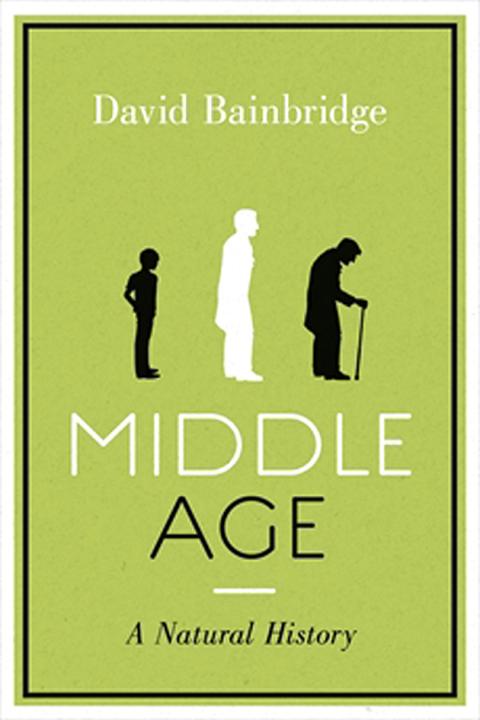
In Western culture middle age is mostly seen as a featureless stopping-off point between the more anguished periods of youth and old age, a dull no man’s land of mild regret and sprouting nasal hair. Unless, that is, you read certain mid-market newspapers. In which case middle age is a cauldron of awfulness, a particular hell made up of women who have left it too late to have a baby and men in sports cars chasing young girls, the two cohorts coming together only to wrangle over the division of the pension pot.
But in this determinedly chirpy book, David Bainbridge wants to show that the years between 40 and 60 actually represent a kind of sunlit upland of “maximal” experience. Yes, we get fatter and slower and less able to read small print (this book is tactfully printed in a large size font). But our bodies stay in pretty good nick: if you get to 40, then you are very likely to get to 60. What’s more, argues Bainbridge in a slightly over-emphatic way, as if talking to someone with early hearing loss, by the time we enter our fifth decade we will have developed cognitive capacities that allow us to think more cleverly than, if not quite as quickly as, we used to at 20. In a culture that depends on harvesting information rather than, say, turnips, this puts middle-aged people in pole position for a really rather lovely life.
All this sounds pretty obvious, if a bit rosy. But Bainbridge teaches veterinary science at Cambridge University and has a more specific point to make. We are, he explains, the only species to experience a distinct plateauing in mid-life, as opposed to the steady wind-down from young adulthood to death experienced by everything from hamsters to elephants. And this, he insists, is thanks to centuries of evolutionary biology.
Our hunter-gathering ancestors did not, as you might have assumed, condemn the occasional person who made it to 35 to a marginal life existing on tribal scraps. Instead, they depended on the graybeards (or at least the salt-and-pepper beards) to organize and lead the all-important hunt for resources. The middle aged may not have been able to outrun the prey, but they were really good at working out where it might be hiding and dividing up the spoils afterwards. These skills turned out to be so useful to the survival of the human race that they became hardwired into the gene code and explain why 45-year-olds are the best people to manage supermarkets, become psychotherapists and even to
run governments.
Given Bainbridge’s day job, he is naturally keen to show that his narrative is grounded in proper science. But while his bibliography includes an impressive list of peer-reviewed articles on subjects such as Ageing and Spatial Acuity of Touch and The Genetic Legacy of the Mongols, none of these specifics appears in the main text. His most over-used phrase must be “studies show,” without any further identifying detail so that we’re rarely told which piece of research he is referring to. The problem, as he would probably be the first to recognize, is that studies can and do show just about anything. His way round this seems to be to offer an argument based on aggregation of the most persuasive sources, but with periodic nods to dissenting evidence (time seems to fly when you’re 50, except when it slows down; middle-aged people are mainly monogamous, apart from when they’re not).
If the broad thrust of the book’s argument doesn’t quite convince, there is still plenty of fascinating detail to scavenge along the way, the sort of thing you could drop into conversation at a middle-aged dinner party when the conversation about the pros and cons of taking statins starts to flag. The fact, for instance, that female painted turtles show no signs of aging at all — their fertility and chances of survival increase as they get older. Or the fact that killer whales are just about the only species apart from humans who have a menopause. Or the way that male chimps prefer to mate with older females. In short, it is when Bainbridge is near his home territory of veterinary science that his book becomes most enlightening. It is when he moves on to human beings and their infinitely more muddled behavior that the book starts to sag, as if it would like to have a nice sit down.
Partly, this is the problem of the popular science genre, which requires a clear take-home message.
Already the author of several popular books, Bainbridge doesn’t seem yet to have found a voice that elegantly bridges the gap between the language of academic and popular science. He veers too far to the arch — at one point using the phrase “dear reader,” for which he should really be shot, even if he is 43 and therefore out of the age band where a man is most likely to meet a violent death. This chumminess is combined with a tic, derived from academic writing, of telling the reader what she is about to be told and then telling her afterwards that she has just been told it. This is particularly irritating given that the book is presumably targeted at the middle aged — the very people who are supposed to have inherited from their ancestors a laser-like ability to spot what really matters in any given situation.
rame>
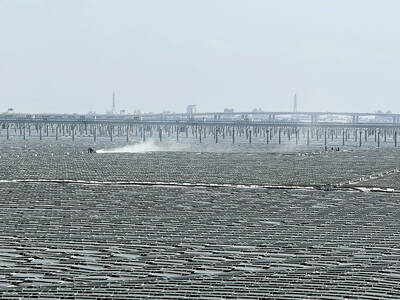
The arithmetic is straightforward and uncomfortable. By the end of 2025, Taiwan had committed itself to a 50-30-20 electricity mix — half natural gas, 30 per cent coal, 20 per cent renewables. The Ministry of Economic Affairs’s (MOEA) own monthly energy reports tell a different story. Natural gas reached 47.8 per cent of generation last year. Coal stood at 35.4 per cent, comfortably above its target ceiling. Renewables came in at 13.1 per cent, well short of the 20 per cent Taipei had pledged a decade earlier. Installed renewable capacity reached roughly half of the 12 gigawatts (GW) the government

There are shadowy cabals plotting to sell out Taiwan to be annexed by China, by invasion if necessary. Fortunately, they are buffoons. In 2019, former Bamboo Union gangster and founder of the China Unification Promotion Party (CUPP), Chang An-le (張安樂, colorfully known as “White Wolf”), led a protest at the Legislative Yuan against comments made by then-premier Su Tseng-chang (蘇貞昌) that in the event of an attack by China, he would never surrender, but would protect the nation by fighting to the end, even if he only had a broom. Chang had party members bring a wooden casket that they
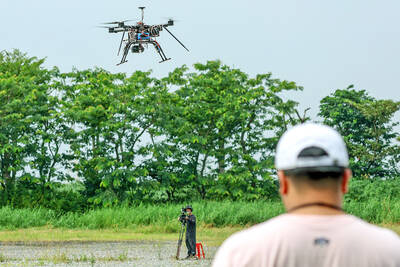
Taiwan’s drone exports are taking off, fuelled by the war in Ukraine, as Taiwanese companies seek a stake in the fast-growing global market for unmanned aerial vehicles (UAV). Low-cost drones used for reconnaissance and strikes are in high demand as governments around the world boost defense spending in the face of intensifying conflicts. A relative new player in the increasingly competitive industry, Taiwan’s pitch is to be an “Asian hub” for the production of UAVs and components free of Chinese materials, or “non-red.” That means its UAVs can be up to three times more expensive than their Chinese competitors, like the world’s biggest
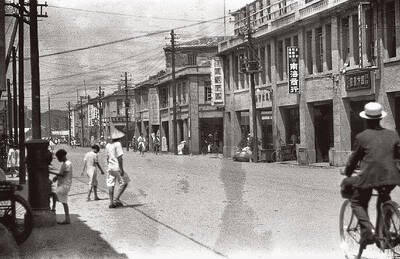
June 1 to June 7 "If all Taiwanese were as afraid of dying as you, then what would happen?” Physician Shih Chiang-nan (施江南) reportedly said this to his wife Chen Chiao-tung (陳焦桐) after she urged him to stop intervening on behalf of Taiwanese soldiers stranded overseas after serving in the Japanese Army during World War II. Shih had clashed with high-ranking officials over the issue, engaged in several heated arguments with Taiwan governor-general Chen Yi (陳儀) and allegedly shouted at general Ko Yuan-fen (柯遠芬), chief of staff of the Taiwan Garrison Command, over


 RSS
RSS