


In early 1997, the then-director of the National Theater Concert Hall asked Cloud Gate Dance Theatre (雲門舞集) founder and artistic director Lin Hwai-min (林懷民) to create a new production in celebration of the hall’s 10th anniversary. The result was Lin’s iconic, yet oft-harrowing, trip down Taiwan’s memory lane, Portrait of the Families (家族合唱).
The company will revive the work, for a second time, in a five-performance run at the National Theater starting on Thursday.
Portrait of the Families was a departure for Lin and Cloud Gate in many ways, with its use of multiple slide projectors to display more than 1,000 old photographs, its use of oral histories in a variety of languages as part of the aural backdrop and a score that mixed beiguan (北管) and nanguan (南管) operatic traditions, Western music and Aboriginal songs.
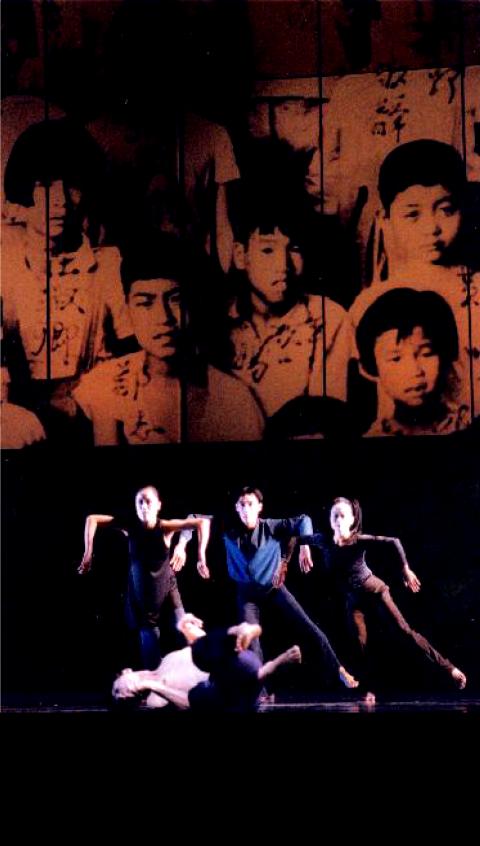
Photo courtesy of Yu Hui-hung
Reviving the piece took more than just digging the set pieces and props out of storage and teaching the troupe’s newer dancers the steps. While the set survived the disastrous fire that destroyed the company’s Bali (八里) home studio and storage facility in 2008, most of the photographs suffered water damage.
“They were stuck together and it took months to restore them. Then we had to go out and replace the ones that were completely lost,” Lin told the Taipei Times in a telephone interview on Monday.
For Lin, the loss of the photos was more than just an artistic disaster. The original photographs came from his own collection, one that he began after seeing a 1994 exhibition of vintage photos in his hometown of Singang (新港), Chiayi County, that traced the people of the town through the last years of China’s Qing Dynasty, the Japanese colonial era, World War II, the arrival of the Chinese Nationalist Party (KMT) government and modern times.
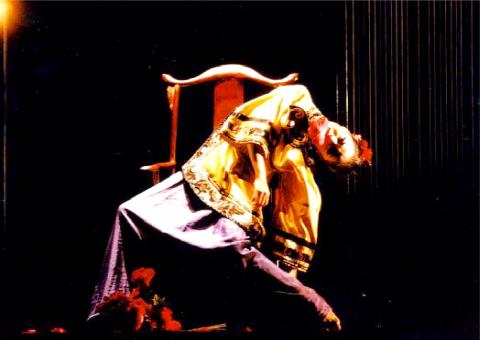
Photo courtesy of Yu Hui-hung
Lin said he had put together his collection from his own family’s photo albums (there are two shots of Lin as a young boy) and secondhand stores. They feature people from all walks of life, including Aborigines, and events such as weddings, formal family portraits and protests. In putting together the original production, he winnowed more than 2,000 photos — including some from archival sources — down to just over 1,000.
Portrait tells the story of Taiwan as seen through the eyes of five main female characters. In an earlier interview, Lin said this was because women usually bear witness to history as their husbands and sons go off to war.
Just as Nine Songs (九歌), Lin’s 1993 journey through life, death and redemption, was inspired by the 1989 Tiananmen Square Massacre, some of Portrait’s most harrowing sections cover the 228 Incident and the resulting White Terror era.
Lin has repeatedly said that Portrait is not political, though he does want to draw attention to photos such as the one from 1947 that shows a burned-out car on Taipei’s Dihua Street (迪化街). The area was “ground zero” for the 228 Incident, when the Taiwan Provincial Monopoly Bureau personnel beat and arrested a cigarette vendor on Feb. 27, 1947, for selling illegal cigarettes, triggering riots and protests against the KMT administration.
Lin also said he didn’t think about the fact that the show premiered just a few months before the nation’s first direct presidential election and that its revival comes just a month before another crucial presidential poll.
“It’s a beautiful coincidence though,” he said. “Especially this time, people aren’t talking about the past. If you don’t review the past, the future is kind of dangerous.”
“When we presented it for a second time in 2003, people kept asking ‘Did you change anything, it’s so beautiful.’ It was just that the first time [1997] people didn’t like it because it was so overwhelming. There were too many messages,” Lin said. “But no, we didn’t change anything, it’s society that has changed.”
“Especially for foreigners, if you want to learn more about Taiwan, then this show will help,” he said, noting that the English-language program includes a transcription of the oral histories that are played during the show.
As he did for Nine Songs, Lin turned to Shanghai-born, US-based designer Ming Cho Lee (李名覺) for the set design for Portraits. However, technology has changed since the first production, and even the 2003 revival.
“In the first production we used 36 slide projectors, now it is all done by computers,” Lin said. “We also rearranged the photos so they flow better to me ... You have to make people see the dancers and see the photos, but then sometimes you have to let the photos speak.”

Taiwan’s English education system is being pulled apart by three opposing forces. Bilingual Nation 2030 pulls students toward English and global communication. Artificial Intelligence (AI) readiness pulls them toward digital judgment, verification and AI-mediated work. But Taiwan’s old exam culture pulls them back toward memorization, grammar drills, timed reading and correct answers. If the education system keeps using old exams to define success, it risks producing graduates who are neither genuinely bilingual nor genuinely AI-ready, but trained for tasks machines can already perform. The first force is Bilingual Nation 2030. Launched in 2018, the policy aimed to “help Taiwan’s workforce connect
It seems every few days one bumps into one of those “real man” comments in which Taiwan is urged to “face reality” or similar, and “make a deal,” with the speaker implying that soon it will be too late. “Deal” advocates always present themselves as having a superior grip on reality, and the manly ability to make the “hard choice.” Their testosterone-laden language often echoes that of Taiwan sellout advocates. Note that such commentary always specifies a process (“make a deal, work with, make progress”), never the end state of what occupation by a violent authoritarian colonialist state will entail. In
June 1 to June 7 "If all Taiwanese were as afraid of dying as you, then what would happen?” Physician Shih Chiang-nan (施江南) reportedly said this to his wife Chen Chiao-tung (陳焦桐) after she urged him to stop intervening on behalf of Taiwanese soldiers stranded overseas after serving in the Japanese Army during World War II. Shih had clashed with high-ranking officials over the issue, engaged in several heated arguments with Taiwan governor-general Chen Yi (陳儀) and allegedly shouted at general Ko Yuan-fen (柯遠芬), chief of staff of the Taiwan Garrison Command, over

“Taiwan’s Opposition Leader Comes to US With a Message Straight Out of Beijing” read a May 31 headline in the Wall Street Journal. Top US administration officials and members of Congress almost certainly read the WSJ, and if there was a bullet point takeaway that people in Washington should absorb ahead of Chinese Nationalist Party (KMT) Chair Cheng Li-wun’s (鄭麗文) arrival in DC on June 9, that headline is it. The last few columns have discussed this very topic, and the timing is not coincidental. While those top officials likely do not read the Taipei Times, judging by the number


 RSS
RSS