


Abstract art is an art of pure forms — the wavy drippings of Jackson Pollock, for example, or Mark Rothko’s rectangles of solid color. Painting of this kind maps the psychic landscape of the artist, and requires no external referent, as a painting of a field or a portrait does. As Pollock once remarked when asked about the content of his work: “I am the subject.”
Viewing abstract art requires that you leave the left side of your brain at the gallery door — or at least suppress that hemisphere’s tendency to analyze things. Questions such as “What does the painting mean?” or “Why is the artist using that particular color?” are less important than engaging in some kind of dialogue with the work that shouldn’t be discursive, but visceral, even transcendent. As such, abstract painting should be as large or larger than the human subject, so that we don’t just look at it but become enveloped by it.
This is precisely the experience I had viewing The Singing River (吟唱的河流), a mural-sized triptych and the largest of 15 remarkably original abstract canvases painted by Wang Su-ling (王淑鈴) on view at Eslite Gallery (誠品畫廊).
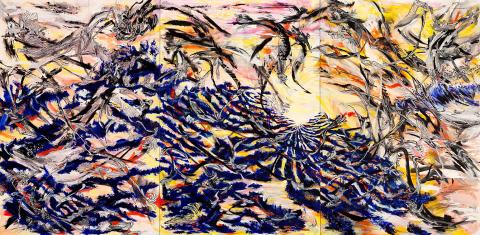
Photo courtesy of Eslite Gallery
A graduate of London’s Royal College of Art, this is Wang’s first solo exhibit in Taiwan — surprising, considering the fact that New York’s Guggenheim Museum and the Museum of Contemporary Art, Los Angeles, among other internationally prominent institutions, have collected and feted her work. For the Taiwan-born, London-based artist, the exhibit is a kind of homecoming after only visiting sporadically since she left in 1993.
Wang’s paintings are bound up in what her sometime collaborator in art and partner in life Daniel Pulman calls a “dehiscence of pictorial form,” or a bursting forth of subconscious visual archetypes onto the canvas. The finished works are a visual feast of memories culled from Taiwan (Wang’s hometown is Cingshuei District (清水區), Greater Taichung) and communicated in an aesthetic idiom culled from East and West.
The Singing River contains all of the elements found in most of the works on display: the philosophical ideas underpinning Taoism and Buddhism as explicated through motifs redolent of Taiwan’s diverse folk culture, the scholarly and contemplative imagery contained in the fluid calligraphic brushstrokes of “mountain-water” painting (山水畫), and the modernist fascination with pure forms, which are the hallmarks of European and American abstraction and abstract expressionism.
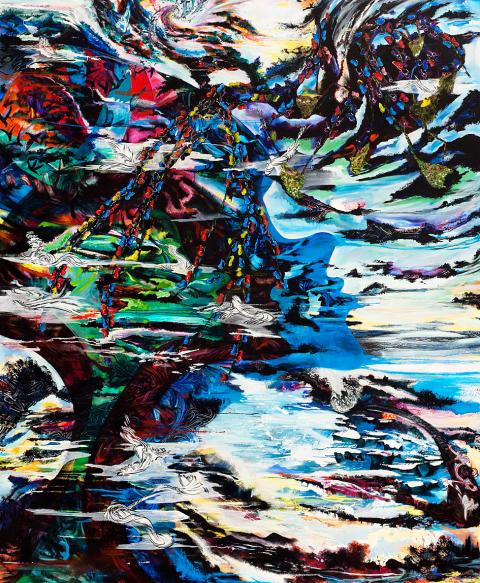
Photo courtesy of Eslite Gallery
Wang invites the viewer into a world pregnant with suggestion. Curvilinear lines rendered in charcoal black evoke face painting from Chinese opera or the Eight Generals (八家將). Dabs of navy blue are built up from the bottom to the center of the canvas, recalling Taiwan’s mountain ranges and those found in Chinese ink painting. In one place the paint’s texture resembles the awesome power of a typhoon; in another, fractured oranges and reds suggest a sunset.
But as with the majority of canvases on display, The Singing River moves beyond mere reminiscence. With its constantly shifting and vaguely discernable clues and layers of opaque meaning, Wang’s paintings are a statement about memory itself.
Equally successful, though for different reasons, is Roots of Home (根源), an architectural installation Wang assembled with Pulman in the gallery space. Constructed using local materials — mud, rice husks, sticky rice, brown sugar, linen — it resembles the disappearing hovels inhabited by farmers in rural Taiwan.
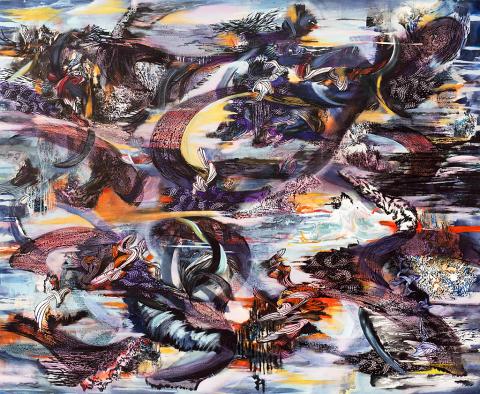
Photo courtesy of Eslite Gallery
A statement about Taiwan’s transformation from an agricultural to an industrial economy, the structure reminds us of objects and lives that have been abandoned to modernity. The placement of burnt branches from a lychee tree in its interior underscores this theme, while bringing to mind the abstract brushstrokes found in the paintings.
There are some canvases that left this viewer unfulfilled. The figurative pretensions of Turning Before the Fields (轉), for example, failed to draw me in. Rather, it concentrated my attention too much on one small detail at the expense of the work overall. Though the bold coloring and suggestive forms that are the hallmarks of Wang’s work are present, so too are a string of butterflies in primary colors. The presence of these insects distracted me with unnecessary sentimentality, which the installation and her other canvases avoid. This, however, is a minor quibble.
Eslite Gallery has become the place in Taipei to view abstract art. Last year’s group show, Variations of Geometric Abstraction in Taiwan’s Contemporary Art (台灣當代幾何抽象藝術的變奏), presented the work of several well-known and emerging Taiwanese artists working in the genre. Wang’s solo show builds on this tradition by introducing the work of an artist in full control of the genre and pointing the way to new ways of experiencing art.
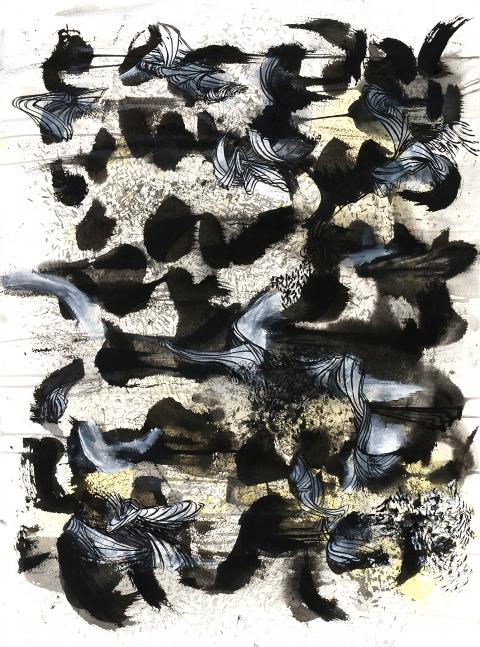
Photo courtesy of Eslite Gallery
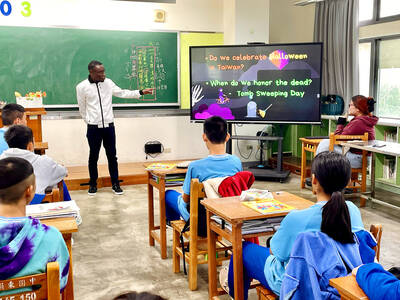
For many people, Bilingual Nation 2030 begins and ends in the classroom. Since the policy was launched in 2018, the debate has centered on students, teachers and the pressure placed on schools. Yet the policy was never solely about English education. The government’s official plan also calls for bilingualization in Taiwan’s government services, laws and regulations, and living environment. The goal is to make Taiwan more inclusive and accessible to international enterprises and talent and better prepared for global economic and trade conditions. After eight years, that grand vision is due for a pulse check. RULES THAT CAN BE READ For Harper Chen (陳虹宇), an adviser
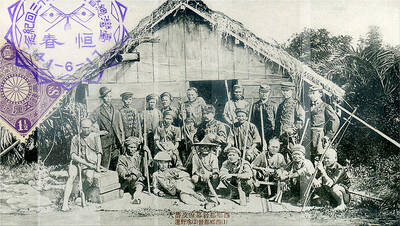
Traditionally, indigenous people in Taiwan’s mountains practice swidden cultivation, or “slash and burn” agriculture, a practice common in human history. According to a 2016 research article in the International Journal of Environmental Sustainability, among the Atayal people, this began with a search for suitable forested slopeland. The trees are burnt for fertilizer and the land cleared of stones. The stones and wood are then piled up to make fences, while both dead and standing trees are retained on the plot. The fences are used to grow climbing crops like squash and beans. The plot itself supports farming for three years.
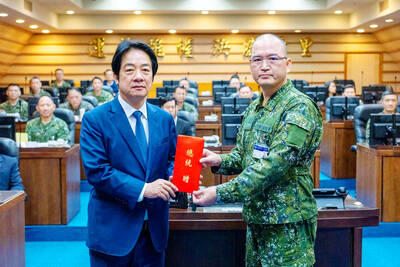
President William Lai (賴清德) on Nov. 25 last year announced in a Washington Post op-ed that “my government will introduce a historic US$40 billion supplementary defense budget, an investment that underscores our commitment to defending Taiwan’s democracy.” Lai promised “significant new arms acquisitions from the United States” and to “invest in cutting-edge technologies and expand Taiwan’s defense industrial base,” to “bolster deterrence by inserting greater costs and uncertainties into Beijing’s decision-making on the use of force.” Announcing it in the Washington Post was a strategic gamble, both geopolitically and domestically, with Taiwan’s international credibility at stake. But Lai’s message was exactly
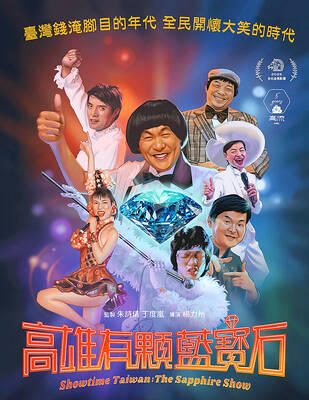
May 4 to May 10 It was once said that if you hadn’t performed at the Sapphire Grand Cabaret (藍寶石大歌廳), you couldn’t truly be considered a star. Taking the stage at the legendary Kaohsiung club was more than just a concert. Performers were expected to entertain in every sense, wearing outlandish or revealing costumes and staying quick on their feet as sharp-tongued, over-the-top hosts asked questions and delivered jokes that would be seen as vulgar, even offensive, by today’s standards. Opening in May 1967 during a period of strict political and social control, Sapphire offered a rare outlet for audiences in


 RSS
RSS