


Downtown Taipei, 2011. “Mushroom’s” boss orders him to deliver a package to an urban development corporation. Failure to do so will result in his termination. He fights his way through narrow and polluted streets packed full of people and vehicles. Stymied by these obstacles, he fails to achieve his goal.
Fast forward to 2050. Same city, same task, but with organized streets and efficient, non-polluting transportation he succeeds, and with time to spare for coffee.
The tales of Mushroom, a comic strip illustrated by Push (the moniker for Chiang Chen-tai, 姜振台), are included in City of Tomorrow — Stories From Today and Tomorrow (also known as Morgenstadt, its German title), an online project launched by the Goethe Institute in Taipei to raise environmental awareness.
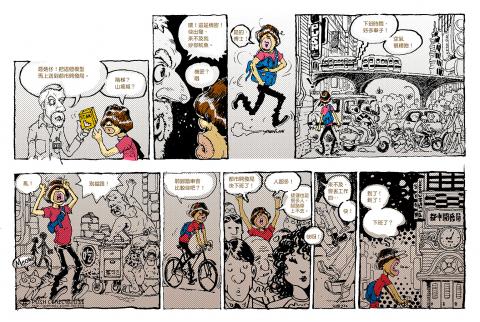
photo courtesy of PUSH Comics, 2011
The institute invited 17 comic artists from Taiwan, China, Japan, Germany and South Korea to draw five strips each that contrast the city they live in now with an imagined future in which “energy efficiency and sustainability have been achieved in all spheres of life,” according to the Web site’s introduction (blog.goethe.de/morgenstadt). The project lasts a year and new comics are posted weekly.
“Comics are a good means of addressing the issue of climate change, sustainability and ecology because it’s well received among the younger generation,” said Markus Wernhard, director of the Goethe Institute in Taipei and the brains behind the project.
Wernhard came up with the idea after reading City of Tomorrow — A Response to Climate Change, a report compiled by Germany’s Federal Ministry of Education and Research that was based on the musings of several German scientists.
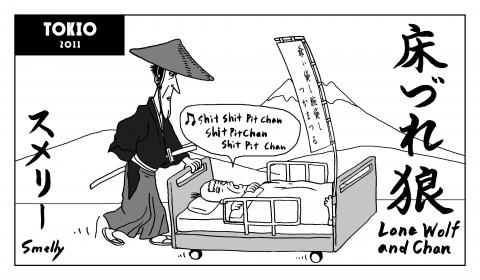
Photo courtesy of smelly
“Not everybody listens to scientists [and] the discourse in the media has become in some way repetitive. Many people just don’t listen anymore. When it comes to climate change or sustainability, they just change channels,” Wernhard said.
The project aims to appeal to Taiwan’s comic-loving public. Beautifully illustrated and largely free of didactic rhetoric (not a surprise coming from artists with names like Smelly, Grizzly Monster and Little Kong), the comics sketch out a future free of today’s environmental anxieties.
The comics range from the wacky to the humorous to the obscure. Japanese artist Smelly (Dai Okazaki), for example, imagines a city named Eco (a play on Edo, the historical name of Tokyo), where people are forbidden to talk because authorities believe it will reduce carbon emissions. Everyone wears face masks and communicates by text message.
“It reflects the empty talk of people who overreact to the issue of climate change,” Wernhard said.
Taiwanese artist Lin Li-chin (林莉菁) foresees a future of clean oceans and sandy beaches, while Chinese artist Coco Wang’s (王可) stark illustrations address China’s overpopulation and one-child policy. Little Kong (Yue Ming, 岳明) creates a boy-meets-girl story — in a vegetarian restaurant.
Wernhard said that bringing together artists from different countries would expose a younger demographic to the issue of sustainability.
“It is something that the younger generation needs to face because it’s their lives, it’s their world, it’s their future,” Wernhard said.
The project’s Web site is available in Chinese, English, German, Japanese and Korean.

Taiwan’s English education system is being pulled apart by three opposing forces. Bilingual Nation 2030 pulls students toward English and global communication. Artificial Intelligence (AI) readiness pulls them toward digital judgment, verification and AI-mediated work. But Taiwan’s old exam culture pulls them back toward memorization, grammar drills, timed reading and correct answers. If the education system keeps using old exams to define success, it risks producing graduates who are neither genuinely bilingual nor genuinely AI-ready, but trained for tasks machines can already perform. The first force is Bilingual Nation 2030. Launched in 2018, the policy aimed to “help Taiwan’s workforce connect
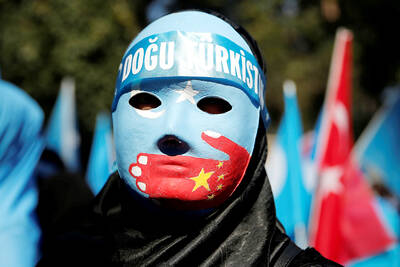
It seems every few days one bumps into one of those “real man” comments in which Taiwan is urged to “face reality” or similar, and “make a deal,” with the speaker implying that soon it will be too late. “Deal” advocates always present themselves as having a superior grip on reality, and the manly ability to make the “hard choice.” Their testosterone-laden language often echoes that of Taiwan sellout advocates. Note that such commentary always specifies a process (“make a deal, work with, make progress”), never the end state of what occupation by a violent authoritarian colonialist state will entail. In
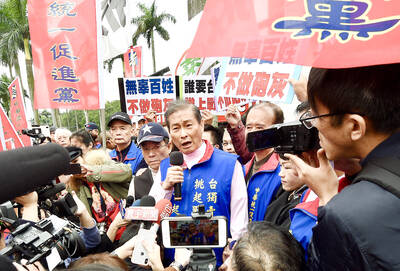
There are shadowy cabals plotting to sell out Taiwan to be annexed by China, by invasion if necessary. Fortunately, they are buffoons. In 2019, former Bamboo Union gangster and founder of the China Unification Promotion Party (CUPP), Chang An-le (張安樂, colorfully known as “White Wolf”), led a protest at the Legislative Yuan against comments made by then-premier Su Tseng-chang (蘇貞昌) that in the event of an attack by China, he would never surrender, but would protect the nation by fighting to the end, even if he only had a broom. Chang had party members bring a wooden casket that they
June 1 to June 7 "If all Taiwanese were as afraid of dying as you, then what would happen?” Physician Shih Chiang-nan (施江南) reportedly said this to his wife Chen Chiao-tung (陳焦桐) after she urged him to stop intervening on behalf of Taiwanese soldiers stranded overseas after serving in the Japanese Army during World War II. Shih had clashed with high-ranking officials over the issue, engaged in several heated arguments with Taiwan governor-general Chen Yi (陳儀) and allegedly shouted at general Ko Yuan-fen (柯遠芬), chief of staff of the Taiwan Garrison Command, over


 RSS
RSS