


Opened three months ago in a swanky two-story building behind the Ambassador Hotel in Taipei, Mayan Grill is an ideal place to impress a date or close that business deal.
The villa-like, spacious interior is aimed toward an upscale clientele. Tapestries, paintings and large mirrors adorn white walls that are framed by large chestnut brown beams. A partially stocked bar at the back rises up to a glass atrium, enabling patrons on the second floor to watch their margaritas (starting at NT$215) or sangrias (NT$180) being mixed. The first floor has two and four-seater tables, while the upper level can accommodate larger groups, and benefits from considerable tropical foliage and a gallery out front. Comfortable wicker sofas and deep chairs are ideal for whiling an evening away over a bottle of tequila.
The guacamole, salsa and many of the menu’s dishes are made from scratch, and the hard tacos are fried in trans-fat free oil. When ordering tacos (soft, hard, salad bowl), burritos or rice bowls from the entree menu, patrons have a choice of grilled chicken or pork (NT$295 and NT$305), spicy ground US beef (NT$315) or shredded US steak (NT$335).
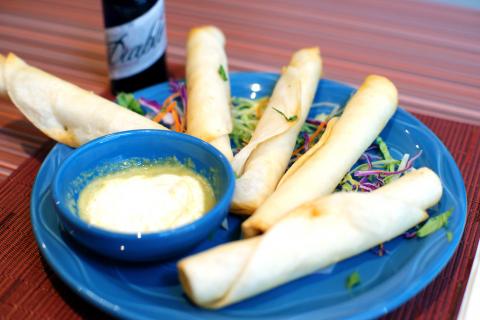
Photo: Noah Buchan, Taipei Times
Mayan Grill has several lunch specials: basic (soft or hard taco, soup, salad and rice, NT$249), full (two tacos, soup, salad, rice and coffee or tea, NT$349) and slow (chips and salsa, two tacos or one burrito, soup, salad, rice, coffee or tea and daily dessert, NT$499). My dining companion and I ordered the basic spicy shredded US beef soft taco and basic grilled chicken soft taco, with flautitas (NT$255) for an appetizer.
The flautitas alone are worth a visit to Mayan Grill. Five soft tortillas with the texture of dessert pastry were wrapped around robust grilled chicken and fresh veggies and served with a tangy green sauce surrounded by sour cream. When asked for something to spice up the dish, a server promptly brought two tincture bottles of “Diablo Devil’s Water” — one called “blood” (super spicy), the other “tears” (spicy). A few dribbles of the “devil’s blood” left me happily sweating and thirsty for a libation.
The moist and succulent stringy US beef in the other soft taco packed a mouth-burning punch, slightly offset by a tangy, lemon-infused marinade. Be sure to ask your server about the spice level of the dishes you order as they are not described on the menu. The long-grain “green rice” served with the specials is cooked with cilantro and parsley, which gave it a slightly bitter though delicious taste, and went well with the sauteed onion and green pepper.
Mayan Grill’s menu also features grilled pork (NT$645), pan-seared steak (NT$1,250) and a chicken dish (NT$695) that “will leave you feeling ready to conquer civilization.” Whether true or not, the relaxed ambiance and delicious food at Mayan Grill left me ready to “conquer” the afternoon. A selection of mid to high-end tequilas is available as are several Mexican beers.
A warning: Check your bill closely when paying because there is something wrong with Mayan Grill’s touch-screen cash register — to the extent that employees have nicknamed it “POS” (piece of shit). What this means for the customer is that you might be significantly overcharged — in my case by over NT$500.

Taiwan’s English education system is being pulled apart by three opposing forces. Bilingual Nation 2030 pulls students toward English and global communication. Artificial Intelligence (AI) readiness pulls them toward digital judgment, verification and AI-mediated work. But Taiwan’s old exam culture pulls them back toward memorization, grammar drills, timed reading and correct answers. If the education system keeps using old exams to define success, it risks producing graduates who are neither genuinely bilingual nor genuinely AI-ready, but trained for tasks machines can already perform. The first force is Bilingual Nation 2030. Launched in 2018, the policy aimed to “help Taiwan’s workforce connect
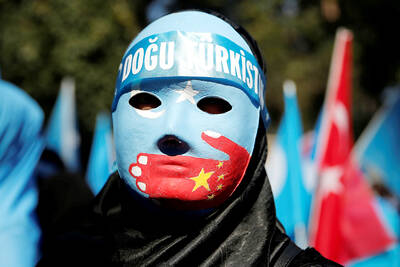
It seems every few days one bumps into one of those “real man” comments in which Taiwan is urged to “face reality” or similar, and “make a deal,” with the speaker implying that soon it will be too late. “Deal” advocates always present themselves as having a superior grip on reality, and the manly ability to make the “hard choice.” Their testosterone-laden language often echoes that of Taiwan sellout advocates. Note that such commentary always specifies a process (“make a deal, work with, make progress”), never the end state of what occupation by a violent authoritarian colonialist state will entail. In
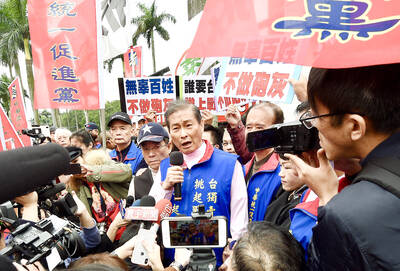
There are shadowy cabals plotting to sell out Taiwan to be annexed by China, by invasion if necessary. Fortunately, they are buffoons. In 2019, former Bamboo Union gangster and founder of the China Unification Promotion Party (CUPP), Chang An-le (張安樂, colorfully known as “White Wolf”), led a protest at the Legislative Yuan against comments made by then-premier Su Tseng-chang (蘇貞昌) that in the event of an attack by China, he would never surrender, but would protect the nation by fighting to the end, even if he only had a broom. Chang had party members bring a wooden casket that they
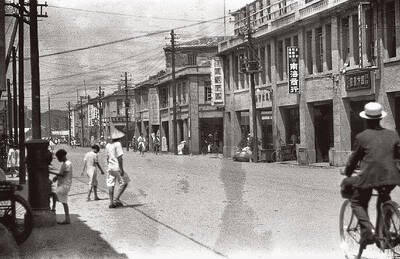
June 1 to June 7 "If all Taiwanese were as afraid of dying as you, then what would happen?” Physician Shih Chiang-nan (施江南) reportedly said this to his wife Chen Chiao-tung (陳焦桐) after she urged him to stop intervening on behalf of Taiwanese soldiers stranded overseas after serving in the Japanese Army during World War II. Shih had clashed with high-ranking officials over the issue, engaged in several heated arguments with Taiwan governor-general Chen Yi (陳儀) and allegedly shouted at general Ko Yuan-fen (柯遠芬), chief of staff of the Taiwan Garrison Command, over


 RSS
RSS