


Dazzling Pink and its spin-off Dazzling Mint operate on a simple premise: serving desserts as big as your head in a relentlessly frilly environment will pull in the crowds. The restaurants, both of which are located near the corner of Zhongxiao East Road (忠孝東路) and Yanji Street (延吉街), attract a mostly female clientele that would look at home on the pages of ViVi Magazine. You will feel underdressed if you aren’t wearing at least a lace collar or shiny platform pumps.
Dazzling Pink has a sleek black-and-white color scheme, like the Ascot scene in My Fair Lady, while Dazzling Mint’s signature shade is more of a soft Tiffany blue. Both locations are brightly lit, all the better to let patrons take portrait snaps (almost every person had at least a camera phone in hand) with Dazzling’s confections, most of which follow the same basic recipe: take a golden block of honey toast and load it with as many different dessert products as it can hold before collapsing.
The alluringly named “party in your mouth” (NT$220) boasts ice cream, custard, whipped cream, at least three different types of berries, strawberry sauce and a single pink macaron. My waitress offered to carve the dish up into bite-sized chunks, leaving me to serve myself with a tiny pair of silver tongs.
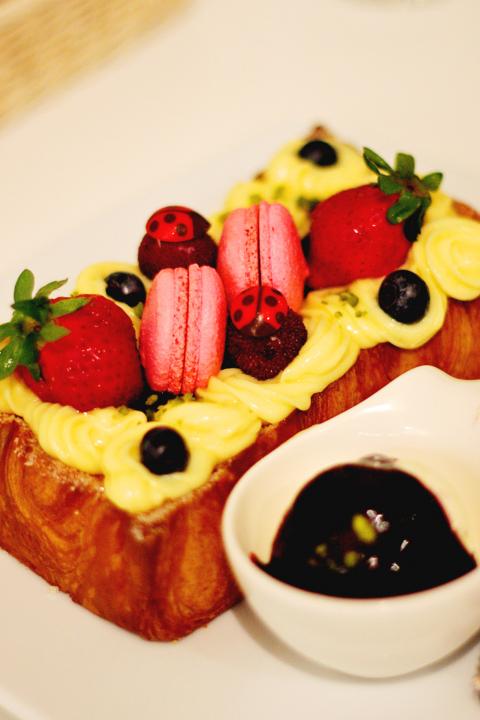
Photo: Catherine Shu, Taipei Times
The honey toast is fluffy, almost cake-like white bread sprinkled with crunchy sugar. It tastes best when dipped into the melting ice cream and syrup. Each topping would satisfy a sweet tooth, but all together they are truly overwhelming (though that is probably the point).
Most of Dazzling’s desserts are more than enough for two people. The blueberry Danish honey toast (NT$280) is almost as big as a house brick and adorned with lashings of custard, berries, two macarons and tiny chocolates shaped like ladybugs (vanilla ice cream was served on the side with blueberry syrup). The dessert, which is only served at Dazzling Mint, tasted nothing like a Danish pastry, however, and the very rich custard was too much after a few bites.
Both Dazzling locations offer a tiny selection of sweet crepes, which may not be as photogenic as the honey toast desserts, but offer a better balance of flavors. The blueberry crepe with wine sauce (NT$250) is filled with fluffy whipped cream and served with a little scoop of vanilla seed ice cream on top. The light drizzling of sauce was just tart enough to complement the sweetness of the other ingredients.
I had low expectations for Dazzling’s savory options, which seem tacked onto the menu like an afterthought, but was pleasantly surprised. The meat in the pork BBQ sandwich (NT$200) had been lightly breaded and fried, and the only hint of “barbecue” came from the sauce, which was more sweet than tangy, but the dish was tasty and filling. Dazzling serves pasta during lunch and dinner hours. The spaghetti with duck breast and mustard orange sauce (NT$220) is cooked pleasingly al dente and the meat is tender. My serving had too much sauce, but I liked how its crunchy mustard seeds served as a foil for the citrus flavor.
The service at the two Dazzling restaurants is fast and efficient. Unfortunately, customers are also expected to be quick and finish up within a 90-minute time limit during dinner hours, even on weekdays (to be fair, both locations are usually crowded). There is a minimum order of one drink per person even if you get an entree and dessert, which is annoying because most of the teas, coffees and slushies feature plenty of sugar themselves.

Taiwan’s English education system is being pulled apart by three opposing forces. Bilingual Nation 2030 pulls students toward English and global communication. Artificial Intelligence (AI) readiness pulls them toward digital judgment, verification and AI-mediated work. But Taiwan’s old exam culture pulls them back toward memorization, grammar drills, timed reading and correct answers. If the education system keeps using old exams to define success, it risks producing graduates who are neither genuinely bilingual nor genuinely AI-ready, but trained for tasks machines can already perform. The first force is Bilingual Nation 2030. Launched in 2018, the policy aimed to “help Taiwan’s workforce connect
It seems every few days one bumps into one of those “real man” comments in which Taiwan is urged to “face reality” or similar, and “make a deal,” with the speaker implying that soon it will be too late. “Deal” advocates always present themselves as having a superior grip on reality, and the manly ability to make the “hard choice.” Their testosterone-laden language often echoes that of Taiwan sellout advocates. Note that such commentary always specifies a process (“make a deal, work with, make progress”), never the end state of what occupation by a violent authoritarian colonialist state will entail. In
June 1 to June 7 "If all Taiwanese were as afraid of dying as you, then what would happen?” Physician Shih Chiang-nan (施江南) reportedly said this to his wife Chen Chiao-tung (陳焦桐) after she urged him to stop intervening on behalf of Taiwanese soldiers stranded overseas after serving in the Japanese Army during World War II. Shih had clashed with high-ranking officials over the issue, engaged in several heated arguments with Taiwan governor-general Chen Yi (陳儀) and allegedly shouted at general Ko Yuan-fen (柯遠芬), chief of staff of the Taiwan Garrison Command, over

“Taiwan’s Opposition Leader Comes to US With a Message Straight Out of Beijing” read a May 31 headline in the Wall Street Journal. Top US administration officials and members of Congress almost certainly read the WSJ, and if there was a bullet point takeaway that people in Washington should absorb ahead of Chinese Nationalist Party (KMT) Chair Cheng Li-wun’s (鄭麗文) arrival in DC on June 9, that headline is it. The last few columns have discussed this very topic, and the timing is not coincidental. While those top officials likely do not read the Taipei Times, judging by the number


 RSS
RSS