


Spicy hot pot (麻辣鍋) is a perennial winter favorite, and Taipei is thick with inexpensive all-you-can-eat hot pot joints and slick, pricey establishments boasting select ingredients and finely concocted broths. 108 Hot Pot (壹零捌麻辣鍋) aims for the latter category, but isn’t a complete success. While the food is delicious, the bill can quickly mount up. And when it comes to service, 108 lags behind other restaurants in a similar price range.
Three minutes on foot from the intersection of Daan Road (大安路) and Zhongxiao East Road (忠孝東路) in Taipei, the two-floor establishment is hard to miss. A purple neon sign outside the entrance screams for attention. Thankfully, the interior is quieter. Tables can seat a party of two up to a group of 12, and for extra privacy the restaurant has 10 roomy booths, which require reservations.
The restaurant is lauded for its three varieties of hot pot broth. According to its Web site, the spicy version is infused with more than 30 herbs and spices. The lustrous red stock’s flavor is rich and smooth, and doesn’t pack much of a chili punch. For more of a kick, order the “medium hot” (中辣) or “very hot” (大辣).
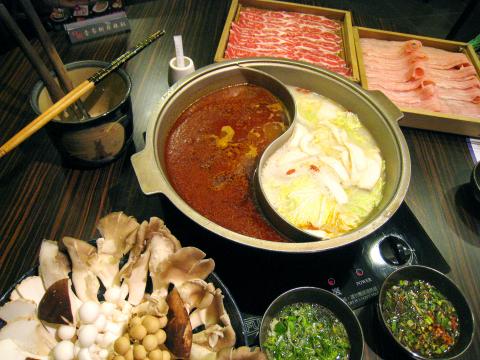
Photo: Ho Yi, Taipei Times
For a sweeter stock, one of the other options is a chicken-based white broth, with hints of ginger and goji berry. An equally delectable tomato-based broth is also available. Diners have to pay an extra NT$120 for a pot that has half chili broth and half non-spicy broth (鴛鴦鍋).
The top-of-the-range food served at 108 is exemplified by the fine quality of the meat items such as prime beef (招牌牛小排, NT$360), Matsusaka pork (雪花松阪豬, NT$320) and mutton (極品小羔羊, NT$290). Seafood options include drunken shrimp (生猛醉翁蝦, NT$290), South African abalone (南非活鮑魚, NT$180 each) and clams (生鮮活蛤蠣, NT$180). The aquariums next to the entrance on the first floor assure diners that their food arrives on the table alive and kicking (except the shrimp, which are numbed in a bowl of Shaohsing rice wine (紹興酒) before meeting their fate in the boiling pot).
The restaurant’s respectable selection of vegetables includes cabbage (高麗菜苗, NT$90), Japanese mountain yam (日本山藥, NT$120), edible chrysanthemum (茼蒿, or tong hao, at NT$90), bamboo fungus (竹笙, NT$120), black jelly fungus (黑木耳, NT$80), golden needle mushrooms (金針菇, NT$80) and king oyster mushroom (杏鮑菇, NT$100).
But what really impresses are the handmade meatballs, such as shrimp balls in loofah (香煎角瓜球, NT$140) and pork in green pepper (翡翠椒鑲肉, NT$140). The finely chopped shrimp wrapped in juicy sponge cucumber leaves a lasting tickle of savoriness on the taste buds. The green pepper rolls are equally delicious. Try cooking the roll in the chili broth and then dipping it in the vinegar sauce to fine tune the spiciness and create multiple layers of flavor.
The big letdown, though, is the waitstaff. During a recent visit on a cold, rainy Sunday evening, the service was unforgivably sluggish given that the restaurant was only half full. To top it off, we were served meat that we hadn’t ordered.

Taiwan’s English education system is being pulled apart by three opposing forces. Bilingual Nation 2030 pulls students toward English and global communication. Artificial Intelligence (AI) readiness pulls them toward digital judgment, verification and AI-mediated work. But Taiwan’s old exam culture pulls them back toward memorization, grammar drills, timed reading and correct answers. If the education system keeps using old exams to define success, it risks producing graduates who are neither genuinely bilingual nor genuinely AI-ready, but trained for tasks machines can already perform. The first force is Bilingual Nation 2030. Launched in 2018, the policy aimed to “help Taiwan’s workforce connect

It seems every few days one bumps into one of those “real man” comments in which Taiwan is urged to “face reality” or similar, and “make a deal,” with the speaker implying that soon it will be too late. “Deal” advocates always present themselves as having a superior grip on reality, and the manly ability to make the “hard choice.” Their testosterone-laden language often echoes that of Taiwan sellout advocates. Note that such commentary always specifies a process (“make a deal, work with, make progress”), never the end state of what occupation by a violent authoritarian colonialist state will entail. In
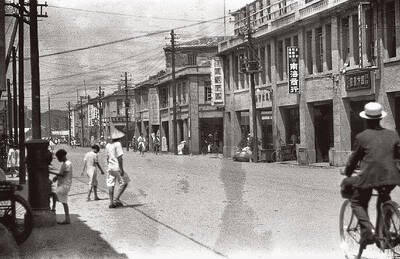
June 1 to June 7 "If all Taiwanese were as afraid of dying as you, then what would happen?” Physician Shih Chiang-nan (施江南) reportedly said this to his wife Chen Chiao-tung (陳焦桐) after she urged him to stop intervening on behalf of Taiwanese soldiers stranded overseas after serving in the Japanese Army during World War II. Shih had clashed with high-ranking officials over the issue, engaged in several heated arguments with Taiwan governor-general Chen Yi (陳儀) and allegedly shouted at general Ko Yuan-fen (柯遠芬), chief of staff of the Taiwan Garrison Command, over

“Taiwan’s Opposition Leader Comes to US With a Message Straight Out of Beijing” read a May 31 headline in the Wall Street Journal. Top US administration officials and members of Congress almost certainly read the WSJ, and if there was a bullet point takeaway that people in Washington should absorb ahead of Chinese Nationalist Party (KMT) Chair Cheng Li-wun’s (鄭麗文) arrival in DC on June 9, that headline is it. The last few columns have discussed this very topic, and the timing is not coincidental. While those top officials likely do not read the Taipei Times, judging by the number


 RSS
RSS