


Fans of indie icon Crowd Lu’s (盧廣仲) zany humor and musical musings on the trials of daily life are in for a double helping of the star on Dec. 18.
The singer/songwriter makes his Taipei Arena debut with an indulgent, daylong event titled Good Morning and Good Evening Crowd Lu Taipei Arena Concert (Good Morning & Good Evening 盧廣仲台北小巨蛋演唱會). Lu will perform a two-part gig, the first segment beginning at 10am, the second at 7:30pm.
“I usually get up early, so I figured I would try a concert in the morning,” Lu told the Taipei Times earlier this week. “This show is going to burn a lot of calories. I’m planning to run around the oval running track.”
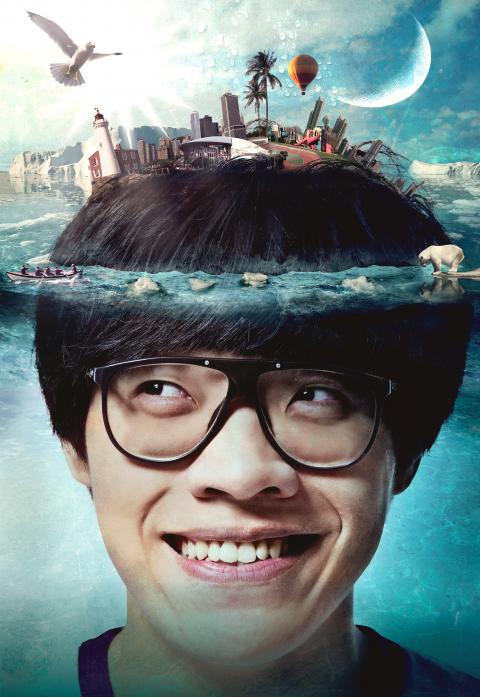
Photo Courtesy Of Team Ear Music
In addition to the performances, there will be a 2pm screening of the movie Little Miss Sunshine, which he says he chose because it’s “full of positive energy.”
Lu captured the public’s imagination in the past few years with two folk-rock albums that explore the joys of everyday life. His hits include Good Morning, Beautiful Dawn (早安晨之美) and Seven Days (七天).
“I listen to blues music that describes common things like ‘my car is broken’ or ‘I’m down on my luck,’” Lu said. “That’s the kind of music I like.”
His celebration of the ordinary is enhanced by his geek chic look — trademark bowl cut, black-rimmed glasses and glaring white socks. The 25-year-old promises to ignite the stage with his infectious, self-deprecating sense of humor.
“I’m an easy-going but polite person,” Lu said. “I don’t want to make fun of other people, so I make fun of myself.”
His career began after he was seriously injured in a car accident when he was a freshman at Tamkang University.
“I had to stay home for six months,” Lu said. “I took up playing guitar and songwriting and started pursuing music.”
Lu released his much lauded debut album 100 Ways of Life (100種生活) in 2008 and went on to win the Best Newcomer Award and the Best Composer Award for the album’s title track at the Golden Melody Awards last year.
Veteran pop producer Tiger Chung (鍾成虎) has dubbed Lu “a musical genius who was run over by a bus” (被公車輾過的音樂鬼才).
Although acclaimed for his oeuvre of folk-rock gems, Lu also boasts a powerful voice, as witnessed when he delivered a ravishing rendition of Karen Mok’s (莫文蔚) Oh Lonely Lover (寂寞的戀人啊) at Riverside Live House this March. Lu, who names Western superstars Whitney Houston and George Michael as influences, plans to push the envelope with next weekend’s performance.
“I will tackle even more different styles of music with these four hours of performing,” Lu said.

Taiwan’s English education system is being pulled apart by three opposing forces. Bilingual Nation 2030 pulls students toward English and global communication. Artificial Intelligence (AI) readiness pulls them toward digital judgment, verification and AI-mediated work. But Taiwan’s old exam culture pulls them back toward memorization, grammar drills, timed reading and correct answers. If the education system keeps using old exams to define success, it risks producing graduates who are neither genuinely bilingual nor genuinely AI-ready, but trained for tasks machines can already perform. The first force is Bilingual Nation 2030. Launched in 2018, the policy aimed to “help Taiwan’s workforce connect

It seems every few days one bumps into one of those “real man” comments in which Taiwan is urged to “face reality” or similar, and “make a deal,” with the speaker implying that soon it will be too late. “Deal” advocates always present themselves as having a superior grip on reality, and the manly ability to make the “hard choice.” Their testosterone-laden language often echoes that of Taiwan sellout advocates. Note that such commentary always specifies a process (“make a deal, work with, make progress”), never the end state of what occupation by a violent authoritarian colonialist state will entail. In
June 1 to June 7 "If all Taiwanese were as afraid of dying as you, then what would happen?” Physician Shih Chiang-nan (施江南) reportedly said this to his wife Chen Chiao-tung (陳焦桐) after she urged him to stop intervening on behalf of Taiwanese soldiers stranded overseas after serving in the Japanese Army during World War II. Shih had clashed with high-ranking officials over the issue, engaged in several heated arguments with Taiwan governor-general Chen Yi (陳儀) and allegedly shouted at general Ko Yuan-fen (柯遠芬), chief of staff of the Taiwan Garrison Command, over

“Taiwan’s Opposition Leader Comes to US With a Message Straight Out of Beijing” read a May 31 headline in the Wall Street Journal. Top US administration officials and members of Congress almost certainly read the WSJ, and if there was a bullet point takeaway that people in Washington should absorb ahead of Chinese Nationalist Party (KMT) Chair Cheng Li-wun’s (鄭麗文) arrival in DC on June 9, that headline is it. The last few columns have discussed this very topic, and the timing is not coincidental. While those top officials likely do not read the Taipei Times, judging by the number


 RSS
RSS