


Last weekend, many of Taiwan’s right-brained professionals descended on the Taipei World Trade Center Nangang Exhibition Hall for the first Taiwan International Cultural and Creative Industry Expo (台灣國際文化創意產業博覽會).
The event, which ran from Nov. 11 to Nov. 14, was launched by the Council of Cultural Affairs (文化建設委員會) to highlight Taiwan’s “creative industries” and made up of 780 booths.
The definition of what constitutes a “creative industry” is very broad: exhibits ran the gamut from a multimedia robot sculpture by artist Akibo Lee (李明道) to booths offering aromatherapy massages and bottled tea.
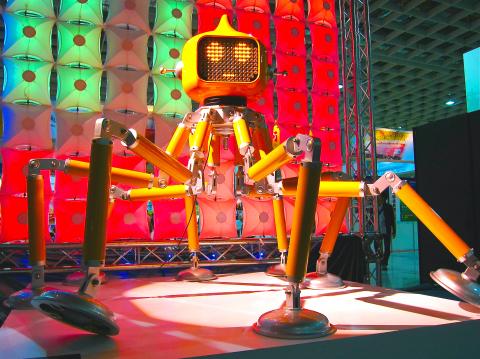
Photo: Catherine Shu, Taipei Times
One section, the Cross-Strait Cultural and Exhibition Creative Industries Exhibition (兩岸文創展), was dedicated to displays by manufacturers, artists and designers from China. The Central America Trade Office (中美洲經貿辦事處) set up a pavilion with products from six countries in the region, while brands from the UK, South Korea and Japan also participated in the event.
The expo’s wide scope had its good and bad points, said Chiu Chung-yu (邱瓊玉), the project planner of design brand In Blooom (印花樂, www.inblooom.com).
“There are brands that are more established here, as well as brands from England and other countries. It’s a good opportunity to see a lot of what is out there,” said Chiu.
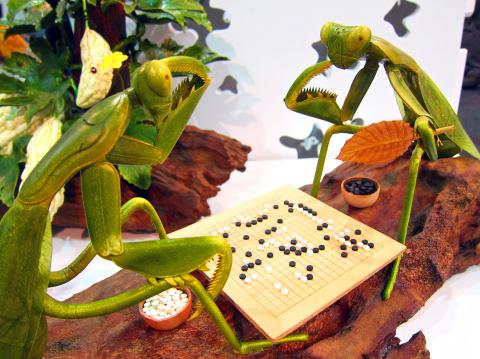
Photo: Catherine Shu, Taipei Times
At the same time, the scope of the expo made it overwhelming at times, she added. While exhibitors were organized into seven themed “pavilions,” the layout still resembled a labyrinth; visitors turning a corner sometimes found themselves facing the backs of a row of booths.
“It’s a little disorganized. There are so many sections and a lot of things I can’t find,” said Chiu.
In Blooom was part of Life Design (設計生活館), which was perhaps the liveliest section on Saturday. Young designers with fledgling labels sold wares directly to visitors, lending the area a bazaar-like atmosphere.
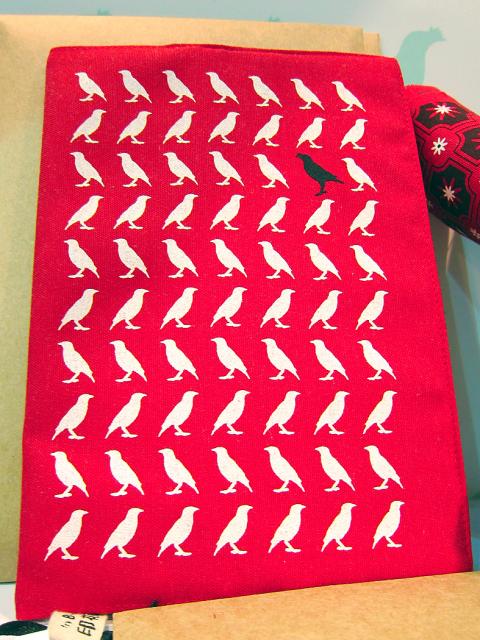
Photo: Catherine Shu, Taipei Times
In Blooom showcased cushions, tote bags and book covers at the expo. The company’s signature fabric prints include several with miniature silhouettes of the crested myna, a bird native to this country. Chiu said that the prints are meant to increase awareness of Taiwan’s ecology by highlighting its indigenous species. Another set of patterns is based on colorful, geometric tiles found in many older buildings.
“We wanted to create a pattern that evokes memories for everyone. Right now the only textile we have that is really Taiwanese is Taiwan floral cloth,” said Chiu, referring to the brightly colored fabric that was prominently featured in the expo’s promotional materials.
There was an emphasis on traditional Taiwanese arts and crafts at the event. The Local Traits Pavilion (地方特色區) featured exhibitors like Anping Sword-Lion Square (安平劍獅埕), whose ceramic busts and figures are based on lion emblems placed on houses in Tainan to ward off evil spirits, and organizations including the National Taiwan Craft Research and Development Institute (國立台灣工藝研究發展中心) and the Taiwan Indigenous People Enterprise and Economic Development Association (社團法人台灣原住民族產業經濟發展協會).
Chiang Li-chan (江立產) represented Pingtung County-based label Kaludasan (彭春霖生活創意工房, www.kaludasan.com.tw), which was founded by Peng Chun-lin (彭春霖), a Rukai (魯凱族) Aborigine. Peng grew up watching his grandmother and aunt weave at their looms and, despite traditional taboos against men engaging in fiber work, began to create his own textiles.
“If he didn’t do it, no one else would,” said Chiang, explaining that Rukai fiber arts began to disappear when women started working outside of the home. Kaludasan’s bags and accessories incorporate traditional Rukai motifs as well as Peng’s own designs.
The expo gives the brand a platform for greater exposure. “We want people to see different sides of Aboriginal culture,” said Chiang.
Designer Chuang Chia-yi (莊佳怡), whose jewelry brand Library Brass (www.librarybrass.com) launched just last month, also saw the event as a chance to build a reputation. Chuang’s background as a sculptor is evident in her bold necklaces and bracelets, which are made from glittering brass chain wrapped around braided ribbons of chiffon.
The expo is Library Brass’ first appearance at such an event. Chuang said it gave her a chance to talk with stores about potentially carrying her line (which is currently sold at Designburg, www.designburg.com) and gauge reactions to the company’s products.
“There’s definitely an age difference,” said Chuang, noting that the people most attracted to her designs tended to be young fashion-forward women who liked the jewelry’s on-trend look.
Chuang, who studied at the Chelsea College of Art and Design, said that it can be a struggle for new designers to make their mark in a country better known for its prowess in technology, but that events like the expo can help them gain recognition.
“The Council of Cultural Affairs has been very supportive by creating opportunities for designers like the expo,” said Chuang. “The creative industry hasn’t fully matured yet in Taiwan, but there is a lot of possibility.”

Taiwan’s English education system is being pulled apart by three opposing forces. Bilingual Nation 2030 pulls students toward English and global communication. Artificial Intelligence (AI) readiness pulls them toward digital judgment, verification and AI-mediated work. But Taiwan’s old exam culture pulls them back toward memorization, grammar drills, timed reading and correct answers. If the education system keeps using old exams to define success, it risks producing graduates who are neither genuinely bilingual nor genuinely AI-ready, but trained for tasks machines can already perform. The first force is Bilingual Nation 2030. Launched in 2018, the policy aimed to “help Taiwan’s workforce connect
It seems every few days one bumps into one of those “real man” comments in which Taiwan is urged to “face reality” or similar, and “make a deal,” with the speaker implying that soon it will be too late. “Deal” advocates always present themselves as having a superior grip on reality, and the manly ability to make the “hard choice.” Their testosterone-laden language often echoes that of Taiwan sellout advocates. Note that such commentary always specifies a process (“make a deal, work with, make progress”), never the end state of what occupation by a violent authoritarian colonialist state will entail. In
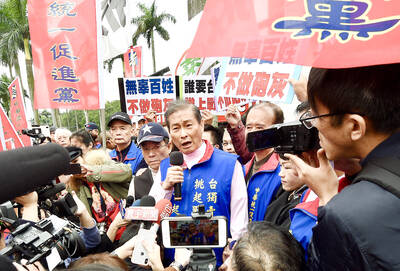
There are shadowy cabals plotting to sell out Taiwan to be annexed by China, by invasion if necessary. Fortunately, they are buffoons. In 2019, former Bamboo Union gangster and founder of the China Unification Promotion Party (CUPP), Chang An-le (張安樂, colorfully known as “White Wolf”), led a protest at the Legislative Yuan against comments made by then-premier Su Tseng-chang (蘇貞昌) that in the event of an attack by China, he would never surrender, but would protect the nation by fighting to the end, even if he only had a broom. Chang had party members bring a wooden casket that they
June 1 to June 7 "If all Taiwanese were as afraid of dying as you, then what would happen?” Physician Shih Chiang-nan (施江南) reportedly said this to his wife Chen Chiao-tung (陳焦桐) after she urged him to stop intervening on behalf of Taiwanese soldiers stranded overseas after serving in the Japanese Army during World War II. Shih had clashed with high-ranking officials over the issue, engaged in several heated arguments with Taiwan governor-general Chen Yi (陳儀) and allegedly shouted at general Ko Yuan-fen (柯遠芬), chief of staff of the Taiwan Garrison Command, over


 RSS
RSS