


Women are way ahead of men in knowing the benefits and risks of hormone replacement. There has yet to be a large study spanning years, comparable to the Women’s Health Initiative, of the safety and effectiveness of hormone therapy for aging men who have signs and symptoms of testosterone deficiency.
Despite beliefs based on observational evidence that estrogen therapy enhanced the health and well-being of menopausal women, when a definitive study was finally done, clinicians and researchers were shocked to discover that the risks of long-term hormone replacement could outweigh its benefits.
Would a similar study of testosterone therapy for men experiencing “andropause” likewise reveal more hazard than help? The answer would be welcomed by an estimated 4 million US men who have subnormal levels of this important hormone, a common result of advancing age.
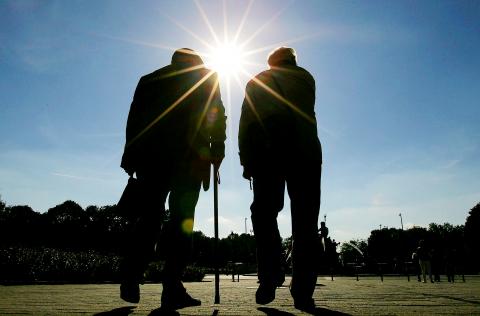
Photo: AFP
But these men, as well as those already receiving testosterone therapy and the baby boomers who may soon develop symptoms of low testosterone, may never know whether adding to their bodies’ waning supply will improve or detract from the quality and length of their lives. Rather, they may have to base a decision about therapy on confusing and conflicting evidence.
Late last year, for example, a six-month federally financed study of a testosterone gel put a surprising hitch in efforts to improve the lives of aging men who experience a decline in energy, mood, vitality and sexuality as a result of low testosterone levels. The study, conducted among 209 men 65 and older who had difficulty walking, was halted when those using the hormone had an unexpectedly high rate of cardiac problems.
The researchers, who published their findings in The New England Journal of Medicine, noted that the deck might have been stacked in favor of a hazardous outcome because study participants, especially the group that received testosterone, had high rates of high blood pressure, diabetes, obesity and elevated blood lipids. Then again, this may be a realistic population to study, given that many candidates for hormone therapy are likely to have such health issues.
A US$45 million study financed by the National Institute on Aging is under way at 12 medical centers to see if a year of treatment with testosterone will help 800 men aged 65 and older with low levels of the hormone and problems with physical functioning, fatigue and sexual or cognitive performance. The study, in which the men are being randomly assigned to receive the hormone or a placebo, will also evaluate the hormone’s effects on cardiac risk factors.
Still, this study will not answer the question of whether it is safe to use the hormone for years, even decades, which would be necessary to maintain any benefits. A major concern is whether long-term use would promote the growth of prostate cancer, which is present but hidden in as many as half of older men.
‘IN LIMBO’
“There are not many good studies of testosterone in older men,” William Bremner, a urologist at the University of Washington in Seattle, said in an interview. “The studies are small and the longest of them lasted only three years. We need the same kind of study for testosterone as the Women’s Health Initiative — several thousand men followed for maybe 10 years. Currently, we’re in limbo as to how to advise patients.”
He acknowledged that the need for such a study for men is “less compelling” because, in contrast to women, who experience an abrupt drop in estrogen at menopause, often with disruptive symptoms, hormone decline in aging men is far more gradual. Symptoms, when they occur, are commonly viewed as normal signs of aging, not hormone deficiency.
A large European study published in the same issue of the journal sought to better determine who, among middle-aged and elderly men, might be candidates for testosterone replacement. Among a sample of 3,369 men aged 40 to 79, researchers at eight European medical centers found that “limited physical vigor” and three sexual symptoms — diminished sexual thoughts and morning erections and erectile dysfunction — were most closely linked to low levels of testosterone.
Although low hormone levels are widely thought to increase a man’s risk of depression, the researchers found that “psychological symptoms had little or no association with the testosterone level.”
There are four main approaches to testosterone therapy available in the US: intramuscular injections every one to three weeks, skin applications through a patch or gel, and pellets implanted under the skin that last for months. The patch can cause skin irritation, and the gel can be transferred to others through skin contact unless care is taken to cover the area where it is applied. Oral administration is rarely used because of toxic effects on the liver.
The most common reason men seek testosterone therapy is waning sexual desire or performance, although the ability of the hormone to relieve sexual symptoms is unpredictable. More than one-quarter of men with normal testosterone levels have such symptoms, and many men with subnormal levels do not. Bremner said he typically suggests a trial of therapy for up to a year to see if sexual function or other symptoms improve.
Citing the results of many small studies, Bremner said: “There is good evidence that testosterone administration can improve muscle mass and strength and increase bone density” in men with subnormal levels.
Abraham Morgentaler, a urologist at Harvard Medical School and author of Testosterone for Life, said in an interview that other noted benefits include a decrease in body fat and total cholesterol and improved blood sugar metabolism.
CLOSE MONITORING
In a report on the risks of testosterone therapy, written with Ernani Luis Rhoden and published in 2004 in The New England Journal of Medicine, Morgentaler noted that testosterone has widespread effects throughout the body, but he and Rhoden concluded that with proper monitoring, any looming hazards can be readily detected.
Before the most recent study, at doses considered normal, the testosterone gel showed little or no effect on cardiovascular risk, the two doctors reported. Injections could result in harmful thickening of the blood, however, especially if above-normal blood levels of the hormone result.
Although testosterone can cause overgrowth of the prostate, studies have not shown harm to urinary function, Morgentaler said. The risk of prostate cancer is of greater concern, given that suppressing the body’s natural production of testosterone can cause this cancer to regress. Men considering treatment should first undergo a full prostate exam and Prostate-Specific Antigen (PSA) measurement, with periodic prostate checkups during therapy, Bremner said.

By global standards, the traffic congestion that afflicts Taiwan’s urban areas isn’t horrific. But nor is it something the country can be proud of. According to TomTom, a Dutch developer of location and navigation technologies, last year Taiwan was the sixth most congested country in Asia. Of the 492 towns and cities included in its rankings last year, Taipei was the 74th most congested. Taoyuan ranked 105th, while Hsinchu County (121st), Taichung (142nd), Tainan (173rd), New Taipei City (227th), Kaohsiung (241st) and Keelung (302nd) also featured on the list. Four Japanese cities have slower traffic than Taipei. (Seoul, which has some

Michael slides a sequin glove over the pop star’s tarnished legacy, shrouding Michael Jackson’s complications with a conventional biopic that, if you cover your ears, sounds great. Antoine Fuqua’s movie is sanctioned by Jackson’s estate and its producers include the estate’s executors. So it is, by its nature, a narrow, authorized perspective on Jackson. The film ends before the flood of allegations of sexual abuse of children, or Jackson’s own acknowledgment of sleeping alongside kids. Jackson and his estate have long maintained his innocence. In his only criminal trial, in 2005, Jackson was acquitted. Michael doesn’t even subtly nod to these facts.
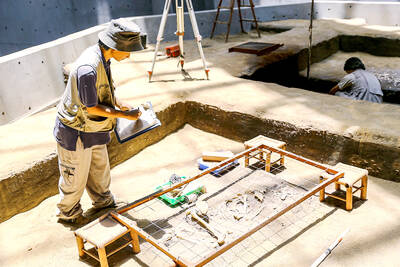
Writing of the finds at the ancient iron-working site of Shihsanhang (十 三行) in New Taipei City’s Bali District (八里), archaeologist Tsang Cheng-hwa (臧振華) of the Academia Sinica’s Institute of History and Philology observes: “One bronze bowl gilded with gold, together with copper coins and fragments of Tang and Song ceramics, were also found. These provide evidence for early contact between Taiwan aborigines and Chinese.” The Shihsanhang Web site from the Ministry of Culture says of the finds: “They were evidence that the residents of the area had a close trading relation with Chinese civilians, as the coins can be
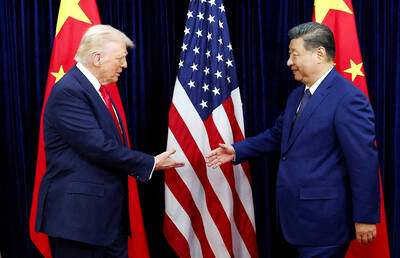
The March/April volume of Foreign Affairs, long a purveyor of pro-China pablum, offered up another irksome Beijing-speak on the issues and solutions for the problems vexing the People’s Republic of China (PRC) and the US: “America and China at the Edge of Ruin: A Last Chance to Step Back From the Brink” rang the provocative title, by David M. Lampton and Wang Jisi (王緝思). If one ever wants to describe what went wrong with US-PRC relations, the career of Wang Jisi is a good place to start. Wang has extensive experience in the US and the West. He was a visiting


 RSS
RSS