


Matthew Dear
Black City
Ghostly International

It doesn’t seem right to call DJ/producer/artist Matthew Dear an electronic musician anymore. In fact, it would be easy to mistake his new album, Black City, for the work of some hip new indie rock band merely dabbling in synthesized dance music.
The truth is that while Dear has roots in Detroit techno, they now only serve as a distant talking point, something belonging to another time and place in his musical life.
A more obvious reference point to begin discussing Dear’s current sound is Talking Heads, as the group’s brand of throbbing white-boy funk drips all over these tracks. The staccato delivery of I Can’t Feel’s lyrics, taken together with the song’s rhythmic, warbly synths and scratchy guitar riffs, is a dead ringer for David Byrne’s work.
But it’s not only his heavy reliance on vocals and guitar-driven song structures that now mark Matthew Dear as a bona fide crossover act, it’s also the organic feel that permeates even Black City’s most highly processed moments.
Dark and robotic, yet pregnant with light and warmth, the theme of Black City is that of a futuristic metropolis and everything to be found there, not only factory automatons, but also the passion and humor of its residents.

You Put a Smell on Me, for instance, features huge, terrifying, industrial-gauge synth stabs, yet manages somehow to ooze warm, tongue-in-cheek wit. Despite its noise, it isn’t trying to alienate the listener. On the contrary, it is a playful invitation to a grimy sexual romp: “You decide if you want to come.”
What impresses most on Black City is the sense of balance Dear finds between so many polarizing elements: rock and techno, machine and body, laughter and desolation. It is the work of a true original, fully realized.
— Taylor Briere

Blonde Redhead
Penny Sparkle
4AD
Over the past 15 years, Blonde Redhead has been a pillar of the indie rock scene, releasing a string of critically acclaimed albums that paid homage to pioneers such as Sonic Youth (their first record was released on Sonic Youth’s label, Smells Like Records) and My Bloody Valentine, all the while managing to craft a sound that was nonetheless distinct.
Penny Sparkle, Blonde Redhead’s most recent offering, distills what has made the band unique in the indie rock world, down to its barest elements — the blend of melancholy surrealism, airy chord progressions and cautious synth adornments — and then completely divorces them from the rock foundation upon which they had been built. The result is a sometimes frustrating collection of songs that never quite get to where they were headed.
This sense of disappointment mostly comes from knowing what the band is actually capable of. Nowhere was this more obvious than at its concert last Sunday in Taipei where the audience — most of them young and new to the band — shrieked with unabashed joy every time the group dipped into its back catalog. It was tough to find fault in their judgment, as the incredible energy of the old songs contrasted sharply with the flatter delivery of the new ones.
The album has its moments, of course — the band has far too much talent to produce an entire album of duds. Everything Is Wrong, for instance, shines here as a lazy waltz through lush sound textures, gorgeously produced and with enough variation to keep one listening with interest.
But even album highlights such as the lead track Here Sometimes, lovely though its minimalistic percussive elements and rich synth stabs may be, lack the sense of climactic oomph that drives so much of the band’s earlier music straight into the hearts of its listeners.
The daggers on Penny Sparkle are too few and far between, and for Blonde Redhead, pretty good just isn’t good enough.
— Taylor Briere
No Age
Everything in Between
Sub Pop
No Age exploded onto the music scene in 2008 with its debut album Nouns, which garnered rave reviews for its seething pop hooks and frothing-at-the-mouth noise experimentation. Imbued with an exhilarating sense of urgency that bordered on recklessness, the album thrived on its own audacity.
The duo’s follow-up record, Everything in Between, finds it exploring a more polished, mature sound. The songs seem, for the most part, to have had more thought put into them, and the shotgun blast feel of Nouns is nowhere to be found here. That isn’t to say the band has gone pop — the album is still stacked with screeching Sonic Youth-style guitars, and drummer Dean Allen Spunt’s whiny vocals still find occasion to veer dangerously into tone-deaf territory. But these sounds have all been re-contextualized within a more traditional songwriting framework, and a wider variety of sounds has been injected into the mix.
Fever Dreaming is an excellent example of a song that would have been chopped in half on Nouns but is given more space to breathe on Everything in Between, benefiting greatly as a result. The song builds power with every repetition of verse and chorus, and a short, ripping bridge section propels it to a familiar No Age climax of grinding guitars matched with a short, repetitive vocal hook.
A new level of sophistication has been introduced to tracks that would otherwise be bang-it-out gut bombs. On Sorts, for instance, a new chord progression in perfect dialogue with the crunchy rhythms that came before pops in near the song’s end, sending it soaring to a new space altogether.
Everything in Between is an improvement on Nouns. But there is a price to pay for all this thoughtfulness. Part of what made Nouns so special was its DIY disregard for prevailing standards. And although Everything in Between is a high quality follow-up, it fails to match its predecessor’s intensity.
— Taylor Briere
Angela Aki
Life
Sony Music
Immensely talented singer/songwriter and pianist Angela Aki follows up her highly successful album Answer with Life.
Aki, who is mostly known to Taiwanese audiences as the original singer and writer of Rene Liu’s (劉若英) recent hit Continue — For the 15-Year-Old Self (繼續 — 給15歲的自己), gets back to basics with this inspirational concept album of Japanese and English-language songs.
The J-pop star, who looks like Greek pop icon Nana Mouskouri (including black-rimmed glasses) but performs with the sensitivity of Edith Wharton, chronicles life’s dreams and heartbreaks with verve. As a musical storyteller, Aki conveys tales rather than merely evoking moods, as many of her peers do.
Having written and produced the album’s 13 tracks — the six English-language songs were co-written with American singer/songwriter Janis Ian — Aki’s forte is extravagant, melodically entrancing ballads. Backed mostly by a simple piano accompaniment performed by herself, Aki delivers pearls of wisdom.
Every Woman’s Song, a paean to female power and bliss, pays tribute to Alicia Keys’ feminist angst and pride, while What Are the Roses For? presents an abstract contemplation on romantic gestures, which the singer both rebukes and pleads for. In the nostalgic love song Remember Me, Aki eulogizes about mementos from a past romance.
The album’s glaring weakness is its up-tempo songs, such as Mad Scientist and Bop Bop Bop (Colors of Your Soul), which misfire because Aki doesn’t exude the energy necessary to carry the frenetic pop rhythms.
Saving the best for last, the album finishes with two tracks that drive Life’s theme of personal growth home.
On Mother of the Earth, Aki probes the meaning of womanhood with literary metaphors, while on the title track she celebrates resilience and the pain experienced on the road to self-actualization.
— Andrew C.C. Huang

Yesterday, the Democratic Progressive Party (DPP) nominated legislator Puma Shen (沈伯洋) as their Taipei mayoral candidate, the Chinese Nationalist Party (KMT) put their stamp of approval on Wei Ping-cheng (魏平政) as their candidate for Changhua County commissioner and former legislator Tsai Pi-ru (蔡壁如) of the Taiwan People’s Party (TPP) has begun the process to also run in Changhua, though she has not yet been formally nominated. All three news items are bizarre. The DPP has struggled with settling on a Taipei nominee. The only candidate who declared interest was Enoch Wu (吳怡農), but the party seemed determined to nominate anyone

In a sudden move last week, opposition lawmakers of the Chinese Nationalist Party (KMT) and Taiwan People’s Party (TPP) passed a NT$780 billion special defense budget as a preemptive measure to stop either Chinese leader Xi Jinping (習近平) or US President Donald Trump from blocking US arms sales to Taiwan at their summit in Beijing, said KMT heavyweight Jaw Shaw-kong (趙少康), speaking to the Taipei Foreign Correspondents Club on Wednesday night in Taipei. The 76-year-old Jaw, a political talk show host who ran as the KMT’s vice presidential candidate in 2024, says that he personally brokered the deal to resolve
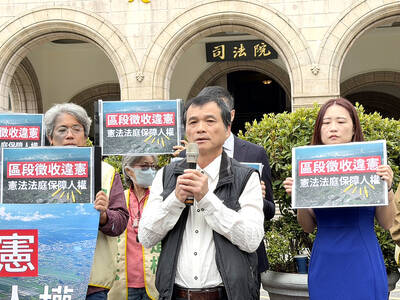
What government project has expropriated the most land in Taiwan? According to local media reports, it is the Taoyuan Aerotropolis, eating 2,500 hectares of land in its first phase, with more to come. Forty thousand people are expected to be displaced by the project. Naturally that enormous land grab is generating powerful pushback. Last week Chen Chien-ho (陳健和), a local resident of Jhuwei Borough (竹圍) in Taoyuan City’s Dayuan District (大園) filed a petition for constitutional review of the project after losing his case at the Taipei Administrative Court. The Administrative Court found in favor of nine other local landowners, but

The Chinese Nationalist Party (KMT), alongside their smaller allies the Taiwan People’s Party (TPP), are often accused of acting on behalf of the Chinese Communist Party (CCP). Some go so far as to call them “traitors.” It is not hard to see why. They regularly pass legislation to stymie the normal functioning of the ruling Democratic Progressive Party’s (DPP) administration, and they have yet to pass this year’s annual budget. They slashed key elements of the government’s proposed NT$1.25 trillion (US$40 billion) special military budget, and in the smaller NT$780 billion package they did pass, it is riddled with provisions that


 RSS
RSS