


Abigail Canaviri, 14, attends school by day in the Bolivian Andes. But when the sun sets she and other children tunnel deep into the world’s highest mine, following in their late fathers’ footsteps in a treacherous search for silver.
“Since age 12 I’ve worked here,” a frail Canaviri says about Cerro Rico, the spectacularly perched mountain-top pit in Potosi, a remote city popular with tourists, that is home to the widows and orphans of Bolivia’s mining world.
“They pay me 20 bolivianos (about US$3) per day to scavenge through 10 or 12 mine carts. I enter at 6pm and leave at 4 or 5 in the morning,” she said.
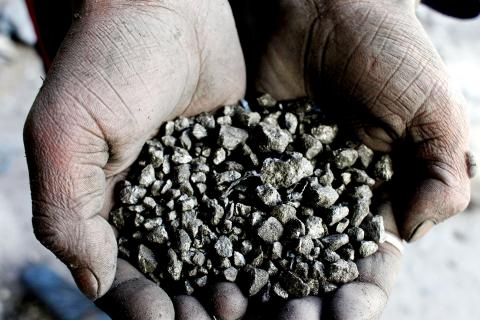
Photo: Bloomberg
Canaviri is one of several dozen children who work alongside 12,000 adults mining the mountain of money that is Cerro Rico, which for four centuries has veined the greatest silver deposit ever uncovered by the Spanish empire.
She and her young friends know the dangers, but have few options as they seek to end — or at least ease — the vicious cycle of poverty afflicting their families.
“My dad died of the mine illness,’” Canaviri said, referring to the respiratory disease silicosis, which worldwide is believed to have killed thousands of miners, whose lungs become infected with crystalline dust that is raised during drilling and inhaled by workers. “Now, I work to help the family.”
She pushes rickety mine carts along metal rails that wind toward the entrance, each bearing about a tonne of earth and rock that she hopes will yield a high payload of silver, tin or zinc.
Her face darkened when she recalled how she suffered an infection earlier this year that sent her to hospital and led to the removal of one of her kidneys — and yet she toils on.
“We lack things. My sister needs shoes, and to meet such needs I go down the mine,” Canaviri said.
Other young teens like Canaviri work in Cerro Rico, southern Bolivia’s historic symbol of wealth that has been operated continuously since the 14th century, first by the Incas, then the Spanish and their indigenous and African slaves, then the Bolivian government and now by private firms.
Fourteen-year-old Efrain Cartagena works alongside Canaviri. His father, too, died from silicosis, forcing the boy to become a breadwinner. He said that after working here for two years he earns about US$8 per day loading and unloading ore.
Before entering the mine, workers of all ages sit and chew coca leaves to ward off hunger and fatigue — a ritual begun centuries ago by native Indians and embraced by today’s miners.
In often vulgar language, they gossip and share their dreams and troubles. Then they hunch over and trundle into various low-ceilinged tunnels, the mud floor often slickened by an acidic liquid runoff containing dangerous chemicals and minerals that drips from the mine’s walls and ceilings.
The future is bleak for these so-called “child moles” who live with death on their backs, according to the Voix Libres Foundation, a Swiss humanitarian organization which runs an orphanage and school in Potosi.
For boys: the future holds work at the mine, with a life expectancy of “around 35 years” because of silicosis, the foundation says. For girls: mine work, multiple pregnancies and early widowhood, before winding up as a “recycler” or night guard at the mine.
According to Voix Libres, which has won an award from the Women’s Union of Potosi for its work with children in the Bolivian Altiplano, there are now between 50 and 60 teenagers who work at the mine — although that number rises along with the price of silver and tin.
In 2001, the International Labour Organization determined that 381 people aged under 18 worked at Cerro Rico, and that nationwide there were 10 times that many children in the industry, although the organization has said that in recent years thousands of underage workers have withdrawn from the mines.
A Potosi federation of cooperatives, formed by miners in some 50 private firms, said major employers shy away from the problem.
“Miners often lie about their age in order to work in the tunnels, avoiding state control and possible loss of their job,” a representative of the group said.
Mining employs thousands of people and generates billions of US dollars in revenue for mineral-rich Bolivia.
But regulations are considered lax, and when the state does make efforts to remove children from the mines, they brush up against a harsh reality.
Bolivian youths enter the mines because “they are poor and orphans from broken homes,” and can earn more there than in the other fields, the ombudsman for children in Potosi, Marcelino Chucucea, said.
He recognizes there are Bolivian rules on the books prohibiting child labor in unsafe conditions, but so long as there are riches to exploit, Cerro Rico will continue to demand cheap labor.

By global standards, the traffic congestion that afflicts Taiwan’s urban areas isn’t horrific. But nor is it something the country can be proud of. According to TomTom, a Dutch developer of location and navigation technologies, last year Taiwan was the sixth most congested country in Asia. Of the 492 towns and cities included in its rankings last year, Taipei was the 74th most congested. Taoyuan ranked 105th, while Hsinchu County (121st), Taichung (142nd), Tainan (173rd), New Taipei City (227th), Kaohsiung (241st) and Keelung (302nd) also featured on the list. Four Japanese cities have slower traffic than Taipei. (Seoul, which has some

Michael slides a sequin glove over the pop star’s tarnished legacy, shrouding Michael Jackson’s complications with a conventional biopic that, if you cover your ears, sounds great. Antoine Fuqua’s movie is sanctioned by Jackson’s estate and its producers include the estate’s executors. So it is, by its nature, a narrow, authorized perspective on Jackson. The film ends before the flood of allegations of sexual abuse of children, or Jackson’s own acknowledgment of sleeping alongside kids. Jackson and his estate have long maintained his innocence. In his only criminal trial, in 2005, Jackson was acquitted. Michael doesn’t even subtly nod to these facts.
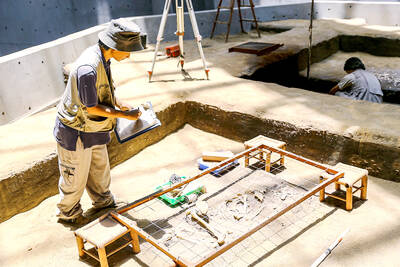
Writing of the finds at the ancient iron-working site of Shihsanhang (十 三行) in New Taipei City’s Bali District (八里), archaeologist Tsang Cheng-hwa (臧振華) of the Academia Sinica’s Institute of History and Philology observes: “One bronze bowl gilded with gold, together with copper coins and fragments of Tang and Song ceramics, were also found. These provide evidence for early contact between Taiwan aborigines and Chinese.” The Shihsanhang Web site from the Ministry of Culture says of the finds: “They were evidence that the residents of the area had a close trading relation with Chinese civilians, as the coins can be

The March/April volume of Foreign Affairs, long a purveyor of pro-China pablum, offered up another irksome Beijing-speak on the issues and solutions for the problems vexing the People’s Republic of China (PRC) and the US: “America and China at the Edge of Ruin: A Last Chance to Step Back From the Brink” rang the provocative title, by David M. Lampton and Wang Jisi (王緝思). If one ever wants to describe what went wrong with US-PRC relations, the career of Wang Jisi is a good place to start. Wang has extensive experience in the US and the West. He was a visiting


 RSS
RSS