


KATY PERRY
Teenage Dream
Capitol
Before sitting down to listen to Katy Perry’s new record, Teenage Dream, I had been assured that it was good by several people whose taste in music I respect. One friend summed it up thus: “Irredeemably sticky, but it compels you to keep going back for more, the tack on your fingers be damned.”
After hearing the lead track Teenage Dream, I thought they might well be right. The song’s minimalist, relaxed feel sets off Perry’s voice nicely; a few tasteful synth stabs give the chorus the oomph it needs, without going over the top. It’s a good song, pleasing to the ears in every way.
The record, however, quickly devolves from there.
It would take a singer of considerable talent and character to lift these songs out of the doldrums created by their cold, lifeless production. While Perry has a decent set of vocal cords, that’s not enough, and oftentimes her delivery is deadpan.
While there are a few good moments scattered here and there — Pearl, a take on 1990s house, deserves mention — the record as a whole is thin, unimaginative and wobbly.
But where the music fails, the imagery wins, and that’s why, ultimately, people are fans of Perry.
On the single California Gurls, Snoop Dogg, reduced to a caricature of a caricature, lends an aimless verse to the track, failing to convince listeners that he has any vested interest in the project beyond his paycheck. It’s hard to believe this is the same man who was at the center of the gangsta rap revolution in the 1990s. Or is it?
This record will sell, but my fingers will remain squeaky clean.
ARCADE FIRE
The Suburbs
Merge
Concept albums are dangerous, and Arcade Fire’s The Suburbs contains many of the format’s telltale faults: songs bleeding into one another; tracks split and labeled as parts (e.g. Half Light I and Half Light II); and lyrical motifs, in this case critiques of suburban life, repeating over and over again.
Fortunately, however, The Suburbs is completely bereft of the pretentiously cringe worthy moments that consign so many other records with grandiose designs to the trash can.
Suburban War opens with a smooth little guitar arpeggio atop which Win Butler sings sadly of the softening of youthful rebellion: “My old friends I can remember when/You cut your hair/I never saw you again.” Yet what begins as melancholic reflection quickly accelerates into outright anger as the pounding of tom-toms and a burst of noisy drones signal the beginning of conflict: “You choose your side/I will choose my side.”
Rococo, which features a monstrously plodding and bassy synth riff, mocks the impotence of urban youths with venom: “Let’s go downtown and talk to the modern kids/They will eat right out of your hand/Using big words that they don’t understand.”
And Month of May is pure power chord rock, a call to arms for disaffected youths: “So much pain for someone so young/I know it’s heavy, I know it ain’t light/But how you gonna lift it with your arms folded tight?”
The Suburbs is an album studded with gems and whose intensity, even during its quietest moments, never wanes.
BEST COAST
Crazy For You
Mexican Summer
Following the buzz generated by a flurry of EPs, singles and shows, the release of Best Coast’s debut album was one of the more hotly anticipated events of this year, at least in indie rock circles.
It’s easy to understand why. The band has a special talent for writing simple, straightforward songs that rock in a way reminiscent of Nirvana at its poppiest. Bobb Bruno’s guitars lay a grungy foundation and Bethany Cosentino’s voice is a dead ringer for Liz Phair, which isn’t a bad thing.
Crazy for You is an exemplar of this formula at work: two chords, a heavy dose of fuzz and powerful vocals that sound stark even when drenched in reverb.
Bratty B is another winner, with sludgy guitar chords, this time accompanied by a chirpy, simple lead guitar that, with a little vocal layering thrown into the mix, manages to sound exceptionally rich.
The lyrics, however, are so juvenile that they immediately put critics who praise the band on the defensive, and several reasons have been offered up as to just why they are so bad. My favorite so far is that the words are deceptively simple, and that lines like “Last night I went out with this guy/This guy he was nice and cute/But he wasn’t you” convey hidden meaning.
They don’t. The lyrics really are bad — that is part of their charm, at times. Besides, Cosentino’s voice is at its best when it’s functioning as another instrument, when it’s oohing and ahhing and rubbing up sexy against a wall of guitar.
It all works together to create a mood that is singular, but with lines like “I wish he was my
boyfriend/I’d love him till the very end,” it’s easy to see how, for some, that mood may be one
of irritation.
Still, the record makes an excellent purchase, provided you’re not the sort who values clever lyrics.
ISOBEL CAMPBELL AND MARK LANEGAN
Hawk
V2 Records
The pairing of Mark Lanegan of Screaming Trees fame, who possesses a gravelly, I’m-thinking-about-my-next-cigarette-even-while-smoking-this-one voice, and Isobel Campbell, of Belle and Sebastian fame, whose voice is as “pure as the fresh driven snow,” to borrow a line from her former band, is a sweet yet dirty combo.
On You Won’t See Me Down Again, their third studio album, the pair run through a set of rootsy rock and ballads that references country, soul, folk and blues. They aren’t trying to break any new ground. The focus is on songwriting — ways to frame their voices that build effective songs. And at this, they succeed.
Though the album has its share of quality rock ’n’ roll, as on the delightfully bluesy title track Hawk, it sounds particularly good when the songs take a more mellow turn.
Eyes of Green is a Sunday morning song, lovely and lazy, built upon a playful melody, with down-home violin lolling about and calling to mind endless fields.
Cool Water is the standout track, with a delicate finger picked guitar that meshes well with the sound of a walking slap-bass and the pair’s voices. It’s the sort of song that makes you want to walk out into the woods and find yourself a quiet river to dip your feet in.
There are a few tracks that miss the mark. Rocker Get Behind Me, as well as album closer Lately, for instance, both run a little too long. And although Sunrise is a lovely track, it sounds a bit too close to Nancy Sinatra’s version of Bang Bang for comfort.
The record is nonetheless solid, and anyone with a hankering for well-constructed songs sung with character should give You Won’t See Me Down Again a spin.



Taiwan’s English education system is being pulled apart by three opposing forces. Bilingual Nation 2030 pulls students toward English and global communication. Artificial Intelligence (AI) readiness pulls them toward digital judgment, verification and AI-mediated work. But Taiwan’s old exam culture pulls them back toward memorization, grammar drills, timed reading and correct answers. If the education system keeps using old exams to define success, it risks producing graduates who are neither genuinely bilingual nor genuinely AI-ready, but trained for tasks machines can already perform. The first force is Bilingual Nation 2030. Launched in 2018, the policy aimed to “help Taiwan’s workforce connect

It seems every few days one bumps into one of those “real man” comments in which Taiwan is urged to “face reality” or similar, and “make a deal,” with the speaker implying that soon it will be too late. “Deal” advocates always present themselves as having a superior grip on reality, and the manly ability to make the “hard choice.” Their testosterone-laden language often echoes that of Taiwan sellout advocates. Note that such commentary always specifies a process (“make a deal, work with, make progress”), never the end state of what occupation by a violent authoritarian colonialist state will entail. In

There are shadowy cabals plotting to sell out Taiwan to be annexed by China, by invasion if necessary. Fortunately, they are buffoons. In 2019, former Bamboo Union gangster and founder of the China Unification Promotion Party (CUPP), Chang An-le (張安樂, colorfully known as “White Wolf”), led a protest at the Legislative Yuan against comments made by then-premier Su Tseng-chang (蘇貞昌) that in the event of an attack by China, he would never surrender, but would protect the nation by fighting to the end, even if he only had a broom. Chang had party members bring a wooden casket that they
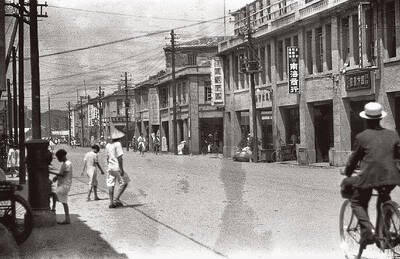
June 1 to June 7 "If all Taiwanese were as afraid of dying as you, then what would happen?” Physician Shih Chiang-nan (施江南) reportedly said this to his wife Chen Chiao-tung (陳焦桐) after she urged him to stop intervening on behalf of Taiwanese soldiers stranded overseas after serving in the Japanese Army during World War II. Shih had clashed with high-ranking officials over the issue, engaged in several heated arguments with Taiwan governor-general Chen Yi (陳儀) and allegedly shouted at general Ko Yuan-fen (柯遠芬), chief of staff of the Taiwan Garrison Command, over


 RSS
RSS