


The scent of Taiwanese dishes wafted through the air. Hip-hop group Kou Chou Ching (拷秋勤) and electro rockers Go Chic were headlining acts. An exhibit from the National Museum of Taiwan History was on display alongside traditional puppet shows. And designers Jasper Huang (黃嘉祥) and Chiu-I Hsu (徐秋宜) battled it out on the runway this past weekend.
Did you somehow miss out on a huge festival in Taipei? Or perhaps in Taichung?
Try halfway around the world.
The annual Taiwan festival kicked off this weekend at Queens Quay West in Toronto, with a second event scheduled for Sept. 4 through Sept. 6 in downtown Vancouver.
Telus Taiwanfest 2010 is a part of Harbourfront Centre’s World Routes 2010. Concerts, culinary showcases, films and a fashion show drew Canadians to check out what Taiwan is all about.
The festival began in Toronto in 1990 as a classical concert night but has evolved into a multi-disciplinary cultural carnival since then, said Sherry Wang, communications director for ACSEA (Asian-Canadian Special Events Association).
This year’s invitation from Vancouver to have stage the festival debut in its downtown was a major coup, she said.
“The goal of the festival is to show Taiwan’s culture and innovation,” Wang said.
Although a tribute to Teresa Teng (鄧麗君) and programs such as I-Wan-Jan Puppet Theatre (亦宛然掌中劇團) showcase aspects of mainstream and traditional Taiwanese culture, the focus this year is on indie bands “to really show how Taiwan continues to progress and move forward in the modern world,” Wang said.
Wang was especially excited to see Kou Chou Ching play because “they actually compose [their] music using the traditional Taiwanese musical scale,” she said. “They go back to the roots of rap” and “are not afraid to speak their minds about current social or political issues, even if that is not necessarily what the market would want.”
Kou Chou Ching rapper Fan Chiang (范姜) said he hopes his group “can make more North American people like Taiwan and become [fans] of Taiwan’s culture and music.” He was looking forward to introducing Canadians to “new music” styles beyond hip-hop.
Taiwanese Canadian musician, producer and DJ Leo Shia, aka Leo37 said Taiwanfest has allowed him to continue touring and to support himself through merchandise sales. “The connections I’ve made and the opportunities that stem from this festival have opened up a whole new set of doors and further opportunities,” he said. “Getting to play in front of a group of people that might not understand what you say really forces you to be flexible and you have to figure out how to work crowds regardless of barriers.”
Taiwan-based Canadian expatriate Nick Fothergill, who also played the event in 2008, said he relishes the chance to be involved in Canadian and Taiwanese cross-cultural activities. “Anything that provides a bridge between my old home, Canada, and my new home, Taiwan, is real treat for me.”
The festival’s music lineup is diverse, with reggae band Matzka, singer and multi-instrumentalist Suming (舒米恩), and indie-rock acts 1976, Aphasia (阿飛西雅), Masia One and Sissey Chao (趙一豪).
But the band that might end up representing the most modern face of Taiwan is electro-rock diva explosion Go Chic, which has recently toured China, Japan, Hong Kong and Macau. This was the band’s first concert in Canada, where it is on a 12-day tour with seven shows in Toronto and Vancouver, including Taiwanfest.
“We’ve got tight schedules and tight pants!” said lead singer Ariel Zheng (鄭思齊) with her characteristic tongue-in-cheek sense of humor. “We’ve heard that the music scene is massive there [and] can’t wait to see what Canada has got.”
“Where you are from definitely affects what you do and what you think,” Zheng said. “In terms of music, we also think it gives us an edge to bring something different. In our song P.O.D, we shout at English teachers in Taiwan trying to get laid, and in our new song Culture Shock, we share some of our thoughts looking at the world as an Asian. I think it’s about time we put [a] spotlight on Taiwan and start putting it on the music map.”



Taiwan’s English education system is being pulled apart by three opposing forces. Bilingual Nation 2030 pulls students toward English and global communication. Artificial Intelligence (AI) readiness pulls them toward digital judgment, verification and AI-mediated work. But Taiwan’s old exam culture pulls them back toward memorization, grammar drills, timed reading and correct answers. If the education system keeps using old exams to define success, it risks producing graduates who are neither genuinely bilingual nor genuinely AI-ready, but trained for tasks machines can already perform. The first force is Bilingual Nation 2030. Launched in 2018, the policy aimed to “help Taiwan’s workforce connect
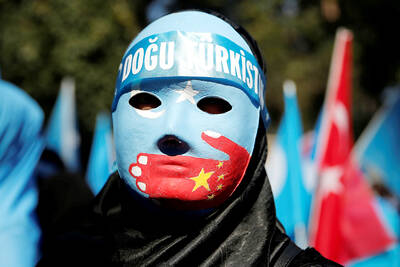
It seems every few days one bumps into one of those “real man” comments in which Taiwan is urged to “face reality” or similar, and “make a deal,” with the speaker implying that soon it will be too late. “Deal” advocates always present themselves as having a superior grip on reality, and the manly ability to make the “hard choice.” Their testosterone-laden language often echoes that of Taiwan sellout advocates. Note that such commentary always specifies a process (“make a deal, work with, make progress”), never the end state of what occupation by a violent authoritarian colonialist state will entail. In
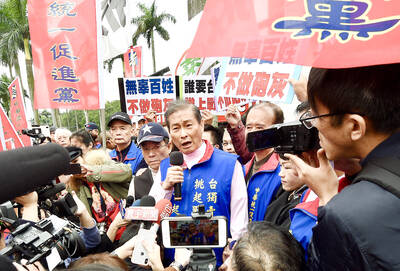
There are shadowy cabals plotting to sell out Taiwan to be annexed by China, by invasion if necessary. Fortunately, they are buffoons. In 2019, former Bamboo Union gangster and founder of the China Unification Promotion Party (CUPP), Chang An-le (張安樂, colorfully known as “White Wolf”), led a protest at the Legislative Yuan against comments made by then-premier Su Tseng-chang (蘇貞昌) that in the event of an attack by China, he would never surrender, but would protect the nation by fighting to the end, even if he only had a broom. Chang had party members bring a wooden casket that they
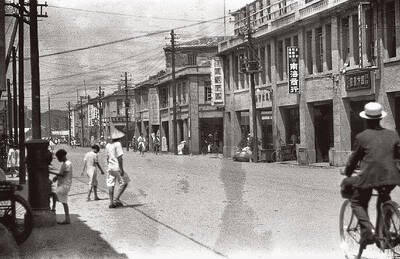
June 1 to June 7 "If all Taiwanese were as afraid of dying as you, then what would happen?” Physician Shih Chiang-nan (施江南) reportedly said this to his wife Chen Chiao-tung (陳焦桐) after she urged him to stop intervening on behalf of Taiwanese soldiers stranded overseas after serving in the Japanese Army during World War II. Shih had clashed with high-ranking officials over the issue, engaged in several heated arguments with Taiwan governor-general Chen Yi (陳儀) and allegedly shouted at general Ko Yuan-fen (柯遠芬), chief of staff of the Taiwan Garrison Command, over


 RSS
RSS