


Taiwan’s pre-eminent art fair, Art Taipei, opens on Friday when 110 galleries from Taiwan and abroad set up shop in the Taipei World Trade Center, Hall 1, for what organizers hope to be a five-day frenzy of viewing, buying and selling.
Painting, sculpture, video and installation will all be on display and with the number of participants up by 25 percent from last year, it appears that the art market downturn is a distant memory as galleries are confident that buyers will be freer with their pocketbooks.
Photography will take center stage this year as Art Taipei predicts that the medium — traditionally under-represented both at Art Taipei and at Taiwan’s galleries — will become the next in thing to collect.
“People think that anyone can pick up a camera and take a photograph. That’s why buyers don’t usually collect photography,” said Joanne Chen (陳韋晴), Art Taipei’s marketing director.
Art Taipei hopes to turn this around by devoting one part of the exhibition space to galleries that are willing to exclusively display works by photographers. “We think that photography will be the next trend for collectors,” Chen said.
Nine local galleries — many of which already specialize in photography — stepped up to the plate and will exhibit works by local photographers such as Chen Chin-pao (陳敬寶), who has won Japan’s prestigious Higashikawa Award, and Taiwanese Photojournalism Award (台灣新聞年度攝影獎) winner Chou Ching-hui (周慶輝).
International galleries decided to stay away from the photo section because, “even if they sell all the works they still cannot cover all the costs of shipping and the booth fee,” Chen said.
In another effort to boost the medium’s profile, photographs by winners and finalists of the 2010 Sony World Photography Awards will be exhibited for the first time at Art Taipei. Arranged by gallerist and curator Caprice Horn, the collection showcases the very best photographs from across the world in genres ranging from photojournalism to fine art.
“The international character of these winning images is a testament to the inclusivity of these global awards. Each of these pictures has a place, a purpose, shows skill, and forethought,” Horn wrote in Art Taipei’s catalogue.
Horn will also give a lecture, The Vision and Trend of World Photography, on Saturday at 2:30pm. It will be followed by a second lecture, An Overview of the Adventure of Asia Photography, by photographers Chiu Yi-chien (邱奕堅) and Suan Hooi-wah (全會華), who will discuss the state of photography in Asia.
The addition of photography follows in the footsteps of Ela — Video, a thematic section created five years ago to promote new media art and which Chen said has become one of the most popular destinations for visitors. Buyers have also noticed the potential of video art as an investment — especially over the past two years — because it is cheaper to collect than painting or sculpture. Ela — Video can be found in Section C of the fair.
The photography and new media sections, however, still make up a small proportion of Art Taipei. The majority of work on display is modern to contemporary paintings and sculptures shown by galleries from the US, China, Japan, Spain, South Korea and Taiwan.
For complete details in Chinese and English go to: www.art-taipei.com


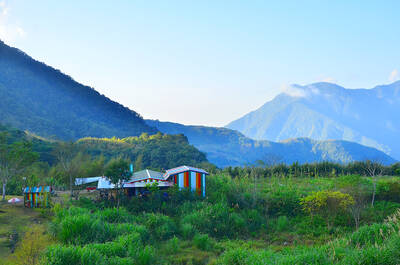
If one asks Taiwanese why house prices are so high or why the nation is so built up or why certain policies cannot be carried out, one common answer is that “Taiwan is too small.” This is actually true, though not in the way people think. The National Property Administration (NPA), responsible for tracking and managing the government’s real estate assets, maintains statistics on how much land the government owns. As of the end of last year, land for official use constituted 293,655 hectares, for public use 1,732,513 hectares, for non-public use 216,972 hectares and for state enterprises 34 hectares, yielding
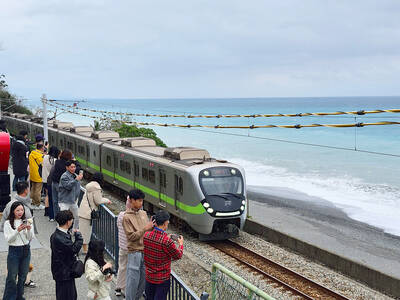
The small platform at Duoliang Train Station in Taitung County’s Taimali Township (太麻里) served villagers from 1992 to 2006, but was eventually shut down due to lack of use. Just 10 years later, the abandoned train station had become widely known as the most beautiful station in Taiwan, and visitors were so frequent that the village had to start restricting traffic. Nowadays, Duoliang Village (多良) is known as a bit of a tourist trap, with a mandatory, albeit modest, admission fee of NT$10 giving access to a crowded lane of vendors with a mediocre view of the ocean and the trains
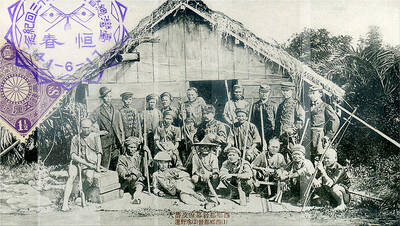
Traditionally, indigenous people in Taiwan’s mountains practice swidden cultivation, or “slash and burn” agriculture, a practice common in human history. According to a 2016 research article in the International Journal of Environmental Sustainability, among the Atayal people, this began with a search for suitable forested slopeland. The trees are burnt for fertilizer and the land cleared of stones. The stones and wood are then piled up to make fences, while both dead and standing trees are retained on the plot. The fences are used to grow climbing crops like squash and beans. The plot itself supports farming for three years.
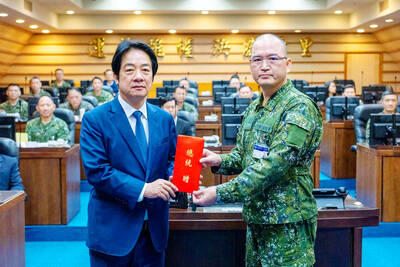
President William Lai (賴清德) on Nov. 25 last year announced in a Washington Post op-ed that “my government will introduce a historic US$40 billion supplementary defense budget, an investment that underscores our commitment to defending Taiwan’s democracy.” Lai promised “significant new arms acquisitions from the United States” and to “invest in cutting-edge technologies and expand Taiwan’s defense industrial base,” to “bolster deterrence by inserting greater costs and uncertainties into Beijing’s decision-making on the use of force.” Announcing it in the Washington Post was a strategic gamble, both geopolitically and domestically, with Taiwan’s international credibility at stake. But Lai’s message was exactly


 RSS
RSS