


Curator Sean Hu (胡朝聖) believes that art should be everywhere. A rice field, plaza and park are among the spaces where he’s mounted exhibits in the past. With Urban Crack (城市隙縫), Hu continues this tradition of taking art outside gallery and museum by presenting the work of 10 artists working in digital photography, video and installation in what he dubs a “mobile gallery.”
Urban Crack’s venue is a formerly dilapidated building near Shuanglian MRT Station (雙連捷運站) that was renovated as a model home — one of those ostentatious structures that are erected for a few months to attract buyers of luxury apartments. It seems like an ideal space because it stands at the interstice between a city’s past and future and sets the stage to ask questions about how these buildings fit into and alter the urban landscape. But Hu goes in a different direction and examines the city from a more general perspective.
“Whenever I go to cities in different countries, I have this sense of deja vu because under globalization they all look the same. But I’m also looking for the differences. And I’m looking for the differences in some crack — in a corner or a back street,” he said.
The theme of difference, however, is somewhat undermined by the fact that these short-lived edifices could easily be judged as emblems of the very buildings that efface a city’s individuality. Additionally, many see these structures as symbols of the profligacy of Taipei’s consumer culture — topics that the exhibit addresses only indirectly. Julie Chou’s (周靈芝) conceptual digital prints of high rises, for example, are statements about hubris and man’s desire to build castles in the sky. Inside Scenery (屋內風景) by Chen I-chun (陳依純) examines our increasingly homogenized world by depicting an empty and sterile convenience store.
Wu Dar-kuen’s (吳達坤) digital prints of street performers in Tokyo put a human face on the urban landscape, suggesting that people are what make a city unique. Isa Ho’s (何孟娟) images of Paris and Taipei pick up on this theme by placing subjects in front of buildings that are in the process of renovation; when combined these are emblems of spiritual and urban renewal.
At one point, I found myself admiring a large-scale image of a tree-lined street — that is, until a gallery employee came over and pointed out that it wasn’t part of the exhibit. Nor were the other photographs showing past buildings that JUT Living Development (忠泰生活開發股份有限公司) — the owner of the property as well as Mot Arts, the gallery holding the exhibit — had renovated or constructed.
A further look around revealed other bizarre similarities: In terms of media — installation, video, digital images — the area reserved for selling apartments mirrors that for selling art. Or is it the other way around? There is no clear boundary separating the two.
And this is what makes the exhibit somewhat problematic. Although the art offers interesting insights into the city, it seems thematically disengaged from the space it is located in — a space that is unlikely to fulfill its stated purpose of enticing the public at large into its confines for a viewing, unless, of course, they have NT$800,000 per pin (1 pin = 3.3m2) to spend on real estate.
Although JUT Living Development, along with related ventures such as JUT Foundation for Arts and Architecture (忠泰建築文化藝術基金會), which donated space to the recently opened Taiwan Photography Museum (台灣攝影博物館), deserves credit for supporting the arts, it is hard to escape the thought that Urban Crack is part of a cross-merchandizing gimmick meant to entice potential property owners into buying art.


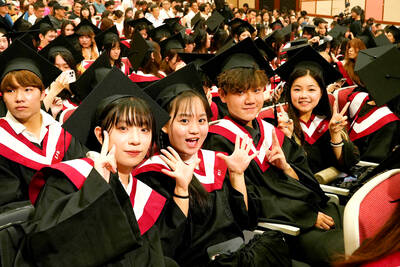
Taiwan’s English education system is being pulled apart by three opposing forces. Bilingual Nation 2030 pulls students toward English and global communication. Artificial Intelligence (AI) readiness pulls them toward digital judgment, verification and AI-mediated work. But Taiwan’s old exam culture pulls them back toward memorization, grammar drills, timed reading and correct answers. If the education system keeps using old exams to define success, it risks producing graduates who are neither genuinely bilingual nor genuinely AI-ready, but trained for tasks machines can already perform. The first force is Bilingual Nation 2030. Launched in 2018, the policy aimed to “help Taiwan’s workforce connect
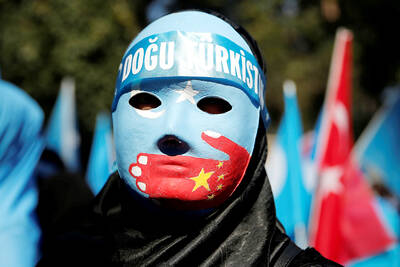
It seems every few days one bumps into one of those “real man” comments in which Taiwan is urged to “face reality” or similar, and “make a deal,” with the speaker implying that soon it will be too late. “Deal” advocates always present themselves as having a superior grip on reality, and the manly ability to make the “hard choice.” Their testosterone-laden language often echoes that of Taiwan sellout advocates. Note that such commentary always specifies a process (“make a deal, work with, make progress”), never the end state of what occupation by a violent authoritarian colonialist state will entail. In
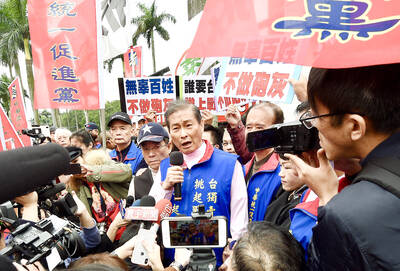
There are shadowy cabals plotting to sell out Taiwan to be annexed by China, by invasion if necessary. Fortunately, they are buffoons. In 2019, former Bamboo Union gangster and founder of the China Unification Promotion Party (CUPP), Chang An-le (張安樂, colorfully known as “White Wolf”), led a protest at the Legislative Yuan against comments made by then-premier Su Tseng-chang (蘇貞昌) that in the event of an attack by China, he would never surrender, but would protect the nation by fighting to the end, even if he only had a broom. Chang had party members bring a wooden casket that they
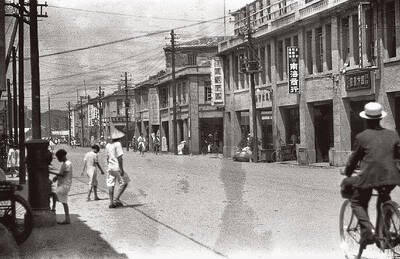
June 1 to June 7 "If all Taiwanese were as afraid of dying as you, then what would happen?” Physician Shih Chiang-nan (施江南) reportedly said this to his wife Chen Chiao-tung (陳焦桐) after she urged him to stop intervening on behalf of Taiwanese soldiers stranded overseas after serving in the Japanese Army during World War II. Shih had clashed with high-ranking officials over the issue, engaged in several heated arguments with Taiwan governor-general Chen Yi (陳儀) and allegedly shouted at general Ko Yuan-fen (柯遠芬), chief of staff of the Taiwan Garrison Command, over


 RSS
RSS