


Carnival, football and samba are typical images of Brazil. But you won’t find any of those in the Brazilian program at this year’s Taipei Film Festival (台北電影節). What you will get are more than 20 feature and documentary films selected to show different facets of the South American country from the 1950s to the present day.
Among the festival’s rare finds is Rio, 40 Degrees (1955) by Nelson Pereira dos Santos, which illustrates the complexity of social relations through a semi-documentary portrait of five peanut venders in Rio de Janeiro. Santos’ black-and-white feature debut is often regarded as the first major work of Cinema Novo, a Brazilian new wave movement that flourished in the 1950s and 1960s.
Cinema Novo’s directors are noted for using the country’s impoverished hinterland and urban slums as settings for critiques and commentary on imperialism and neocolonialism. Glauber Rocha’s Earth Entranced (1967) and Antonio das Mortes (1969) are two Cinema Novo magnum opuses that allegorically portray the political scene after Brazil’s 1964 coup ushered in an era of authoritarianism that forced many artists into exile.
Festival curator Jane Yu (游惠貞) said this year’s Brazilian program presented a challenging task. The less-than-systematic preservation of films in Brazil meant it took more time and effort to track down certain movies. Brazil’s enthusiasm for football also presented an obstacle when organizers tried to invite the country’s filmmakers to Taipei. “You [get] responses like, ‘It’s World Cup month. Is there any way you can re-schedule your festival?’” Yu said.
Another central feature of this year’s festival is a retrospective for what would have been the 100th birthday of Chinese actress Run Lingyu (阮玲玉). The silent movie star made 29 movies before she took her own life in 1935 at the age of 25. The festival’s program features Run’s eight surviving movies on loan from the Beijing Film Archive (北京電影資料館).
Run’s legendary life was immortalized half a century after her death in Hong Kong director Stanley Kwan’s (關錦鵬) Center Stage (阮玲玉, 1992), featuring Maggie Cheung (張曼玉) as Run. Kwan’s film will also be screened at the festival.
To make Run’s silent movies more accessible to contemporary audiences, special screenings of three selected films will be accompanied by live music performances and a pien shih (辯士), or onstage narrator, a job from the silent movie era that involved explaining the movie and commenting on the plot.
Taipei Film Festival organizers faced criticism two years ago when they decided to focus on feature-length films at the Taipei Awards, an annual competition and an important platform for young filmmakers in Taiwan. The disputed changes included more award categories for feature-length films and limiting the top prize of NT$1 million, previously open to all types of film, to feature-length works.
In response to the criticism, the Taipei Film Festival changed the rules this year and made all feature, documentary, animation and short works eligible for award categories including best director, best cinematography and best editing, as well as the coveted top cash prize.
“Our film committee members think the festival should maintain its spirit, which encourages openness and creativity,” said festival director Hu Yu-feng (胡幼鳳).



Yesterday, the Democratic Progressive Party (DPP) nominated legislator Puma Shen (沈伯洋) as their Taipei mayoral candidate, the Chinese Nationalist Party (KMT) put their stamp of approval on Wei Ping-cheng (魏平政) as their candidate for Changhua County commissioner and former legislator Tsai Pi-ru (蔡壁如) of the Taiwan People’s Party (TPP) has begun the process to also run in Changhua, though she has not yet been formally nominated. All three news items are bizarre. The DPP has struggled with settling on a Taipei nominee. The only candidate who declared interest was Enoch Wu (吳怡農), but the party seemed determined to nominate anyone
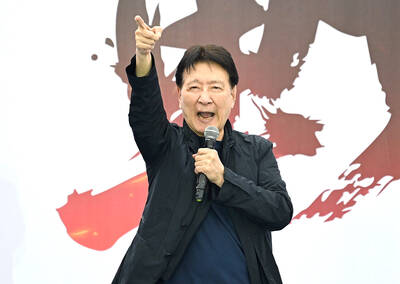
In a sudden move last week, opposition lawmakers of the Chinese Nationalist Party (KMT) and Taiwan People’s Party (TPP) passed a NT$780 billion special defense budget as a preemptive measure to stop either Chinese leader Xi Jinping (習近平) or US President Donald Trump from blocking US arms sales to Taiwan at their summit in Beijing, said KMT heavyweight Jaw Shaw-kong (趙少康), speaking to the Taipei Foreign Correspondents Club on Wednesday night in Taipei. The 76-year-old Jaw, a political talk show host who ran as the KMT’s vice presidential candidate in 2024, says that he personally brokered the deal to resolve
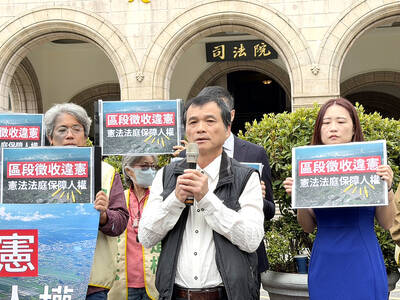
What government project has expropriated the most land in Taiwan? According to local media reports, it is the Taoyuan Aerotropolis, eating 2,500 hectares of land in its first phase, with more to come. Forty thousand people are expected to be displaced by the project. Naturally that enormous land grab is generating powerful pushback. Last week Chen Chien-ho (陳健和), a local resident of Jhuwei Borough (竹圍) in Taoyuan City’s Dayuan District (大園) filed a petition for constitutional review of the project after losing his case at the Taipei Administrative Court. The Administrative Court found in favor of nine other local landowners, but

The Chinese Nationalist Party (KMT) and its sock puppet, the Taiwan People’s Party (TPP), passed their version of the government’s proposed supplementary defense spending bill last week, engendering much commentary. While all eyes were on the defense budget, the PRC’s assault on Taiwan was advancing on other fronts. The removal of domestic drone production and other technologies critical to the nation’s asymmetrical defenses from the list of items purchased in the “compromise” bill shows how the KMT-TPP alliance appears to be serving the People’s Republic of China (PRC). Ironically, the cuts will impact industries heavily represented by tech firms in areas run


 RSS
RSS