


WHERE :
Oluanpi Lighthouse National Park
(鵝鑾鼻燈塔國家公園)
WHEN :
Today through Monday. Tonight bands will be setting up, and there will be performances from 6pm to midnight. Tomorrow and Sunday
the music goes from noon until 12:30am, and on Monday performances run from noon until 9pm, or later, depending on the whims of the musicians.
ON THE NET :
www.springscream.com
ADMISSION :
Tickets are available at the door or from 7-Eleven ibon kiosks. A three-day festival pass is NT$1,600 if bought today, or NT$1,700 at the door. Tonight there is a sound check and pre-party for bands and holders of three-day tickets. On the door, entry to tonight’s event is NT$600. One-day passes are NT$1,100 for tomorrow, Sunday and Monday. Only three-day pass-holders are entitled to use the campgrounds.
THE ‘REAL’ SPRING SCREAM :
There is only one Spring Scream, though this weekend there will be many raves and concerts in the Kending area. The original Spring Scream (春天吶喊) is the one held at Oluanpi Lighthouse National Park (鵝鑾鼻燈塔國家公園).
GETTING THERE :
For chartered buses to Spring Scream from Taipei, check www.kitravel.com.tw/servlet/springscream.bus for updates. Other bus companies run regular services to Kending via Kaohsiung. Contact them directly or through Taipei Bus Station (www.taipeibus.com.tw, or by calling (02) 7733-5888).
The fastest, if not the most economical, way to go is to take the Taiwan High Speed Rail (www.thsrc.com.tw, tel: (02) 6626-8000) to Kaohsiung’s Zuoying Station (高鐵左營車站) and then share a taxi or minivan to the Spring Scream site at Oluanpi Lighthouse National Park (鵝鑾鼻燈塔國家公園). If you are in a full minivan, the cost is about NT$450 per person. The Taiwan Railway Administration (www.railway.gov.tw/en/index/index.aspx, tel: (02) 2381-5226) also offers train services to Kaohsiung from Taipei. Buses also run from Kaohsiung to Kending from both Kaohsiung Train and Zuoying stations.
In Kending, buses leave for Oluanpi hourly with stops near the McDonald’s and 7-Eleven.
As this is a holiday weekend, expect heavy traffic. The short trip to Oluanpi from Hengchun (恆春) can take more than three hours. Spring Scream organizers recommend an alternative route. Start east of Hengchun and pass along Qiaotou Road (橋頭路) and Jiae Highway (佳鵝公路). See the “traffic” section of the festival’s Web site for a map. Traveling in the wee hours may help.
ACCOMMODATION:
Camping at the Spring Scream site is available for three-day pass holders and performers only. The fee is NT$2,000 per tent (not per person) for five days, starting today. The campsite has complete bathrooms and hot showers.
Other campsites are located alongside the road between
Kending and Oluanpi and charge around NT$100 to NT$200 per person per night.



Taiwan’s English education system is being pulled apart by three opposing forces. Bilingual Nation 2030 pulls students toward English and global communication. Artificial Intelligence (AI) readiness pulls them toward digital judgment, verification and AI-mediated work. But Taiwan’s old exam culture pulls them back toward memorization, grammar drills, timed reading and correct answers. If the education system keeps using old exams to define success, it risks producing graduates who are neither genuinely bilingual nor genuinely AI-ready, but trained for tasks machines can already perform. The first force is Bilingual Nation 2030. Launched in 2018, the policy aimed to “help Taiwan’s workforce connect

It seems every few days one bumps into one of those “real man” comments in which Taiwan is urged to “face reality” or similar, and “make a deal,” with the speaker implying that soon it will be too late. “Deal” advocates always present themselves as having a superior grip on reality, and the manly ability to make the “hard choice.” Their testosterone-laden language often echoes that of Taiwan sellout advocates. Note that such commentary always specifies a process (“make a deal, work with, make progress”), never the end state of what occupation by a violent authoritarian colonialist state will entail. In
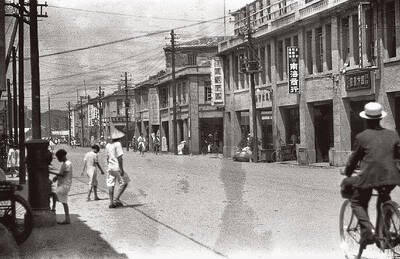
June 1 to June 7 "If all Taiwanese were as afraid of dying as you, then what would happen?” Physician Shih Chiang-nan (施江南) reportedly said this to his wife Chen Chiao-tung (陳焦桐) after she urged him to stop intervening on behalf of Taiwanese soldiers stranded overseas after serving in the Japanese Army during World War II. Shih had clashed with high-ranking officials over the issue, engaged in several heated arguments with Taiwan governor-general Chen Yi (陳儀) and allegedly shouted at general Ko Yuan-fen (柯遠芬), chief of staff of the Taiwan Garrison Command, over

“Taiwan’s Opposition Leader Comes to US With a Message Straight Out of Beijing” read a May 31 headline in the Wall Street Journal. Top US administration officials and members of Congress almost certainly read the WSJ, and if there was a bullet point takeaway that people in Washington should absorb ahead of Chinese Nationalist Party (KMT) Chair Cheng Li-wun’s (鄭麗文) arrival in DC on June 9, that headline is it. The last few columns have discussed this very topic, and the timing is not coincidental. While those top officials likely do not read the Taipei Times, judging by the number


 RSS
RSS